CLOVES Syndrome Genetics and Precision Medicine Treatment Challenges
Source:The Hindu ↗
Why It Matters
Questions around genetic mutations, hereditary vs somatic diseases, and biotechnology applications (like precision medicine and gene editing) feature consistently in Prelims and Mains (GS3). Furthermore, the management of rare diseases is an ongoing public health and governance issue relevant to GS2.
Summary
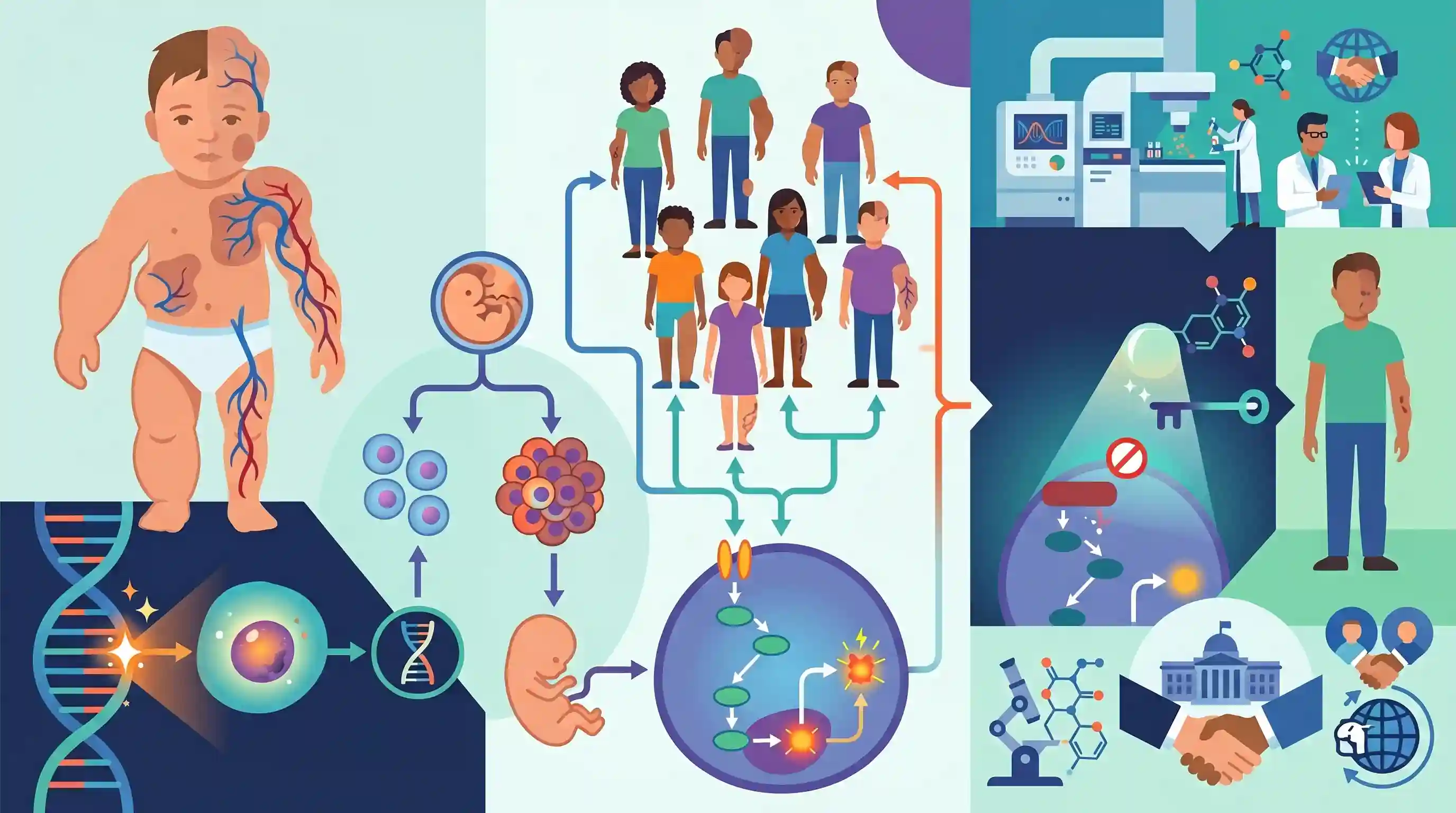
CLOVES syndrome is a rare congenital condition characterized by overgrowth of tissues, vascular malformations, and skeletal anomalies. It stems from non-hereditary, somatic mutations in the PIK3CA gene that occur during embryonic development. Because it is part of the PIK3CA-related overgrowth spectrum (PROS), targeted treatments have historically been lacking. However, the recent FDA approval of alpelisib provides a precision-medicine approach by inhibiting the affected pathway. The article sheds light on the broader challenges of managing rare, genetic "orphan diseases," highlighting the critical role of advanced biotechnology and supportive healthcare policies.
Key Points
- CLOVES syndrome is a rare congenital disorder causing lipomatous overgrowth, vascular malformations, epidermal nevi, and skeletal or spinal anomalies.
- The disease is not inherited but caused by somatic mutations in the PIK3CA gene during early embryonic development.
- It falls under a broader group of conditions known as the PIK3CA-related overgrowth spectrum (PROS).
- Treatment primarily focused on managing symptoms until the FDA's recent approval of alpelisib (Vijoice), a targeted therapy that inhibits the PI3K pathway.
- The disorder highlights the complexities of rare diseases (orphan diseases), calling for genetic mapping, precision medicine, and supportive public health policies.
Important Terms
National Policy for Rare Diseases 2021

A 2021 Indian government framework categorizing rare diseases into three groups to provide financial support (up to ₹50 lakh) for treatment at designated Centres of Excellence.
UPSC context
GS Paper 2: Social Justice and Health. Tests knowledge of government welfare schemes and healthcare accessibility for vulnerable populations.
CLOVES Syndrome
A rare, non-hereditary congenital disorder (Congenital Lipomatous Overgrowth, Vascular malformations, Epidermal nevi, and Skeletal anomalies) caused by somatic mutations in the PIK3CA gene.
UPSC context
GS Paper 3: Science and Technology. Relevant for "Health and Disease" and "Biotechnology" segments, testing understanding of rare genetic conditions.
PIK3CA-related overgrowth spectrum (PROS)
An umbrella term for a group of rare genetic disorders characterized by overgrowth of various tissues (skin, bone, blood vessels) due to mutations in the PIK3CA gene.
UPSC context
GS Paper 3: Science and Technology. Tests knowledge of disease classification and the impact of genetic mutations on human health.
PIK3CA Gene
A gene providing instructions for making the p110 alpha protein, a subunit of PI3K enzyme that regulates cell growth, division, and survival.
UPSC context
GS Paper 3: Science and Technology. Tests basics of genetics, cell-signaling pathways, and the molecular basis of diseases.
Alpelisib
The first FDA-approved targeted kinase inhibitor for PROS and CLOVES, originally developed for breast cancer, which works by blocking the overactive PI3K pathway.
UPSC context
GS Paper 3: Biotechnology. Tests awareness of precision medicine, drug repurposing, and recent breakthroughs in treating rare diseases.
Orphan Drugs
Pharmaceutical products developed specifically to treat rare medical conditions (orphan diseases) which would otherwise be unprofitable to produce without government incentives.
UPSC context
GS Paper 2: Health. Tests understanding of pharmaceutical regulation, R&D challenges, and the ethics of drug pricing.
Prelims Trap
CLOVES syndrome is a hereditary genetic disorder passed down from parents to offspring.
Somatic mutations occur after conception in specific cells and are non-hereditary. Unlike germline mutations (in sperm/eggs), somatic mutations cannot be passed to the next generation.
Static Concepts Connected
What is the fundamental difference between somatic and germline mutations?
- Somatic Mutations: Occur in non-reproductive cells after conception. They accumulate over a lifetime and are not inherited by offspring (e.g., CLOVES syndrome, most cancers).
- Germline Mutations: Occur in reproductive cells (sperm or egg). They are inherited from parents and are passed on to all cells of the offspring.
What are the key provisions of the National Policy for Rare Diseases (NPRD) 2021?
- Disease Categorization: Classifies rare diseases into three groups based on treatment feasibility, long-term costs, and optimal management needs.
- Financial Assistance: Provides up to ₹50 lakh per patient for treatment at designated Centres of Excellence under the Rashtriya Arogya Nidhi (RAN) scheme.
- Crowdfunding Mechanism: Establishes an online digital platform to facilitate voluntary corporate and individual crowdfunding for high-cost rare disease treatments.
Cross-Topic Patterns
Precision Medicine and BioE3 Policy
The shift towards targeted biotherapeutics for rare genetic disorders directly aligns with India's recent BioE3 policy, which promotes high-performance biomanufacturing for personalized healthcare and precision medicine.
Intellectual Property vs. Orphan Drugs
The high cost of orphan drugs for rare diseases frequently triggers WTO TRIPS and Indian Patent Act debates, specifically regarding compulsory licensing to ensure affordable healthcare access.

Expect a comparative statement question testing Somatic vs. Germline mutations paired with the NPRD 2021 funding criteria in Prelims 2026.
Linked PYQs · 2
Linked PYQs · 2
- 2021PrelimsGS1
In the context of hereditary diseases, consider the following statements : 1. Passing on mitochondrial diseases from parent to child can be prevented by mitochondrial replacement therapy either before or after in vitro fertilization of egg. 2. A child inherits mitochondrial diseases entirely from mother and not from father. Which of the statements given above is/are correct?
- 2020PrelimsGS1
Consider the following statements: 1. Genetic changes can be introduced in the cells that produce eggs or sperms of a prospective parent. 2. A person's genome can be edited before birth at the early embryonic stage. 3. Human induced pluripotent stem cells can be injected into the embryo of a pig. Which of the statements given above is/are correct?
