Judicial Intervention on Vacant Medical Seats
Source:Indian Express ↗
Why It Matters
It demonstrates the interplay between judicial review and executive functioning in the education sector, specifically addressing systemic inefficiencies (like vacant seats) in critical professional fields such as public healthcare and medical education.
Summary
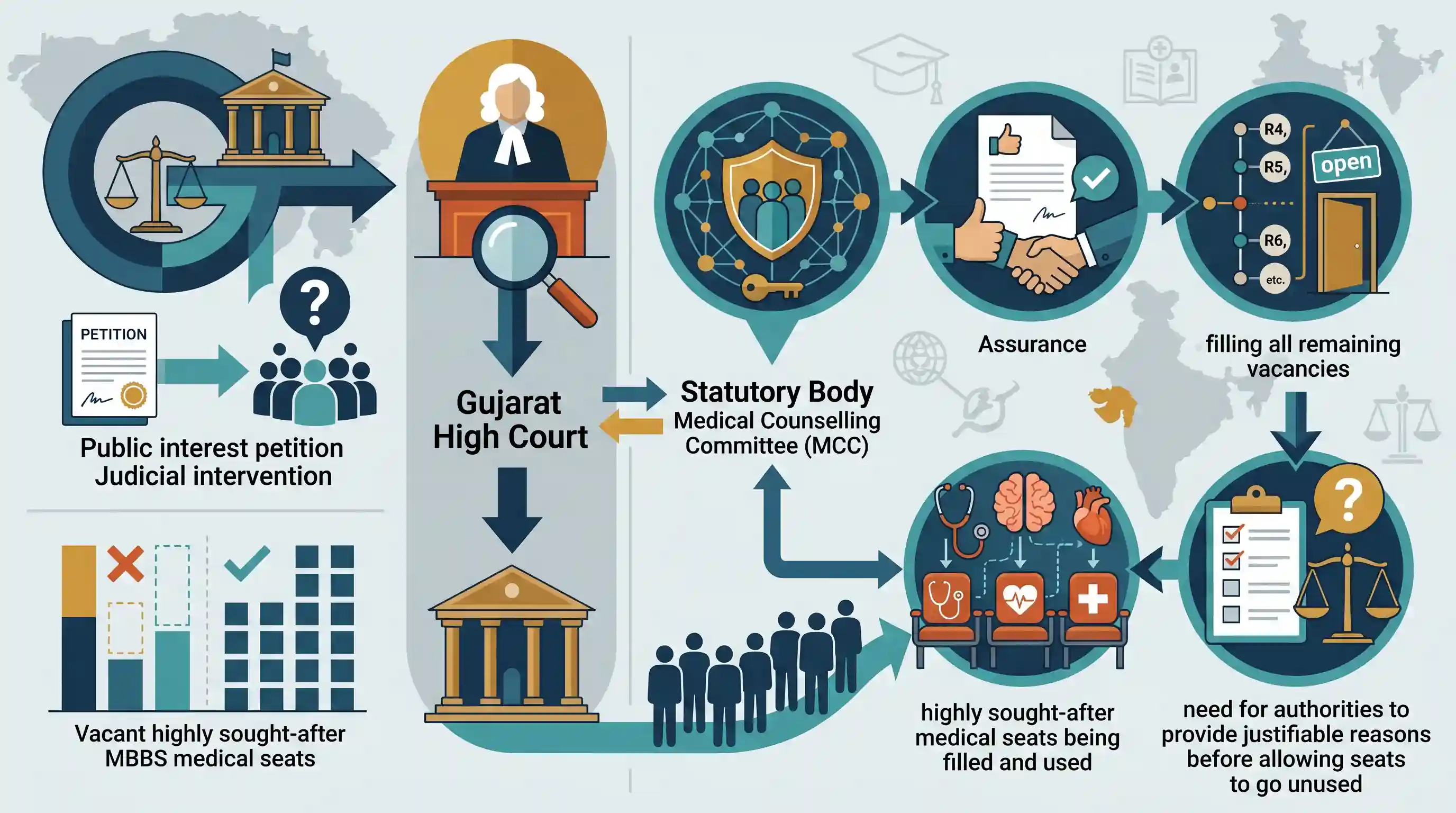
The Gujarat High Court disposed of a petition regarding vacant MBBS seats after the Medical Counselling Committee (MCC) assured the court that additional admission rounds would be conducted to fill all remaining vacancies. The court's intervention underscored the need for authorities to provide justifiable reasons before allowing highly sought-after medical seats to go unused.
Key Points
- The Gujarat High Court intervened in the issue of unfilled MBBS seats, demanding justification from authorities for not holding further admission rounds despite high student demand.
- The Medical Counselling Committee (MCC), in consultation with the National Medical Commission (NMC), committed to conducting subsequent counselling rounds to fill all vacant medical seats.
- The case highlights the role of judicial oversight in ensuring administrative bodies optimally utilize scarce and valuable resources in higher medical education.
Important Terms
National Medical Commission (NMC)

India's apex regulatory body for medical education and professionals. It replaced the Medical Council of India (MCI) in 2020 to improve transparency and standards under the Ministry of Health.
UPSC context
GS Paper 2: Statutory/Regulatory bodies. Tests knowledge of health sector reforms and institutional governance.
Medical Counselling Committee (MCC)
A body under the Directorate General of Health Services (DGHS) that conducts centralized online counseling for All India Quota (AIQ) medical and dental seats based on NEET scores.
UPSC context
GS Paper 2: Governance/Education. Tests understanding of centralized admission mechanisms and government-led health education management.
Admission Committee for Professional Undergraduate Medical Courses (ACPUMC)
A Gujarat government body responsible for regulating and conducting merit-based counseling for state quota seats in medical, dental, and allied undergraduate courses within the state.
UPSC context
GS Paper 2: Social sector services. Relevant for state-level administrative structures in health and education sectors.
Gujarat High Court
The state's highest constitutional court. In medical seat cases, it often exercises writ jurisdiction under Article 226 to address administrative lapses or ensure fair access to education.
UPSC context
GS Paper 2: Judiciary. Tests the scope of judicial intervention and the role of High Courts in upholding citizens' rights.
Stray Vacancy Round
The final phase of medical counseling held by authorities (MCC or state bodies) to fill any remaining vacant seats after regular counseling rounds are completed.
UPSC context
GS Paper 2: Social sector/Education. Highlights procedural complexities and optimization of scarce public resources like medical seats.
Prelims Trap
The Medical Counselling Committee (MCC) is a statutory body created under the National Medical Commission Act, 2019.
While the NMC is a statutory body, the MCC is purely an administrative committee functioning under the Directorate General of Health Services (DGHS).
Static Concepts Connected
What is the statutory framework and structure of the National Medical Commission (NMC)?
- Statutory Origin: Established under the NMC Act, 2019, replacing the corruption-plagued Medical Council of India (MCI).
- Four Autonomous Boards: Operates through four autonomous boards: UG Medical Education Board, PG Medical Education Board, Medical Assessment & Rating Board, and Ethics & Medical Registration Board.
- Fee Regulation: Frames guidelines for determining fees for 50% of seats in private medical institutions and deemed universities.
How does the medical quota system (AIQ vs State) function in India?
- SC Mandate: Created via a Supreme Court directive to allow merit-based access to medical seats across state borders without domicile requirements.
- AIQ (15%): Comprises 15% of all government medical college seats nationally, for which centralized counselling is conducted by the MCC.
- State Quota (85%): The remaining 85% of seats are reserved for domiciled students of the respective states and counselled by state authorities.
Cross-Topic Patterns
Judicial review in academic administration
Courts generally avoid academic timetables, but non-utilization of scarce medical seats triggers judicial review under Article 226 to prevent arbitrary administrative wastage of national resources.
Private fee caps and vacant seat paradox
The paradox of seats remaining vacant in a doctor-deficient country directly connects to exorbitant private college fees, highlighting the struggle to enforce fee-capping under the NMC Act.

Expect a multi-statement Prelims question comparing the statutory powers of the NMC with the administrative mandate of the DGHS-led MCC.
Linked PYQs · 2
Linked PYQs · 2
- 2015MainsGS2
The quality of higher education in India requires major improvements to make it internationally competitive. Do you think that the entry of foreign educational institutions would help improve the quality of higher and technical education in the country? Discuss.
- 2024MainsGS2
In a crucial domain like the public healthcare system the Indian State should play a vital role to contain the adverse impact of marketisation of the system. Suggest some measures through which the State can enhance the reach of public healthcare at the grassroots level.
