Interstate Water Sharing Disputes and BBMB Regulatory Frameworks
Source:The Hindu ↗
Why It Matters
Inter-state water disputes act as significant flashpoints in Indian federalism, exposing the limitations of existing legal frameworks (such as Article 262 and tribunals) to ensure timely, enforceable, and equitable resource sharing among states.
Summary
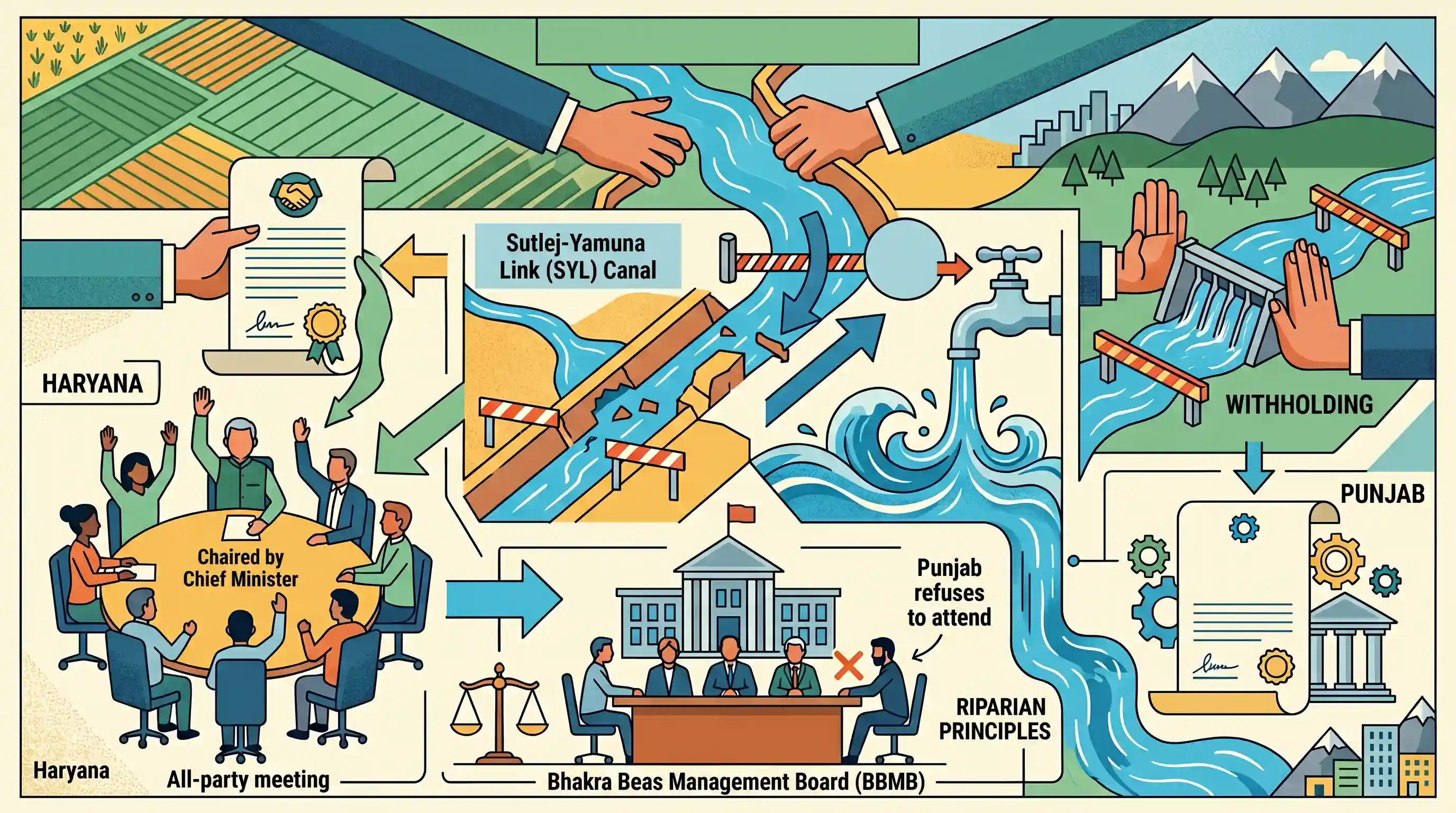
An all-party meeting in Haryana, chaired by Chief Minister Nayab Singh Saini, unanimously passed a resolution condemning Punjab's "unconstitutional" withholding of river waters and demanding the immediate implementation of Bhakra Beas Management Board (BBMB) decisions. The friction heightened after Punjab refused to attend a BBMB meeting regarding the release of an extra 4,500 cusecs of water for Haryana and Rajasthan. Haryana reiterated its unified stance on completing the Sutlej-Yamuna Link (SYL) canal and asserted that water sharing is governed by the Punjab Reorganisation Act, 1966, rather than merely riparian principles. The escalation in this inter-state water dispute underscores complex challenges in Indian federalism and inter-state resource management.
Key Points
- An all-party meeting in Haryana urged Punjab to unconditionally release water and comply with BBMB directives.
- Haryana CM termed Punjab's withholding of water as "unconstitutional" and a violation of the Punjab Reorganisation Act, 1966.
- The BBMB previously directed the release of an additional 4,500 cusecs of water from the Bhakra Nangal dam for Haryana and Rajasthan, which Punjab opposed.
- Haryana political parties presented a united front to push for the early construction of the Sutlej-Yamuna Link (SYL) canal.
- Punjab convened a special Vidhan Sabha session to assert its stance on river waters, escalating the long-standing inter-state dispute.
Important Terms
Punjab Reorganisation Act, 1966

The central legislation that divided the erstwhile state of Punjab into Punjab and Haryana in 1966. It contains specific sections (78-80) governing the sharing of river waters and project assets.
UPSC context
GS II (Polity); essential for understanding statutory basis of inter-state resource sharing and federal disputes.
Bhakra Beas Management Board (BBMB)
A statutory body formed under the 1966 Act to manage the Bhakra-Nangal and Beas projects. It regulates water and power distribution to Punjab, Haryana, Rajasthan, and other northern regions.
UPSC context
GS II (Statutory Bodies); tests knowledge of administrative mechanisms in inter-state river management.
Sutlej-Yamuna Link (SYL) Canal
A proposed 214-km canal to transfer Ravi-Beas waters from Punjab to Haryana. It remains a major point of contention due to conflicting claims over water rights and territorial sovereignty.
UPSC context
GS II & GS I (Geography/Polity); a classic case study for inter-state disputes and judicial intervention.
Article 262 of the Constitution
A constitutional provision empowering Parliament to adjudicate disputes over inter-state rivers. It allows for the exclusion of Supreme Court jurisdiction in such matters through specific central laws.
UPSC context
GS II (Polity); foundational article for federal water governance and judicial limitations.
Inter-State River Water Disputes (ISRWD) Act, 1956
Legislation enacted under Article 262 that provides for the establishment of ad-hoc tribunals to resolve inter-state water conflicts when bilateral negotiations between states fail.
UPSC context
GS II (Governance); vital for understanding the legal machinery for dispute resolution and recent reform proposals.
Riparian Principle
A legal doctrine where water rights belong to those who own land adjacent to a water body. Punjab often cites this to oppose water transfer to non-riparian Haryana.
UPSC context
GS I (Geography); tests conceptual understanding of water rights versus statutory allocations in federal disputes.
Prelims Trap
"The Supreme Court exercises exclusive original jurisdiction over all inter-state river water disputes under Article 131 of the Constitution."
Article 262 empowers Parliament to explicitly bar the Supreme Court's jurisdiction over inter-state river water disputes, which it did via the Inter-State Water Disputes Act.
Static Concepts Connected
How does the Constitution handle Inter-State River Water Disputes?
- Article 262: Empowers Parliament to provide for the adjudication of any dispute or complaint regarding inter-state rivers or river valleys.
- Jurisdiction Bar: Parliament may by law restrict the Supreme Court or any other court from exercising jurisdiction over such disputes.
- ISWD Act 1956: Enacted by Parliament under Art 262 to set up ad-hoc tribunals, whose awards are intended to be final and binding.
What principles govern the sharing of river waters between Indian states?
- Riparian Doctrine: Grants water rights exclusively to the state through whose territory the river flows (often invoked by upstream states like Punjab).
- Equitable Apportionment: Focuses on fair sharing based on need, prior use, and basin geography, overriding strict riparianism in India's tribunal awards.
- Helsinki Rules: International guidelines (1966) that heavily influence Indian tribunals to prioritize the equitable utilization of international or inter-state drainage basins.
Cross-Topic Patterns
Water Disputes & Inter-State Councils
While Tribunals adjudicate legal water rights, Article 263 (Inter-State Council) and Zonal Councils act as consultative forums, though they often fail to resolve hardened regional resource conflicts like the SYL canal.
BBMB: Statutory vs Tribunal Mechanisms
Unlike ad-hoc tribunals formed under the ISWD Act 1956, the BBMB is a permanent statutory body under the Punjab Reorganisation Act 1966, showing different legislative tools for resource division.

Expect a 2026 Prelims statement tricking aspirants on the SC's original jurisdiction (Art 131) vs the statutory bar (Art 262) on rivers.
Linked PYQs · 3
Linked PYQs · 3
- 2024MainsGS2
What changes has the Union Government recently introduced in the domain of Centre-State relations ? Suggest measures to be adopted to build the trust between the Centre and the States and for strengthening federalism.
- 2019MainsGS2
From the resolution of contentious issues regarding distribution of legislative powers by the courts, 'Principle of Federal Supremacy' and 'Harmonious Construction' have emerged. Explain.
- 2025PrelimsGS1
With reference to India, consider the following: I. The Inter-State Council II. The National Security Council III. Zonal Councils How many of the above were established as per the provisions of the Constitution of India?
