Air Quality Life Index and Particulate Pollution Crisis
Source:The Hindu ↗
Why It Matters
Air pollution is a recurring theme in UPSC exams (both Prelims and Mains). The AQLI report provides essential data points for answering questions on the effectiveness of the National Clean Air Programme (NCAP), the impact of environmental degradation on life expectancy, and the disparity between national standards and WHO guidelines.
Summary
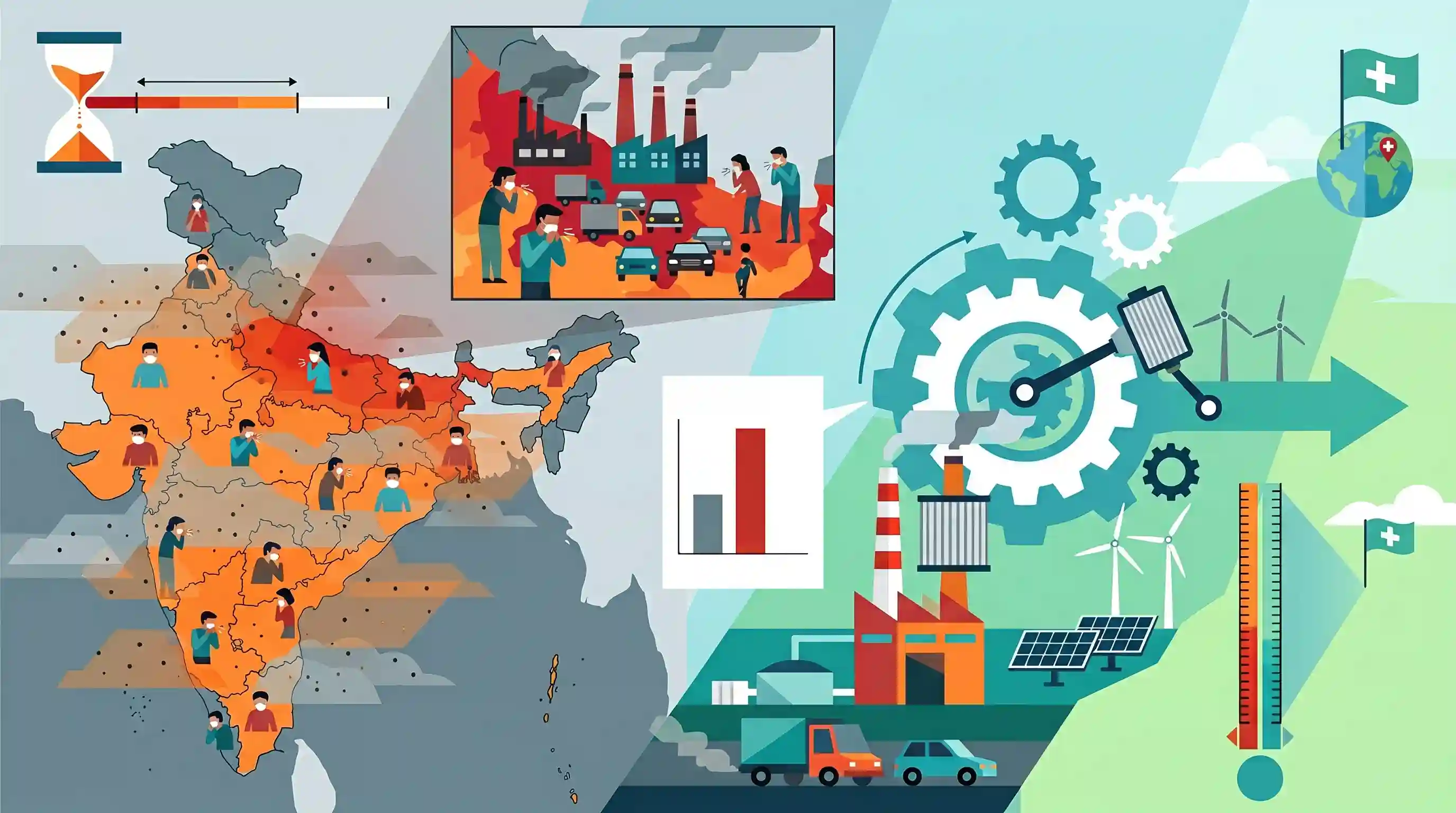
The AQLI 2025 report reveals a dire public health crisis in India, noting that the entire population lives in areas where annual PM2.5 levels exceed the WHO's safe limit of 5 µg/m³. This severe particulate pollution significantly reduces the life expectancy of the average Indian, with the impact being most acute in the densely populated Indo-Gangetic Plain. The findings underscore the critical importance of strictly implementing the National Clean Air Programme (NCAP) to curb emissions and align domestic air quality closer to international health standards.
Key Points
- According to the AQLI 2025 report by EPIC, 100% of India's population breathes air that exceeds the WHO's annual PM2.5 guideline of 5 µg/m³.
- The severe particulate matter pollution has a profound impact on public health, causing a significant reduction in the average life expectancy of Indians.
- The Indo-Gangetic Plain remains the most polluted region in the country, where residents stand to lose the most years off their lives due to toxic air.
- Achieving the emission reduction targets set under the National Clean Air Programme (NCAP) could substantially improve life expectancy and mitigate the public health crisis.
Important Terms
National Clean Air Programme (NCAP)

India's flagship 2019 initiative to reduce particulate matter (PM10 and PM2.5) concentrations by 40% by 2026 across 131 non-attainment cities through city-specific action plans and improved monitoring.
UPSC context
GS-III (Environment); essential for questions on government strategies to combat air pollution and achieving National Ambient Air Quality Standards.
Air Quality Life Index (AQLI)
An annual report by UChicago's Energy Policy Institute that quantifies the relationship between particulate pollution and life expectancy, translating air quality data into potential years of life lost.
UPSC context
GS-III (Environment); provides critical health-impact data for the Mains and underscores the urgency of pollution mitigation.
PM2.5
Fine inhalable particles (2.5 micrometers or smaller) that penetrate the lungs and bloodstream, causing severe respiratory and cardiovascular issues; it is the primary metric for measuring toxic air.
UPSC context
GS-III (Pollution/Health); the core indicator for air quality monitoring and frequently tested in Science and Environment.
World Health Organization (WHO)
A specialized UN agency that sets global health standards; its 2021 air quality guidelines lowered the safe annual PM2.5 exposure limit to a stringent 5 µg/m³.
UPSC context
GS-II (International Organizations) and GS-III; used for comparative analysis between domestic and global environmental health benchmarks.
Energy Policy Institute at the University of Chicago (EPIC)
A research institute at the University of Chicago that developed the AQLI, providing evidence-based insights into the social and economic impacts of energy and environmental policies.
UPSC context
GS-III (Environment); significant for identifying authoritative international sources that influence domestic environmental discourse.
Indo-Gangetic Plain (IGP)
A vast, fertile region in North India encompassing the most polluted areas globally; its high population density and geographical features trap particulate emissions, severely impacting longevity.
UPSC context
GS-I (Geography) and GS-III; crucial for discussing regional pollution patterns, stubble burning, and climatic influences on air quality.
Prelims Trap
The Air Quality Life Index is published by WHO, and NCAP non-attainment cities are those failing to meet WHO air quality guidelines.
AQLI is published by the University of Chicago (EPIC). Furthermore, NCAP non-attainment cities are identified based on India's domestic NAAQS, not the stricter WHO guidelines.
Static Concepts Connected
Why is the Indo-Gangetic Plain (IGP) highly susceptible to severe winter smog?
- Temperature Inversion: During winter, a layer of cold air near the surface traps warmer air above it, preventing the vertical dispersion of pollutants.
- Topographical Barrier: The Himalayas to the north act as a massive physical barrier, preventing winds from flushing out the trapped pollutants, creating a stagnant 'valley effect'.
- Anthropogenic Load: A dense concentration of vehicular traffic, construction dust, industrial emissions, and seasonal agricultural residue (stubble) burning heavily loads the stagnant air mass.
What are the core operational criteria of the National Clean Air Programme (NCAP)?
- Non-Attainment Cities: NCAP targets 'non-attainment cities'—cities that have consistently failed to meet the National Ambient Air Quality Standards (NAAQS) for five consecutive years.
- Revised Reduction Targets: The government revised the initial goal, now aiming for a 40% reduction in PM2.5 and PM10 particulate concentrations by 2025-26 in these targeted cities.
- Data & Monitoring: The programme relies heavily on expanding continuous ambient air quality monitoring stations (CAAQMS) and conducting city-specific source apportionment studies.
Cross-Topic Patterns
Fiscal Federalism + Urban Air Quality Grants
The 15th Finance Commission linked specific urban grants for million-plus cities to their performance in improving air quality, blending fiscal federalism (GS2) with environmental outcomes (GS3).
Pollution + Stubble Burning + Crop Diversification
The IGP air crisis connects to GS3 Agriculture, highlighting the urgent need for crop diversification away from water-intensive paddy to reduce seasonal stubble burning and groundwater depletion.

Expect a 2026 Prelims question mixing WHO's 5 µg/m³ PM2.5 limit, EPIC's AQLI, and the NAAQS criteria defining NCAP non-attainment cities.
Linked PYQs · 3
Linked PYQs · 3
- 2022PrelimsGS1
In the context of WHO Air Quality Guidelines, consider the following statements: 1. The 24-hour mean of PM2.5 should not exceed 15 µg/m³ and annual mean of PM2.5 should not exceed 5 µg/m³. 2. In a year, the highest levels of ozone pollution occur during the periods of inclement weather. 3. PM10 can penetrate the lung barrier and enter the bloodstream. 4. Excessive ozone in the air can trigger asthma. Which of the statements given above are correct?
- 2020MainsGS3
What are the key features of the National Clean Air Programme (NCAP) initiated by the Government of India?
- 2021MainsGS3
Describe the key points of the revised Global Air Quality Guidelines (AQGs) recently released by the World Health Organisation (WHO). How are these different from its last update in 2005? What changes in India's National Clean Air Programme are required to achieve these revised standards?
