GISAT 1A Mission and ISRO Launch Vehicle Reliability
Source:The Hindu ↗
Why It Matters
This topic is vital for understanding India's space capabilities, the strategic importance of Earth observation and geostationary imaging satellites, and ISRO's efforts to maintain reliability and mission success in its launch programs.
Summary
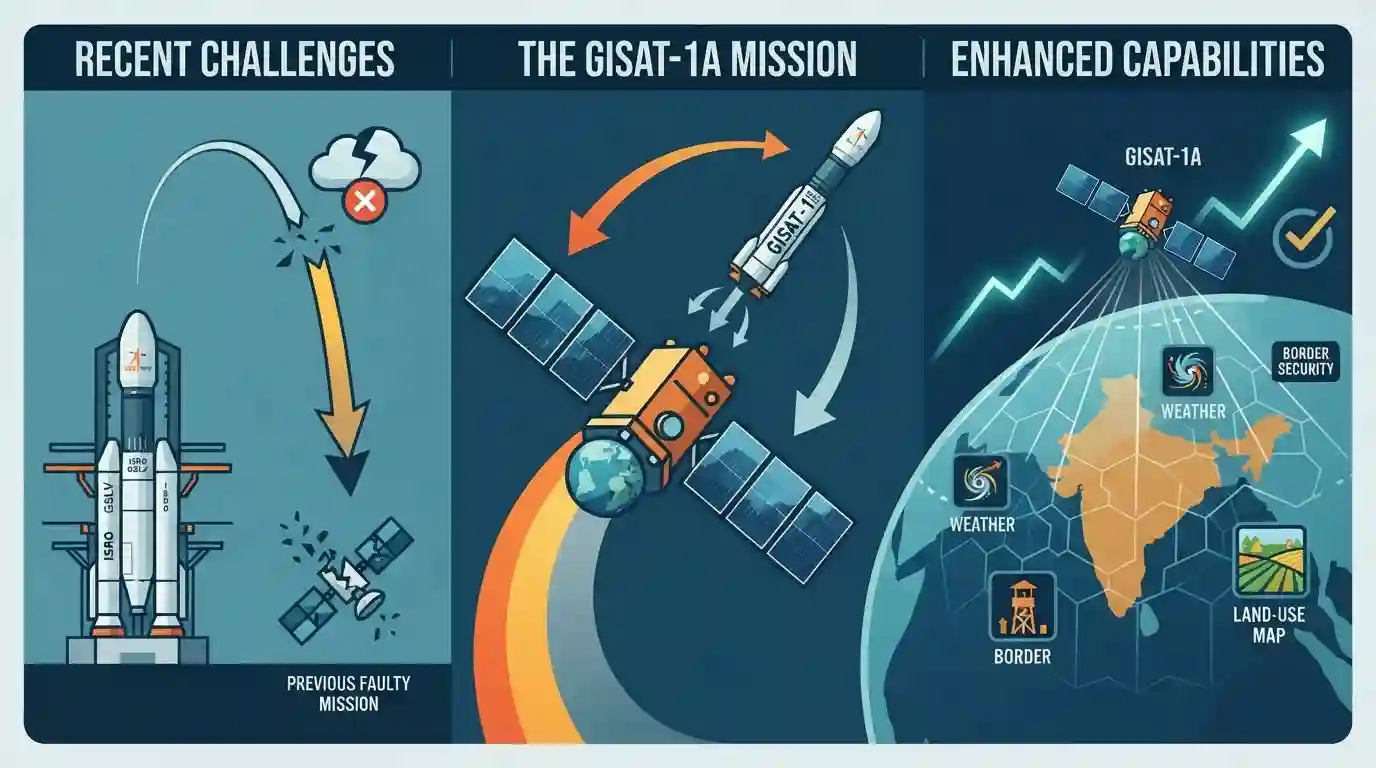
The article discusses the upcoming GISAT-1A mission by ISRO, highlighting its importance in mending a recent streak of faulty launches and bolstering India's capabilities in high-frequency Earth observation from geostationary orbits.
Key Points
- ISRO is preparing for the GISAT-1A mission to overcome recent setbacks and faulty launch streaks.
- GISAT (Geostationary Imaging Satellite) series aims to provide continuous, real-time imaging of the Indian subcontinent from geostationary orbit.
- Earth observation satellites in geostationary orbits allow high-frequency monitoring for applications like disaster management, weather forecasting, and strategic surveillance.
- Addressing launch vehicle reliability is critical for India's growing commercial and scientific space ambitions.
Important Terms
GISAT-1A mission

An advanced Earth-imaging mission by ISRO (also designated EOS-05) designed to operate from a geosynchronous orbit to provide high-frequency, continuous monitoring of the Indian subcontinent.
UPSC context
UPSC Science and Technology (Space Technology): Tests understanding of India's earth observation satellites, launch vehicles (GSLV), and applications in disaster management and strategic surveillance.
ISRO
India's national space agency responsible for planning, executing, and managing space exploration, satellite deployment, and launch vehicle programs like PSLV and GSLV.
UPSC context
UPSC GS Paper III (Science & Technology): Important for questions on institutional achievements, space policy, and national technological self-reliance.
Geostationary Orbit
A high orbit located approximately 36,000 km above Earth's equator where a satellite matches Earth's rotation period, appearing stationary over a fixed point.
UPSC context
UPSC Science and Technology: Evaluates concepts of satellite orbits, orbital mechanics, and specific applications like communication, meteorology, and continuous earth observation.
The Hindu
A major English-language daily broadsheet newspaper in India known for credible policy, governance, science, and economic analysis.
UPSC context
UPSC Civil Services Preparation: Essential current affairs reading source for editorial opinions, international relations, socio-economic issues, and analytical depth.
Prelims Trap
GISAT-1A is a standard Low Earth Orbit (LEO) earth observation satellite providing periodic global coverage.
Aspirants frequently confuse GISAT with standard sun-synchronous LEO remote sensing satellites, overlooking its unique 36,000 km geostationary placement enabling constant 30-minute real-time imaging intervals.
Static Concepts Connected
What are the principal differences between Low Earth Orbit (LEO) and Geostationary Orbit (GEO) satellites?
- Altitude & Period: Altitude range sits below 2,000 km for LEO, whereas Geostationary Orbit resides at exactly 35,786 km altitude.
- Revisit & Coverage: LEO satellites offer high spatial resolution with periodic revisit times, while GEO satellites match Earth's rotation to maintain constant regional coverage.
- Primary Application: GEO altitude permits continuous meteorological and disaster monitoring of a fixed subcontinent, unlike LEO which requires multi-satellite constellations.
Cross-Topic Patterns
GISAT Real-Time Imaging + Disaster Management
Geostationary Earth observation payloads deployed for real-time disaster management integrate directly into national disaster response frameworks under NDMA guidelines.

GISAT orbit physics (LEO vs GEO revisit times) and GSLV indigenous cryogenic stage role are prime candidates for science-tech match statements.
Linked PYQs · 2
Linked PYQs · 2
- 2018PrelimsGS1
With reference to India's satellite launch vehicles, consider the following statements: 1. PSLVs launch the satellites useful for Earth resources monitoring whereas GSLVs are designed mainly to launch communication satellites. 2. Satellites launched by PSLV appear to remain permanently fixed in the same position in the sky, as viewed from a particular location on Earth. 3. GSLV Mk III is a four-staged launch vehicle with the first and third stages using solid rocket motors; and the second and fourth stages using liquid rocket engines. Which of the statements given above is/are correct?
- 2016MainsGS3
Discuss India's achievements in the field of Space Science and Technology. How the application of this technology has helped India in its socio-economic development?
