Himalayan Hydropower Tunnel Safety and Geological Hazards
Source:The Hindu ↗
આ શા માટે મહત્વનું છે
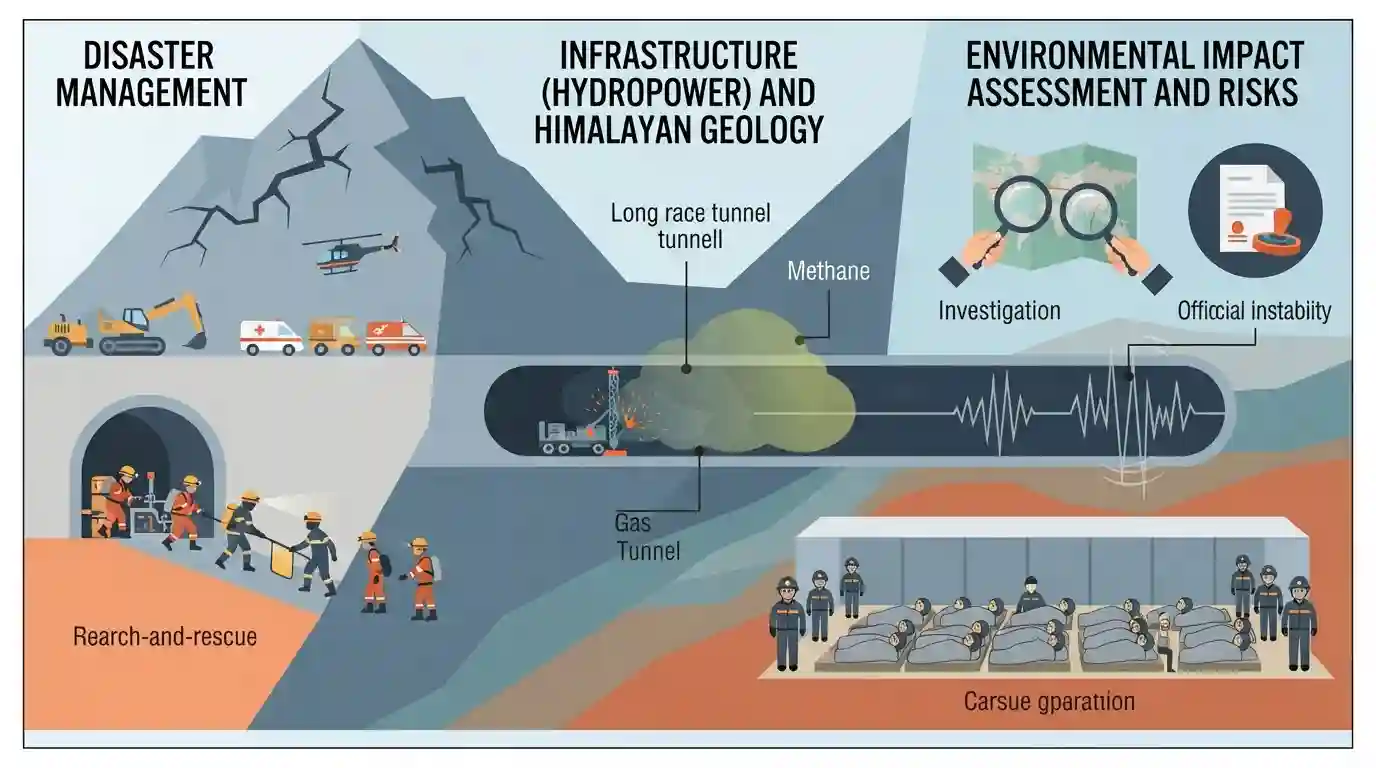
This disaster draws attention to the structural and geological hazards of tunneling and infrastructure development in the ecologically sensitive and seismic Himalayan zone. Similar to previous incidents like the Silkyara tunnel collapse, it emphasizes the need for advanced geological survey technologies (such as detection of trapped gases like methane), stricter safety regulations, and robust environmental impact assessments for run-of-the-river hydropower projects.
સારાંશ
All 25 workers trapped inside the under-construction head race tunnel of the 500 MW Teesta Stage-VI Hydropower Project in Sikkim's Namchi district were found dead after an intensive search and rescue operation. The tragedy was caused by an explosion resulting from a sudden release of suspected methane gas, likely ignited by drilling sparks hitting methane-embedded rock. Both the NHPC and the Sikkim government have ordered investigations into the accident, which underscores critical safety and geological risks in Himalayan infrastructure projects.
મુખ્ય મુદ્દા
- Search and rescue operations concluded in Namchi district, Sikkim, after recovering the bodies of all 25 workers trapped inside an under-construction hydropower tunnel.
- The accident occurred in the head race tunnel of the 500 MW Teesta Stage-VI Hydropower Project on July 20, 2026.
- According to NHPC, the explosion was caused by a sudden, explosive release of suspected methane gas, likely triggered when drilling struck methane-embedded rocks and generated sparks.
- Both the Central PSU NHPC and the Sikkim state government have ordered separate investigations into the disaster.
- NHPC announced an ex-gratia payment of ₹5 lakh to the next of kin of each deceased worker.
- The tragedy highlights the complex geological hazards and industrial safety deficits associated with mega infrastructure projects in the fragile Himalayan landscape.
મહત્વપૂર્ણ શબ્દો
NHPC Limited

A Government of India Mini Ratna Category-I Public Sector Enterprise under the Ministry of Power, established in 1975, responsible for planning, executing, and operating major hydropower and renewable energy projects.
UPSC context
GS Paper III (Infrastructure - Energy). Tests understanding of India's public sector energy development, renewable capacity, and infrastructure planning.
Sikkim State Disaster Management Authority (SSDMA)
The nodal institution established in 2005 under the Disaster Management Act, responsible for coordinating, planning, and executing disaster prevention, preparedness, mitigation, and response strategies in Sikkim.
UPSC context
GS Paper III (Disaster Management). Tests institutional frameworks for disaster risk reduction, community-led disaster preparedness, and Himalayan hazards mitigation.
Run-of-the-river Hydropower
A type of hydroelectric facility that generates electricity using the natural flow and elevation drop of a river, requiring minimal water storage and causing less submergence and ecological displacement.
UPSC context
GS Paper III (Environment, Infrastructure). Tests understanding of sustainable alternatives to large dams, environmental impact assessment (EIA), and clean energy transitions.
Head Race Tunnel (HRT)
An underground conduit or pressure tunnel designed to convey water from the intake structure or reservoir of a hydropower project directly to the surge shaft, penstock, or powerhouse turbines.
UPSC context
GS Paper III (Infrastructure, Science & Technology). Tests knowledge of hydroelectric design, safety protocols, and challenges of underground tunneling.
Methane Gas Hazards (Underground Excavation)
The dangerous accumulation and sudden release of trapped geological methane gas pockets in young, fractured rock formations, posing severe risks of explosion and toxic asphyxiation during tunneling operations.
UPSC context
GS Paper III (Disaster Management). Tests identification of geological and occupational safety hazards during major infrastructure development in fragile mountain belts.
પ્રિલિમ્સ ટ્રેપ
Methane gas explosion hazards and monitoring regulations are applicable only to coal mines and sedimentary oil fields.
Ancient pocketed methane can be trapped within Himalayan metamorphic rock formations, making underground tunneling projects (like hydropower HRTs) equally vulnerable to explosive gas strikes.
સંલગ્ન સ્થિર ખ્યાલો
What is a Run-of-the-River Hydropower Project and its key components?
- Mechanism: Redirects natural river flow through tunnels to generate electricity, minimizing surface reservoir submergence but requiring extensive underground excavation.
- Head Race Tunnel: The critical underground hydraulic conduit that channels water from the intake dam to the surge tank and powerhouse.
- Submergence vs Excavation: While avoiding massive displacement of surface reservoirs, deep tunneling creates significant subterranean geological and hydrological stress.
Why is the Himalayan region highly vulnerable to underground tunneling disasters?
- Seismic Vulnerability: Located in highly active Seismic Zones IV and V, making the young fold mountains prone to tectonic shifts.
- Geological Instability: Tunneling frequently encounters fragile thrust zones, sheared rock masses, and trapped high-pressure aquifers or ancient gas pockets.
- Information Deficit: The lack of dense, real-time geological mapping before drilling often leads to unpredicted strikes of unstable geological features.
આંતર-વિષય પેટર્ન
Hydropower vs. Himalayan Carrying Capacity
Recurring disasters demonstrate that individual EIAs fail to capture cumulative environmental degradation, requiring basin-wide carrying capacity assessments.
Occupational Safety and Tunneling Codes
Underlines the critical gap in implementing the Occupational Safety Code 2020 concerning real-time gas detection and ventilation in non-mining tunneling.

Fragile Himalayan geology and tunneling hazards (like Silkyara or Teesta) likely to be tested via carrying capacity and EIA reforms in GS-3.
સંલગ્ન PYQ · 2
સંલગ્ન PYQ · 2
- 2017PrelimsGS1
With reference to river Teesta, consider the following statements: 1. The source of river Teesta is the same as that of Brahmaputra but it flows through Sikkim. 2. River Rangeet originates in Sikkim and it is a tributary of river Teesta. 3. River Teesta flows into Bay of Bengal on the border of India and Bangladesh. Which of the statements given above is/are correct?
- 2019MainsGS3
Disaster preparedness is the first step in any disaster management process. Explain how hazard zonation mapping will help disaster mitigation in the case of landslides.
