European nations accuse Russia of using toxin in dissident death
Source:Indian Express ↗
Why It Matters
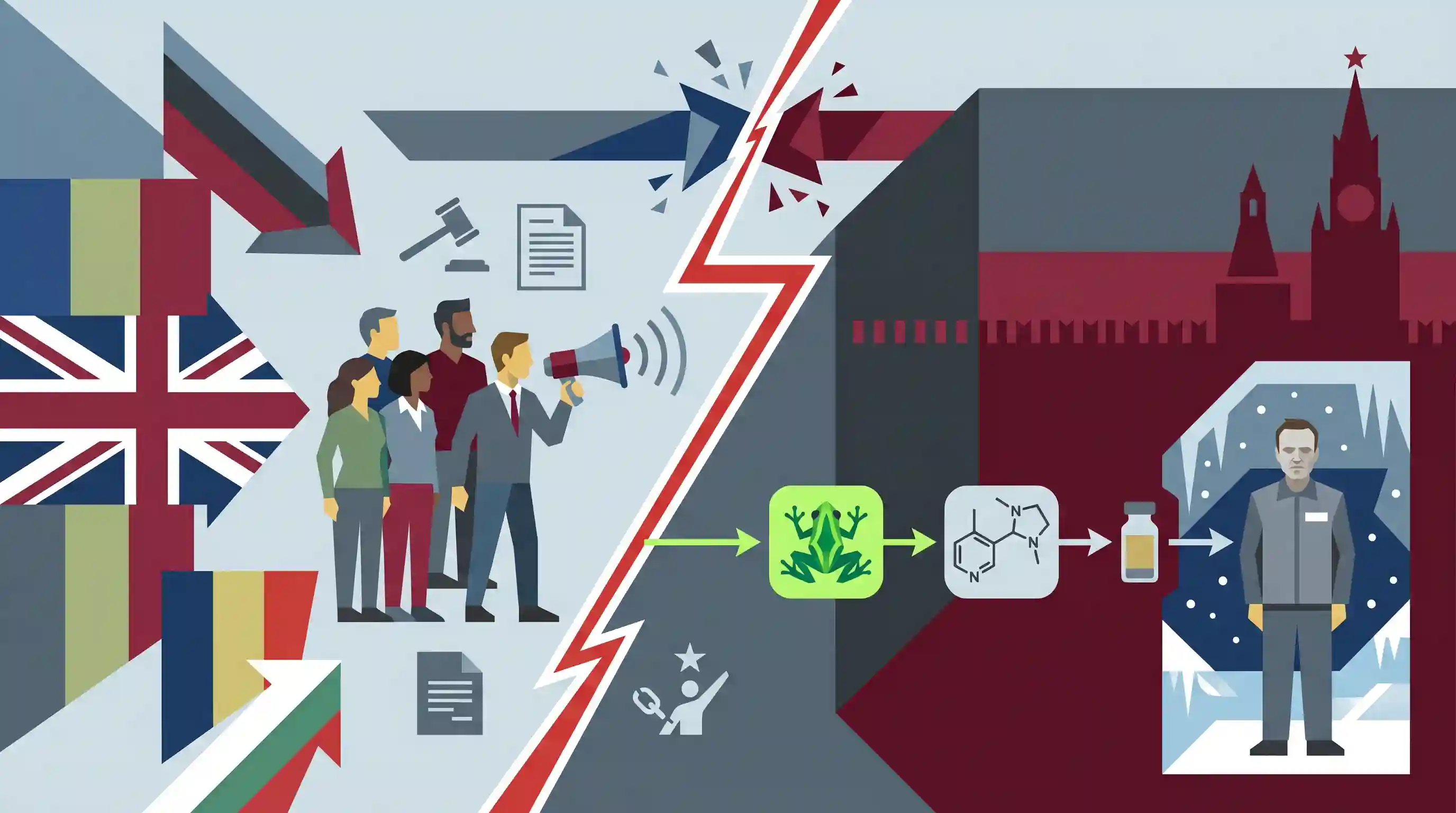
The incident underscores the geopolitical frictions between Russia and Western nations, human rights violations, and the weaponization of rare biological toxins (like epibatidine from poison dart frogs). It provides a real-world example for UPSC Mains questions on human rights, political dissent (GS2/GS4), and natural toxins (GS3/Prelims).
Summary
Britain and four European allies have accused Russia of assassinating opposition leader Alexei Navalny in an Arctic prison using a rare lethal toxin. Investigations have reportedly linked his death to epibatidine, a highly potent biological toxin derived from South American poison dart frogs. The specialized nature of the poison conclusively links the Kremlin to the incident, highlighting the extreme measures taken by the Russian state to silence political dissent and whistleblowers. This development further exacerbates geopolitical tensions between Russia and the West while raising serious ethical and human rights concerns.
Key Points
- Britain and four European allies have alleged that the Russian government is responsible for the death of opposition leader Alexei Navalny in an Arctic prison.
- Investigations claim to have conclusively linked his death to the use of a lethal biological toxin.
- The toxin identified is epibatidine, a rare and highly potent substance naturally found in South American poison dart frogs.
- The use of such a specialized and rare biological agent points to a state-sponsored assassination designed to eliminate political opposition.
Important Terms
Alexei Navalny

Prominent Russian opposition leader and anti-corruption activist who died in an Arctic prison in 2024. He was a central figure in modern geopolitical debates regarding Russian democracy.
UPSC context
GS Paper 2: International Relations/Human Rights; relevant for case studies on political dissent and global democratic standards.
Epibatidine
A potent neurotoxin derived from South American poison dart frogs that causes respiratory failure. It is allegedly used as a biological agent to silence political dissent.
UPSC context
GS Paper 3: Science & Technology/Security; concerns biological agents and non-conventional warfare.
Kremlin
A fortified complex in Moscow serving as the seat of the Russian government; used as a metonym for the executive authority of the Russian Federation.
UPSC context
GS Paper 2: International Relations; essential for identifying key state actors in global geopolitics.
Biological and Toxin Weapons Convention (BTWC)
A 1972 treaty prohibiting the development, production, and stockpiling of biological and toxin weapons, considered a cornerstone of international disarmament.
UPSC context
GS Paper 2/3: Security and International Treaties; critical for topics on global security and arms control.
Chemical Weapons Convention (CWC)
A 1993 multilateral treaty overseen by the OPCW that bans the use and production of chemical weapons.
UPSC context
GS Paper 2: Important for oversight of international law and prohibited weapons of mass destruction.
State-sponsored Assassination
The targeted killing of a person, such as a political dissident, conducted or directed by a sovereign state’s government or agents.
UPSC context
GS Paper 2/4: Governance and Ethics; relates to extrajudicial killings and breaches of international law.
Human Rights
Fundamental rights inherent to all individuals, including the right to life and freedom from political persecution.
UPSC context
GS Paper 2: Governance and International Relations; central to the syllabus regarding fundamental rights and protections.
Prelims Trap
The Biological Weapons Convention possesses strict, institutionalized verification mechanisms to investigate alleged poisonings.
Unlike the Chemical Weapons Convention (which has the OPCW), the BWC lacks a formal verification regime or independent inspecting body. Aspirants wrongly assume WMD treaties uniformly have built-in enforcement mechanisms.
Static Concepts Connected
How does the Biological Weapons Convention (BWC) differ from the Chemical Weapons Convention (CWC)?
- Lack of Verification: The 1975 BWC bans biological/toxin weapons but notably lacks a formal verification mechanism or an implementing organization to conduct inspections.
- OPCW Enforcement: The 1997 CWC features a strict, institutionalized verification regime administered by the OPCW, which conducts routine and challenge inspections globally.
- Toxin Grey Area: Both treaties struggle to monitor toxins (like Epibatidine or Ricin) that fall into a grey area, being biological in origin but chemical in action.
What are Alkaloid neurotoxins and how do they function?
- Organic Origin: They are naturally occurring organic compounds containing basic nitrogen atoms, typically found in plants and amphibians (like South American dart frogs).
- Receptor Overstimulation: Epibatidine binds to nicotinic acetylcholine receptors in the nervous system, overstimulating them to the point of lethal paralysis and respiratory failure.
- Therapeutic Origins: Many toxins are originally studied for medicine. Epibatidine was investigated as a potent non-opioid painkiller before being deemed too toxic for human use.
Cross-Topic Patterns
Dual-use dilemma in biotechnology
The synthesis of natural toxins bridges Science (Biotech) and GS4 Ethics. It highlights the challenge of controlling open-source scientific research originally intended for pharmaceuticals but weaponized by state actors.
Rise of state-sponsored toxic assassinations
From Novichok in the UK to Epibatidine in Russia, state actors increasingly use specialized, difficult-to-trace biological and chemical agents to eliminate dissidents, bypassing traditional international legal frameworks.

The lack of a BWC verification body vs OPCW's role for the CWC makes a comparative Prelims statement highly probable in 2026.
Linked PYQs · 3
Linked PYQs · 3
- 2024PrelimsGS1
Consider the following : 1. Butterflies 2. Fish 3. Frogs How many of the above have poisonous species among them?
- 2025MainsGS2
"The reform process in the United Nations remains unresolved, because of the delicate imbalance of East and West and entanglement of the USA vs. Russo-Chinese alliance.” Examine and critically evaluate the East-West policy confrontations in this regard.
- 2022MainsGS4
Whistle-blower, who reports corruption and illegal activities, wrongdoing and misconduct to the concerned authorities, runs the risk of being exposed to grave danger, physical harm and victimization by the vested interests, accused persons and his team. What policy measures would you suggest to strengthen protection mechanism to safeguard the whistle-blower?
