Rare Albino Hog Deer Sighted in Kaziranga National Park
Source:Indian Express ↗
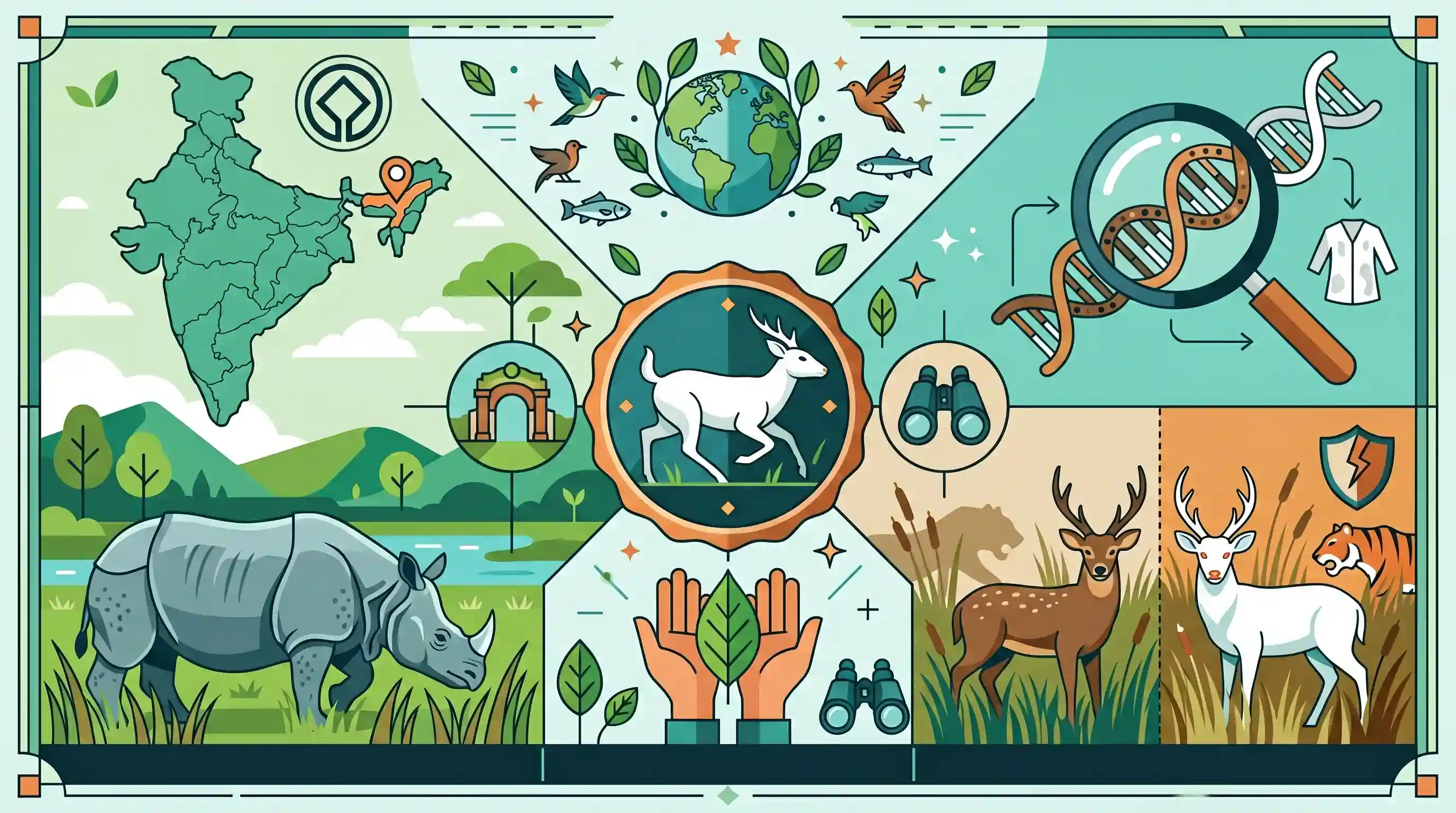
Why It Matters
Spotlighting rare genetic traits (albinism) in wildlife serves as a practical example for genetics and adaptation. It also provides an occasion to review the geographical distribution, behavioral traits of specific fauna like the Hog Deer, and the ecological profile of Kaziranga National Park.
Summary
A rare albino hog deer was spotted in Kaziranga National Park, Assam. The animal's distinct white coat is caused by albinism, a genetic trait resulting from a lack of melanin, which inadvertently increases its vulnerability to predators by removing natural camouflage. Kaziranga is a UNESCO World Heritage Site famous for its one-horned rhinoceroses. Hog deer, native to South and Southeast Asia, are known for running with their heads low to navigate dense habitats, resembling a hog's movement.
Key Points
- A rare albino hog deer was recently sighted and captured on video at Assam's Kaziranga National Park.
- Albinism is a genetic condition characterized by the absence of the pigment melanin, which makes the deer stand out in its green surroundings, increasing its vulnerability to predators.
- Kaziranga National Park is a UNESCO World Heritage Site primarily renowned for its population of the Indian one-horned rhinoceros.
- Hog deer (Axis porcinus) are native to South and Southeast Asia, named for their unique habit of running with heads hung low to duck under vegetation like a hog, rather than leaping over obstacles.
Important Terms
Kaziranga National Park

Located in Assam, this sanctuary is home to two-thirds of the world's one-horned rhinoceroses. It is a UNESCO World Heritage Site and a designated Tiger Reserve situated along the Brahmaputra River.
UPSC context
GS Paper III (Environment/Biodiversity). Tests knowledge of protected areas, conservation success stories, and geographical features like the Brahmaputra floodplains.
UNESCO World Heritage Site
A landmark or area recognized by UNESCO for its "Outstanding Universal Value" to humanity under the 1972 Convention. These sites receive international legal protection and conservation support.
UPSC context
GS Paper I (Culture) & III (Environment). Tests understanding of international treaties, conservation frameworks, and India's significant landmarks.
Indian Hog Deer (Axis porcinus)
A small, solitary deer species native to South and Southeast Asia, known for its hog-like running style. It is classified as "Endangered" on the IUCN Red List.
UPSC context
GS Paper III (Biodiversity). Tests familiarity with threatened species, their habitats (tall grasslands), and legal protection under the Wildlife Protection Act.
Albinism
A rare, hereditary genetic condition characterized by the partial or complete absence of melanin pigment in the skin, hair, and eyes, often resulting in increased vulnerability to predators.
UPSC context
GS Paper III (Science & Technology/Environment). Tests basic biological concepts, genetics (recessive traits), and the impact of physical traits on wildlife survival.
Melanin
A natural pigment found in most organisms that determines the color of skin, hair, and eyes while providing protection against harmful ultraviolet (UV) radiation from the sun.
UPSC context
GS Paper III (Science & Technology). Tests fundamental biological processes and the physiological significance of pigmentation in organisms.
Prelims Trap
"The Hog Deer is endemic to Kaziranga and forms part of its iconic 'Big Five' species."
Hog Deer are native across South and Southeast Asia, not endemic to Assam. Furthermore, Kaziranga's iconic 'Big Five' features the Swamp Deer (Barasingha), not the Hog Deer.
Static Concepts Connected
What are the defining geographical and ecological features of Kaziranga National Park?
- Hydrology: Bounded by the Brahmaputra River to the north and east, the Mora Diphlu to the south, and intersected centrally by the Diphlu River.
- The Big Five: It is critical habitat for the One-horned Rhinoceros, Royal Bengal Tiger, Asian Elephant, Wild Water Buffalo, and Swamp Deer (Barasingha).
- Landscape: Comprises tall alluvial grasslands, swamps, and tropical moist deciduous forests that are dynamically maintained by annual monsoonal floods.
What is the biological difference between Albinism and Leucism in wildlife?
- Albinism: A genetic condition causing a complete absence or severe deficiency of melanin, resulting in pale/white coats and distinctly pink or red eyes due to visible blood vessels.
- Leucism: A condition causing partial loss of multiple types of pigmentation (not just melanin). Animals may have white patches or pale coats but crucially retain normal eye color.
- Ecological Disadvantage: Both genetic mutations strip wild prey of their natural camouflage, making them highly visible and thus much more vulnerable to predators.
Cross-Topic Patterns
Behavioral traits in species questions
UPSC increasingly tests distinct animal behaviors. The hog deer's unique habit of running with its head low to duck under vegetation makes it a prime candidate for description-based species identification questions.
Brahmaputra floods and ecosystem maintenance
Kaziranga's alluvial grasslands rely on the Brahmaputra's annual floods to wash away dry vegetation and deposit silt, maintaining the critical habitat for grazers like rhinos and deer.

Expect a multi-statement question mixing Kaziranga's rivers (Diphlu), its 'Big Five' species, and unique traits of the Hog Deer.
Linked PYQs · 2
Linked PYQs · 2
- 2020PrelimsGS1
Which one of the following protected areas is well-known for the conservation of a sub-species of the Indian swamp deer (Barasingha) that thrives well on hard ground and is exclusively graminivorous?
- 2013PrelimsGS1
Consider the following fauna of India : 1. Gharial 2. Leatherback turtle 3. Swamp deer Which of the above is/are endangered?
