Uttar Pradesh Electoral Roll Revisions and Party Booth Strategies
Source:Indian Express ↗
Why It Matters
The continuous updating and purification of electoral rolls is fundamental to conducting free and fair elections. Massive voter deletions highlight the operational mechanisms of the ECI, the legal framework under the Representation of the People Act, 1950, and the potential risk of disenfranchising legitimate voters, which directly impacts democratic representation and the constitutional right to vote.
Summary
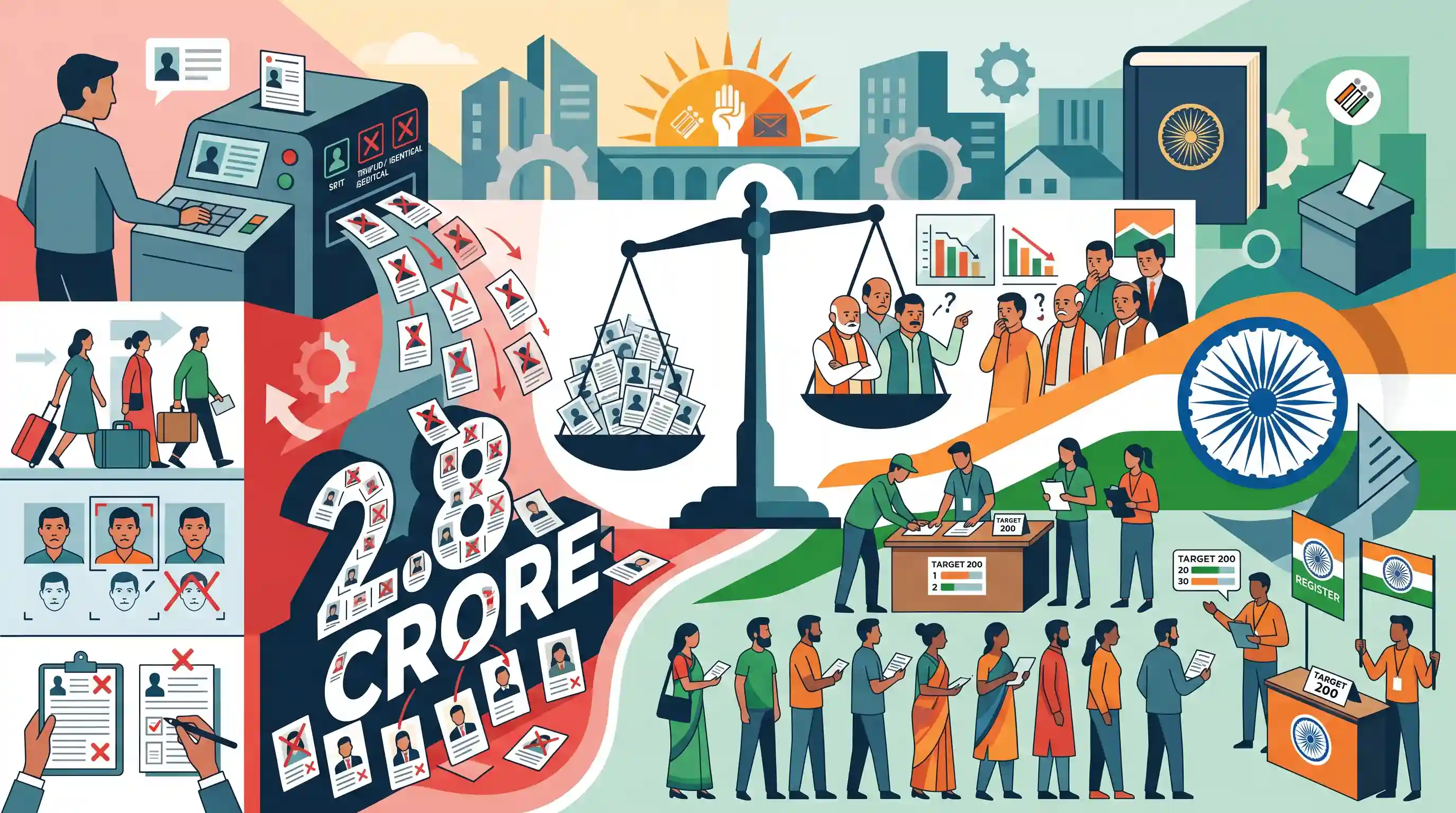
The Election Commission of India's recent Special Summary Revision in Uttar Pradesh has resulted in the deletion of 2.89 crore names from the electoral rolls under the 'SIR' (Shifted, Invalid/Identical, Repeated) criteria. This large-scale purging of voter lists has set off alarm bells within the ruling Bharatiya Janata Party (BJP), which fears a negative impact on its electoral prospects due to potential disenfranchisement of its supporters. In response, the BJP has mandated its party workers to actively participate in the voter registration process, setting a target to add 200 voters per polling booth. The development highlights the critical administrative mechanisms of electoral roll revision under the Representation of the People Act, 1950, and brings into focus the challenges of maintaining accurate voter lists without compromising the constitutional right to vote (Article 326).
Key Points
- Approximately 2.89 crore voter names were deleted from the Uttar Pradesh electoral rolls under the 'SIR' (Shifted, Invalid/Identical, Repeated) categorization.
- The massive scale of these deletions has triggered alarm within the BJP over potential erosion of its voter base.
- To counter the impact, the party has launched a targeted booth-level campaign, setting a goal for workers to add at least 200 genuine voters per polling booth.
- The Election Commission of India (ECI) regularly conducts Special Summary Revisions (SSR) to sanitize electoral rolls by removing bogus or duplicate entries and registering new eligible voters.
- The controversy underscores the delicate balance between maintaining electoral integrity by purging duplicate voters and ensuring no legitimate citizen is deprived of their constitutional right to vote.
Important Terms
Special Intensive Revision (SIR)

A comprehensive, house-to-house verification drive by the Election Commission to update electoral rolls, removing ineligible entries (dead/shifted) and adding new voters ahead of major elections.
UPSC context
GS Paper II: Governance and Elections; tests knowledge of administrative mechanisms for ensuring electoral roll integrity and preventing disenfranchisement.
Representation of the People Act, 1950
The primary legislation governing the allocation of seats, delimitation of constituencies, and the preparation/revision of electoral rolls for Parliamentary and Assembly elections in India.
UPSC context
GS Paper II: Statutory Bodies/Polity; essential for understanding the legal framework of Indian democracy and voter eligibility.
Article 326 of the Constitution
The constitutional provision establishing universal adult suffrage, granting every Indian citizen aged 18+ the right to vote in Lok Sabha and State Assembly elections, unless legally disqualified.
UPSC context
GS Paper II: Indian Constitution; tests the principle of political equality and the foundational rights of the Indian electorate.
Election Commission of India (ECI)
An independent constitutional body established under Article 324 responsible for the superintendence, direction, and control of elections to Parliament, State Legislatures, and the offices of President/Vice-President.
UPSC context
GS Paper II: Constitutional Bodies; a core topic regarding the maintenance of free, fair, and credible elections.
SIR Deletion Criteria
Administrative benchmarks used during roll purification to identify names to be deleted: Shifted (residence changed), Invalid/Identical (duplicates), or Repeated entries.
UPSC context
GS Paper II: Electoral Reforms; relevant for understanding technical challenges in maintaining 'clean' voter lists and their political impact.
Prelims Trap
"The preparation, revision, and sanitization of electoral rolls are governed by the Representation of the People Act, 1951."
Preparation and revision of electoral rolls fall strictly under the RPA, 1950. The RPA, 1951 deals with the actual conduct of elections and disqualifications.
Static Concepts Connected
What is the statutory and constitutional basis for electoral rolls in India?
- Constitutional Mandate: Article 325 mandates a single general electoral roll for every territorial constituency, prohibiting exclusion based on religion, race, caste, or sex.
- RPA 1950: The Representation of the People Act, 1950 provides the statutory framework for delimitation of constituencies and the preparation/revision of electoral rolls.
- Constitutional Right: Article 326 grants universal adult suffrage, cementing the right to vote as a Constitutional Right (a frequent UPSC PYQ focus).
What are the ECI's mechanisms to sanitize voter lists?
- Special Summary Revision: The ECI conducts annual SSRs to enroll newly eligible voters (turning 18) and remove dead, shifted, or duplicate voters.
- Form 7: The statutory form under the Registration of Electors Rules, 1960 used for objecting to an inclusion or seeking deletion of a name in the electoral roll.
- Ground Verification: Booth Level Officers (BLOs) conduct house-to-house enumeration to physically verify 'SIR' (Shifted, Invalid, Repeated) entries before deletions are authorized.
Cross-Topic Patterns
Aadhaar linking to weed out 'SIR' voters
The Election Laws (Amendment) Act, 2021 allowed linking Aadhaar with electoral rolls specifically to eliminate the 'Repeated' and 'Identical' entries that trigger such mass deletions.
'Shifted' voters and Remote EVM proposals
Mass deletions of 'Shifted' voters highlight the disenfranchisement of internal migrants, contextualizing the ECI's recent proposals to introduce Multi-Constituency Remote Electronic Voting Machines (RVMs).

Expect a 2026 Prelims question contrasting RPA 1950 (voter rolls) vs RPA 1951 (election conduct), alongside Article 326's right to vote.
Linked PYQs · 3
Linked PYQs · 3
- 2017PrelimsGS1
Right to vote and to be elected in India is a
- 2022MainsGS2
Discuss the role of the Election Commission of India in the light of the evolution of the Model Code of Conduct.
- 2024MainsGS2
Examine the need for electoral reforms as suggested by various committees with particular reference to "one nation one election" principle.
