AI in Judiciary Must Remain Assistive Not Judicial, Says CJI
Source:The Hindu ↗
Why It Matters
This article addresses the intersection of technology and justice administration. Under GS2 (Judiciary/Governance), it provides crucial fodder on the limits of technological integration, the threat of algorithmic bias, and the draft regulatory rules of the Supreme Court. It is highly useful for contemporary questions on digital court systems, judicial pendency remedies, and the ethics of AI decision-making.
Summary
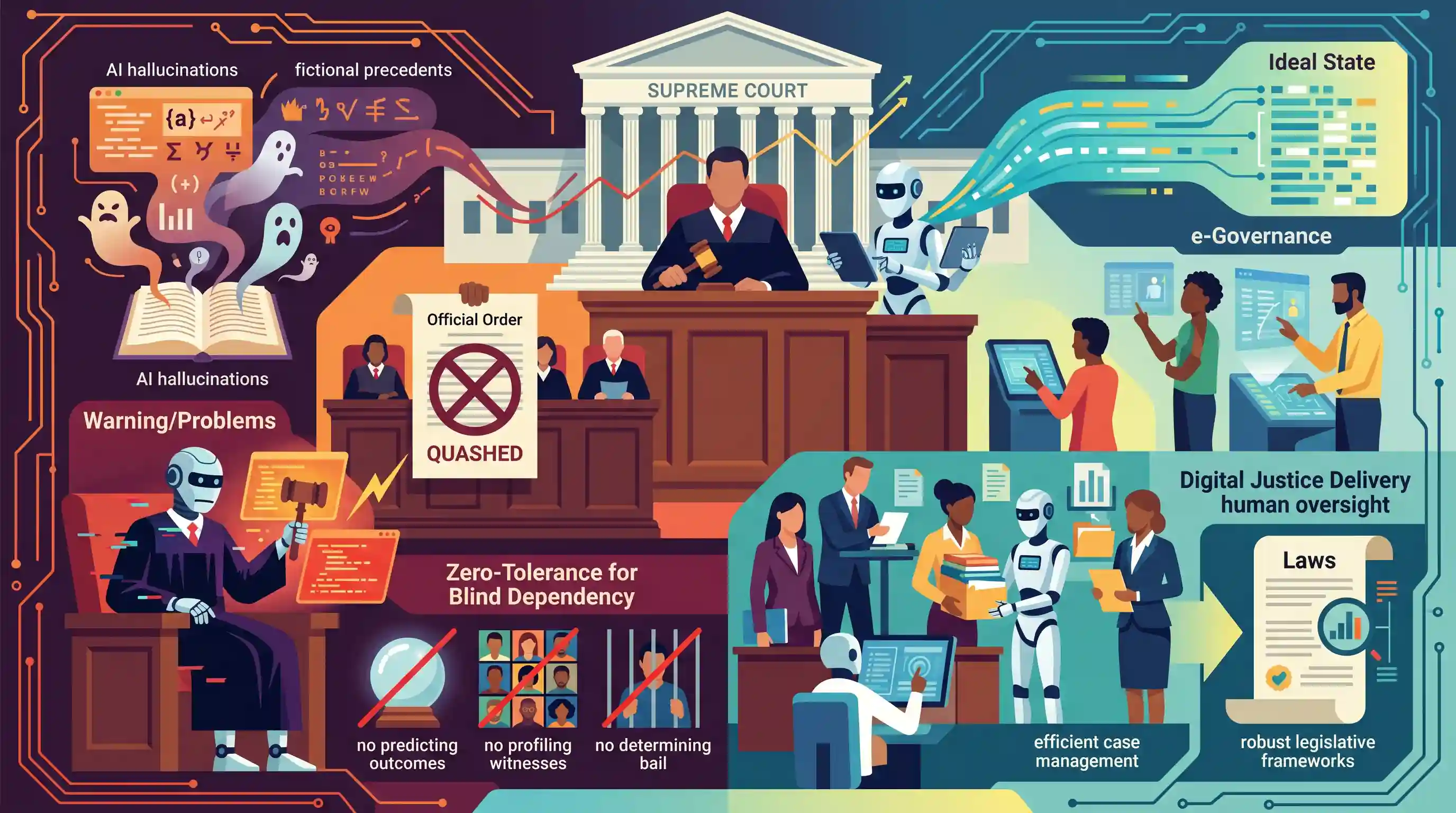
Chief Justice of India Surya Kant has emphasized that Artificial Intelligence (AI) must only serve as an assistant in the legal system and not as a judge. Amidst rising concerns over 'AI hallucinations'—including a recent NCLT order quashed by the Supreme Court for relying on fictional AI-generated precedents—the judiciary has advocated zero-tolerance for blind algorithmic dependency. Draft Supreme Court rules currently ban the use of AI for predicting judicial outcomes, profiling witnesses, or determining bail eligibility. The CJI urged for robust legislative frameworks and human oversight to ensure technology enhances, rather than disrupts, access to justice.
Key Points
- CJI’s Stance on AI: Chief Justice Surya Kant clarified that the role of Artificial Intelligence (AI) in the legal ecosystem must be strictly assistive (such as procedural convenience, legal research, case summarisation, and translation) and never adjudicatory.
- The Hazard of AI Hallucinations: The Supreme Court recently quashed a tribunal (NCLT) order that relied on fictitious, AI-generated case citations (including a fake case titled 'Mercy versus Mankind'), warning that blind reliance on machine intelligence is 'catastrophic' to the judicial process.
- Draft Supreme Court Rules: The draft SC rules explicitly prohibit the deployment of AI for deciding actual judicial outcomes, witness profiling, or evaluating bail eligibility to ensure algorithmic bias does not compromise constitutional liberties.
- Boundary of Justice and Discretion: AI can triage disputes, organise evidence, or translate documents. However, the moment it begins to weigh the equities of one party against another, it enters the domain of human judgment, which algorithms do not have the authority or capability to perform.
- Need for Legislative and Human Oversight: The CJI stressed that technological adoption cannot be resisted, but must be accompanied by human oversight and legislative clarity to prevent algorithms from narrowing access to justice, especially for vulnerable sections.
Important Terms
Draft Regulations for Use of Artificial Intelligence in Courts, 2026

A proposed regulatory framework by the Supreme Court’s AI Committee governing AI integration in Indian courts. It mandates human primacy, bans AI-driven adjudication/risk-scoring, and requires lawyers to disclose AI-assisted filings.
UPSC context
GS Paper II (Judiciary & e-Governance): Tests analytical skills regarding judicial reforms, ethical technology deployment, and access to digital justice.
National Company Law Tribunal (NCLT)
A quasi-judicial body in India constituted under the Companies Act, 2013, to adjudicate corporate disputes, insolvency resolution processes, and company law matters.
UPSC context
GS Paper II (Quasi-judicial bodies) & GS III (Insolvency): Evaluates knowledge of corporate governance, insolvency resolution, and judicial oversight of tribunals.
AI Hallucination
The phenomenon where generative AI models produce incorrect, fabricated, or non-existent information—such as fake legal precedents—posing a critical threat to the integrity of judicial processes.
UPSC context
GS Paper III (Technology Ethics) & GS Paper II (Judiciary): Tests awareness of technological risks, regulatory frameworks, and AI-driven challenges to the rule of law.
Arbitration Council of India (ACI)
A statutory body introduced under the Arbitration and Conciliation (Amendment) Act, 2019, tasked with grading arbitral institutions, accrediting professional arbitrators, and promoting institutional ADR in India.
UPSC context
GS Paper II (Statutory Bodies & Dispute Redressal): Assesses mechanisms designed to minimize litigation delays and establish India as a global arbitration hub.
Indian Institute of Arbitration and Mediation
A non-profit organization in India providing alternative dispute resolution services, professional training, and accreditation to promote institutional arbitration, mediation, and dispute management.
UPSC context
GS Paper II (Judiciary & ADR): Tests mechanisms to resolve case pendency, legal reforms, and enhance India's profile as a global arbitration hub.
Supreme Court of India
The highest judicial forum and final court of appeal under the Constitution of India, serving as the supreme defender of fundamental rights and legal interpreter.
UPSC context
GS Paper II (Judiciary): Essential core syllabus topic evaluating the powers, jurisdiction, constitutional role, and recent technological integration of the apex court.
Prelims Trap
The draft Supreme Court guidelines of 2026 completely ban the use of AI tools like SUPACE and SUVAS in judicial proceedings.
The draft rules only prohibit adjudicatory, profiling, and predictive AI. Assistive AI tools for legal research (SUPACE) and translation (SUVAS) are actively promoted.
Static Concepts Connected
What is the constitutional basis of the Supreme Court's power to make rules?
- Article 145: Under Article 145, the Supreme Court has the power to make rules regulating the court's general practice and procedure.
- Presidential Approval: Any rules made by the Supreme Court are subject to parliamentary laws and require the approval of the President of India.
- Functional Scope: The rules govern key areas such as conditions for practicing, appeals, constitutional benches, and modern electronic procedures.
How does automated decision-making conflict with the constitutional mandate of Article 21?
- Due Process: Article 21 guarantees a fair, just, and reasonable procedure, which inherently demands human application of mind and subjective discretion.
- Black-Box Problem: Machine learning algorithms suffer from a lack of explainability, which violates the principles of natural justice and the right to a reasoned judicial order.
Cross-Topic Patterns
Algorithmic Bias + Right to Equality
Automated profiling or bail evaluation tools risk perpetuating socio-economic biases in data, directly violating the right to equality and equal protection under Article 14.
e-Courts Phase-III + Federal Finance
The ₹7,210 crore centrally sponsored e-Courts scheme tests fiscal federalism, as states must co-fund and maintain digital infrastructure initiated by central judicial policy.

Mains 2026 is highly likely to contrast the efficiency gains of e-Courts Phase-III with the constitutional risks of AI-driven adjudication.
Linked PYQs · 3
Linked PYQs · 3
- 2024MainsGS2
e-governance is not just about the routine application of digital technology in service delivery process. It is as much about multifarious interactions for ensuring transparency and accountability. In this context evaluate the role of the 'Interactive Service Model' of e-governance.
- 2023MainsGS2
e-governance, as a critical tool of governance, has ushered in effectiveness, transparency and accountability in governments. What inadequacies hamper the enhancement of these features ?
- 2023MainsGS3
Introduce the concept of Artificial Intelligence (AI). How does Al help clinical diagnosis? Do you perceive any threat to privacy of the individual in the use of Al in healthcare?
