Social Media Intermediary Accountability and Political Speech
Source:The Hindu ↗
Why It Matters
The incident underscores the tension between social media platform guidelines and political freedom of expression. It is relevant for GS Paper II (Polity and Governance - Freedom of Speech) and GS Paper III (Role of Social Media and Cybersecurity), illustrating the practical challenges of intermediate liability and political accountability in the digital age.
Summary
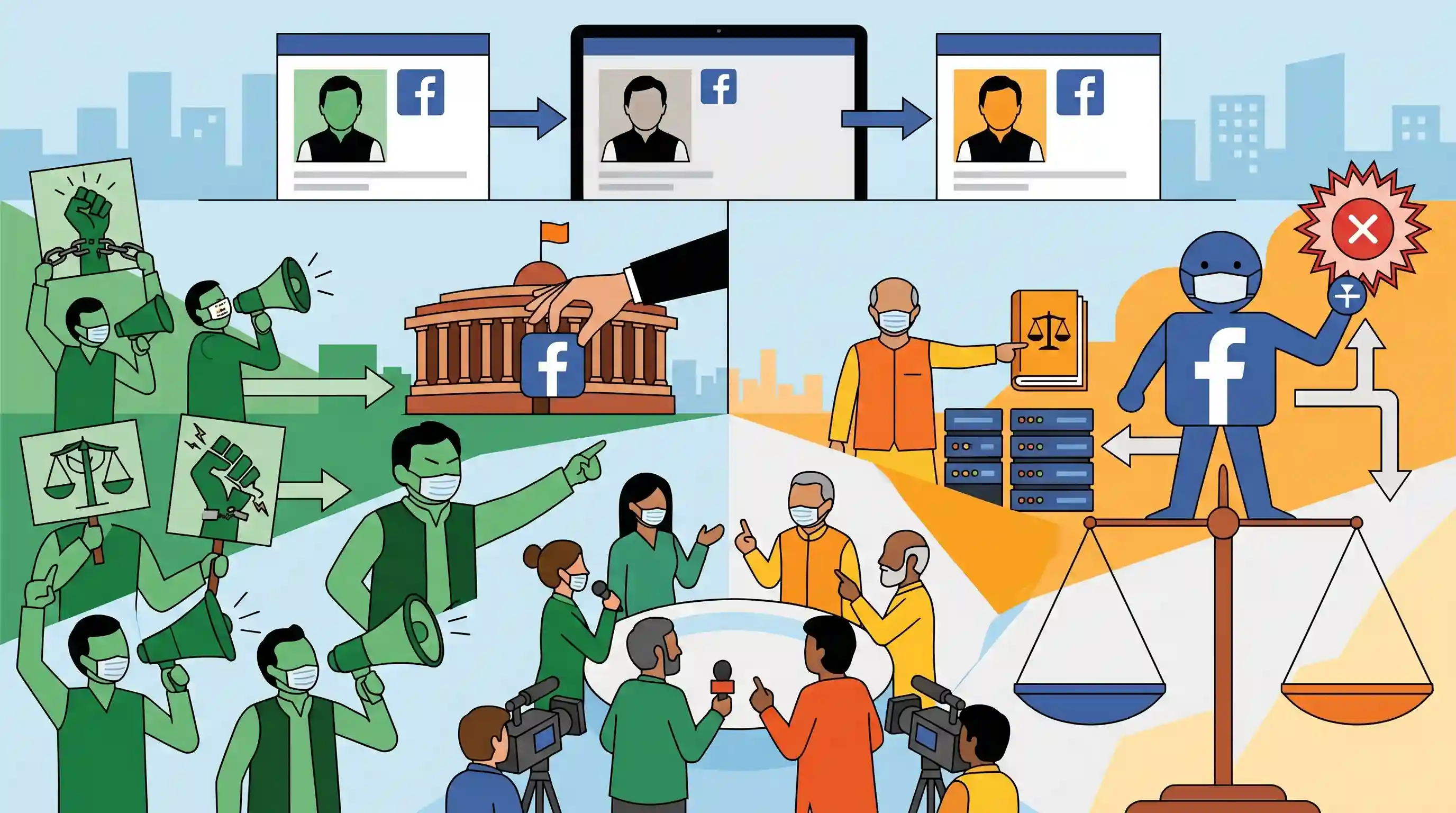
The official Facebook account of Samajwadi Party leader Akhilesh Yadav was temporarily suspended and later restored, prompting political controversy. While the Union Minister for Electronics and IT clarified that Facebook independently took the action in response to an abusive post, the SP alleged it was an orchestrated move by the ruling BJP to suppress opposition voices. The incident highlights ongoing debates surrounding freedom of expression, political censorship, and the regulation of social media intermediaries.
Key Points
- Samajwadi Party president Akhilesh Yadav's official Facebook account was briefly suspended and subsequently restored without clear initial explanation.
- Union Minister Ashwini Vaishnaw stated the suspension was initiated by Facebook due to a "very abusive post," denying any government involvement.
- Meta confirmed the page was restored after the issue was escalated to them.
- The SP leadership alleged the suspension was directed by the BJP government, describing it as an "undeclared emergency" aimed at suppressing opposition voices.
Important Terms
Social Media Intermediaries

Entities defined under the IT Rules 2021 that facilitate online interaction, content creation, and sharing among users, like Facebook and X.
UPSC context
GS Paper III (Internal Security/Cybersecurity) and GS Paper II (Regulatory Governance/Digital Rights).
Freedom of Speech and Expression
A fundamental right under Article 19(1)(a) guaranteeing citizens the liberty to express opinions, though subject to "reasonable restrictions" like public order and decency.
UPSC context
GS Paper II (Polity/Constitution); tests understanding of civil liberties and judicial interpretations.
IT Rules, 2021
Framework under the Information Technology Act governing digital platforms, mandating due diligence, grievance redressal, and the removal of unlawful content.
UPSC context
GS Paper II (Government Policies) and Paper III (Technology); focuses on digital sovereignty and media ethics.
Samajwadi Party
A prominent regional political party in Uttar Pradesh, founded in 1992, based on socialist principles; it is a major player in India's federal politics.
UPSC context
GS Paper II (Political Parties/Federalism); tests knowledge of party systems and electoral politics.
Safe Harbour Provision
Legal protection under Section 79 of the IT Act, 2000, exempting intermediaries from liability for third-party content provided they comply with government rules.
UPSC context
GS Paper III (IT & Computers/Cyber Security); relates to intermediary accountability and platform regulation.
Grievance Redressal Mechanism
A mandatory three-tier system under the IT Rules 2021 for resolving user complaints regarding content, involving officers and government-appointed appellate committees.
UPSC context
GS Paper II (Governance/Accountability); concerns citizen-centric administration and dispute resolution in the digital age.
Prelims Trap
Social media intermediaries can only remove content or suspend accounts if directed by the government under Section 69A of the IT Act.
Platforms can independently suspend accounts for violating their own terms of service or community guidelines, completely independent of any government blocking order.
Static Concepts Connected
What is the 'Safe Harbour' provision for social media intermediaries?
- Section 79: Section 79 of the IT Act, 2000 grants intermediaries immunity from legal liability for third-party user content hosted on their platforms.
- Conditional immunity: The protection is contingent upon platforms acting merely as neutral hosts and strictly observing 'due diligence' as prescribed under the IT Rules.
- Shreya Singhal caveat: The Supreme Court clarified that platforms must take down content upon receiving 'actual knowledge' via a court order or government notification.
What is the role of Grievance Appellate Committees (GACs)?
- Creation: Established under the IT (Amendment) Rules, 2022, GACs are bodies entirely appointed by the Central Government.
- Core function: They serve as an appellate mechanism for users dissatisfied with content moderation decisions made by a platform's internal grievance officer.
- Compliance: Orders passed by the Grievance Appellate Committees are legally binding on the social media intermediaries.
Cross-Topic Patterns
Fundamental Rights vs Private Platforms
The incident highlights the debate on the horizontal application of Article 19(1)(a)—whether constitutional free speech guarantees should be enforceable against private tech monopolies like Meta.
Voluntary Code of Ethics in Elections
Connects to how the Election Commission coordinates with platforms via the Voluntary Code of Ethics to regulate abusive posts and ensure a level playing field during campaigns.

Questions on IT Rules in 2026 will likely test the distinction between government blocking powers (Sec 69A) and platform moderation.
Linked PYQs · 2
Linked PYQs · 2
- 2014MainsGS2
What do you understand by the concept "freedom of speech and expression"? Does it cover hate speech also ? Why do the films in India stand on a slightly different plane from other forms of expression ? Discuss.
- 2024MainsGS3
Social media and encrypting messaging services pose a serious security challenge. What measures have been adopted at various levels to address the security implications of social media? Also suggest any other remedies to address the problem.
