NSG Cover Withdrawal and VVIP Security Politics
Source:The Hindu ↗
Why It Matters
The provision and withdrawal of VVIP security cover in India repeatedly raise questions about the impartiality of intelligence assessments and the misuse of executive power against political opponents. It is relevant to GS Paper 2 (Governance, Democratic Politics) and touches upon GS Paper 3 (Various Security Forces and Agencies).
Summary
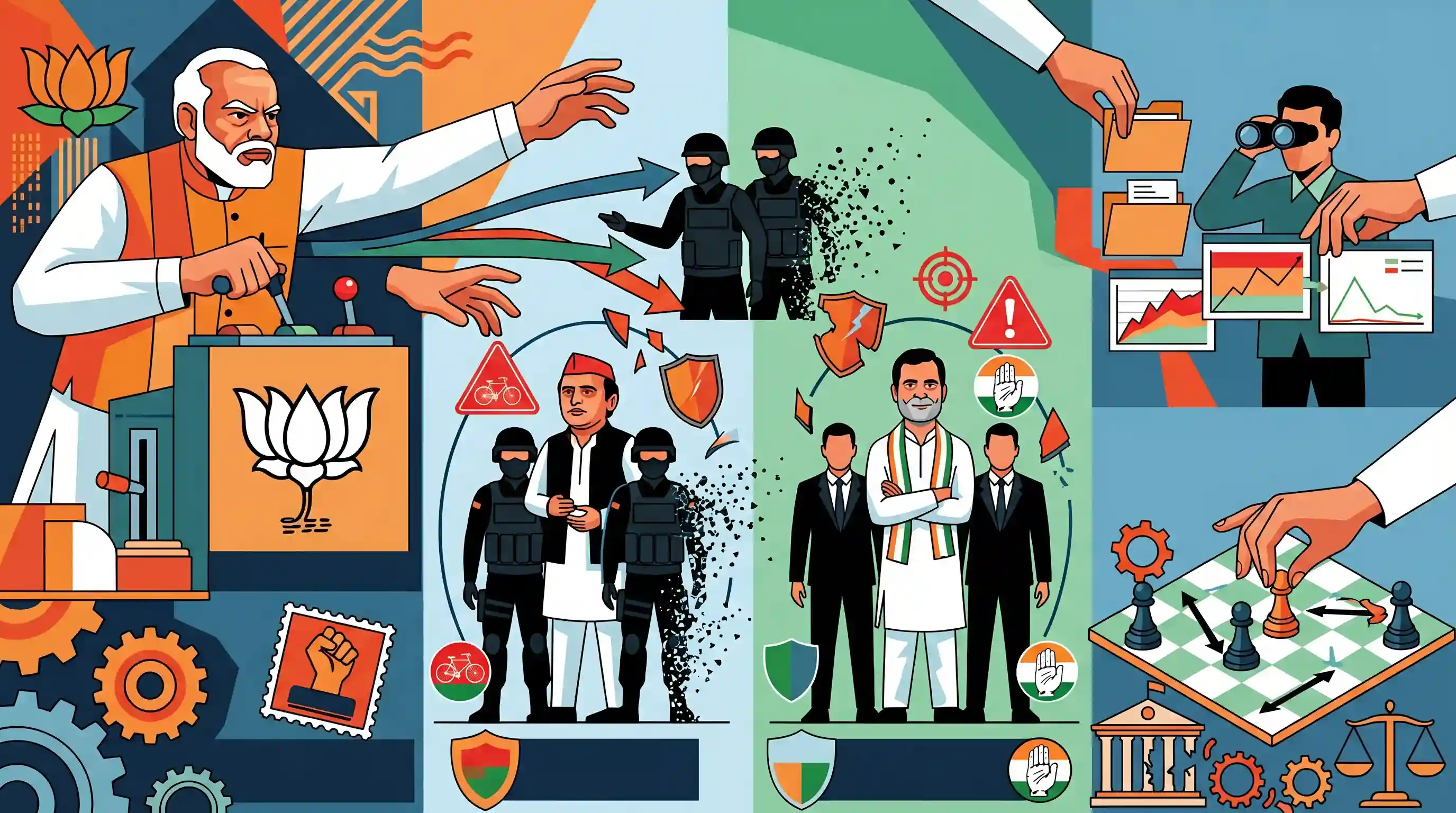
Samajwadi Party President Akhilesh Yadav has criticized the BJP-led central government for withdrawing his National Security Guard (NSG) cover, alleging that the move is a politically motivated attempt to compromise his safety. Drawing parallels to the earlier removal of Congress leader Rahul Gandhi's SPG protection, Yadav accused the ruling party of weaponizing VIP security protocols and manipulating intelligence threat assessments to target opposition figures.
Key Points
- Samajwadi Party leader Akhilesh Yadav's 'Z-plus' NSG security cover was removed by the central government.
- Yadav accused the BJP government of weaponizing VVIP security cover to intimidate political opponents and compromise their safety.
- The incident parallels the previous withdrawal of Special Protection Group (SPG) cover for Congress leader Rahul Gandhi.
- The controversy underscores concerns about the objectivity of threat assessments by intelligence agencies and the politicization of state security apparatus.
Important Terms
National Security Guard (NSG)

An elite counter-terrorism unit under the Ministry of Home Affairs, established in 1984. Known as "Black Cats," it specializes in anti-hijacking and hostage rescue, though it is being phased out of VIP security duties.
UPSC context
GS Paper III (Internal Security); tests knowledge of diverse security forces and their specific mandates.
Special Protection Group (SPG)
An elite agency providing proximate security to the Prime Minister of India. Following a 2019 amendment, its cover is restricted to the sitting Prime Minister and immediate family residing at their official residence.
UPSC context
GS Paper II (Governance); relevant for understanding executive protection protocols and legislative amendments.
Z+ Security Category
The highest tier of security protection in India (below SPG), involving approximately 55 personnel. It is granted to high-risk individuals based on threat assessments by central intelligence agencies.
UPSC context
GS Paper III (Internal Security); relates to security categorization and the management of internal threats.
Intelligence Bureau (IB)
India’s premier internal intelligence agency under the Ministry of Home Affairs. It conducts the threat assessments that determine the level of security cover provided to political and public figures.
UPSC context
GS Paper III (Internal Security); tests understanding of intelligence gathering and domestic stability.
Ministry of Home Affairs (MHA)
The central ministry responsible for internal security, police forces, and border management. It exercises administrative control over the NSG and determines the level of protection for various individuals.
UPSC context
GS Paper II (Polity); essential for understanding the administrative structure of India’s security apparatus.
Prelims Trap
The Special Protection Group (SPG) provides permanent security cover to the serving Prime Minister and all former Prime Ministers.
The SPG (Amendment) Act 2019 strictly limits SPG cover to the serving PM and immediate family at their official residence. Former PMs only receive it for 5 years post-tenure.
Static Concepts Connected
Which agencies handle VIP security after the withdrawal of NSG?
- CAPFs' Role: CRPF and CISF's specialized VIP security wings primarily handle Z and Z-plus security following the MHA's decision to relieve the NSG from VIP duties.
- NSG's Core Mandate: Established in 1986, the NSG ('Black Cats') was designed exclusively as a federal counter-terrorism and anti-hijacking force, not for routine VIP protection.
- Threat Assessment: The MHA determines security tiers (X, Y, Z, Z+) based on threat perception inputs from the Intelligence Bureau (IB) and R&AW.
What is the legal standing and accountability of Indian intelligence agencies?
- No Statutory Backing: Agencies like the Intelligence Bureau (IB) and R&AW operate under executive orders and lack a specific statutory framework governing their powers and functions.
- Executive Oversight: They function under the executive control of the MHA and Cabinet Secretariat, lacking the direct parliamentary committee scrutiny seen in other democracies.
Cross-Topic Patterns
Politicization of Central Agencies
Connects the discretionary allocation of VIP security with broader GS2 themes on the alleged misuse of executive-controlled bodies (like CBI, ED) against opposition figures and the need for institutional autonomy.
Internal Security Force Modernization
Freeing the NSG from VIP duties aligns with the post-26/11 defense modernization push, ensuring elite forces focus strictly on counter-terrorism, anti-hijacking, and securing vital installations (GS3).

Expect a Prelims statement comparing the statutory mandates of NSG, SPG, and CAPFs, focusing specifically on the 2019 SPG Amendment limits.
Linked PYQs · 2
Linked PYQs · 2
- 2022MainsGS2
“While the national political parties in India favour centralisation, the regional parties are in favour of State autonomy.” Comment.
- 2023PrelimsGS1
With reference to Home Guards, consider the following statements: 1. Home Guards are raised under the Home Guards Act and Rules of the Central Government. 2. The role of the Home Guards is to serve as an auxiliary force to the police in maintenance of internal security. 3. To prevent infiltration on the international border/coastal areas, the Border Wing Home Guards Battalions have been raised in some States. How many of the above statements are correct?
