Akashvani Kolkata Celebrates Centenary of Broadcasting Heritage
Source:the-statesman ↗
Why It Matters
Akashvani (All India Radio) has played an instrumental role in shaping modern India's cultural and political consciousness. The centenary of its Kolkata station highlights the institution's historical significance, particularly its archives preserving the voices of iconic figures like Tagore and Bose. Such cultural and historical milestones are highly relevant for the WBCS Prelims under Modern Indian History and Culture sections.
Summary
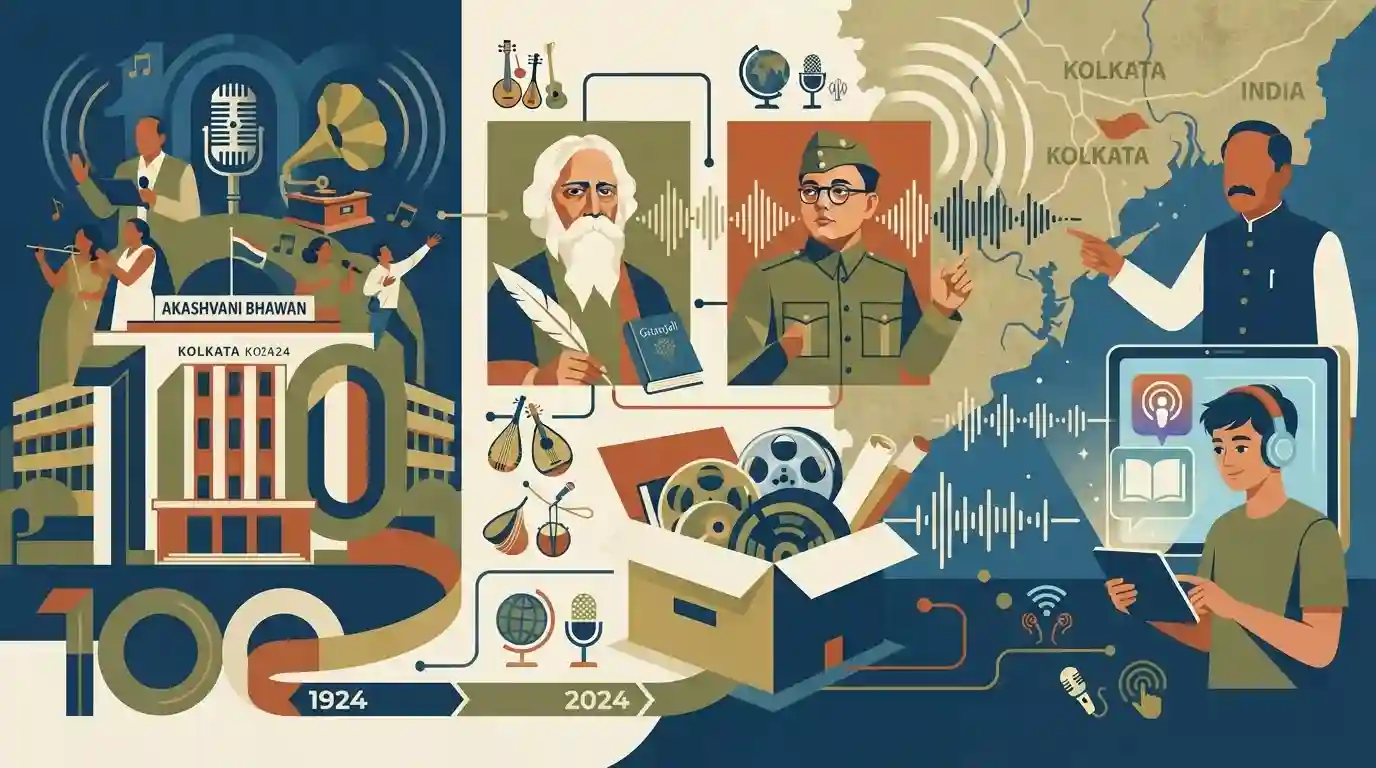
Akashvani Kolkata recently celebrated its centenary, marking 100 years of broadcasting. The milestone was observed through cultural programmes and reminiscences from veteran broadcasters. Serving as a crucial cultural and informational hub, the station holds rich archives featuring historic speeches by prominent figures like Rabindranath Tagore and Netaji Subhas Chandra Bose. Union Minister Sukanta Majumdar highlighted the importance of making these invaluable archives accessible to the new generation.
Key Points
- Akashvani Kolkata celebrated 100 years of broadcasting in India with cultural programmes and veteran recollections.
- The station possesses invaluable audio archives, including speeches of Rabindranath Tagore and Netaji Subhas Chandra Bose.
- Veterans shared memories of the station's pivotal role in disseminating culture and information throughout Bengal.
- Union Minister of State for Information and Broadcasting, Sukanta Majumdar, acknowledged the milestone and its heritage significance.
Important Terms
Akashvani Kolkata

A historic regional broadcasting station that commenced its first official Bengali broadcast on August 26, 1927. It serves as a vital cultural and informational hub, preserving rare historic archives of prominent Indian figures.
UPSC context
Relevant for WBCS Paper III (Modern Indian History) and Paper IV (Current Affairs), highlighting Bengal's media evolution and cultural heritage.
All India Radio
India's national public radio broadcaster, officially named Akashvani in 1956. Established in 1936 from the Indian State Broadcasting Service, it played a crucial unifying role in modern Indian history and operates under Prasar Bharati.
UPSC context
Important for WBCS Paper III (Modern Indian History) and Paper V (Polity), covering the development of mass media.
Rabindranath Tagore
A visionary Bengali polymath, poet, and Nobel laureate who fundamentally reshaped Bengali literature and music. His historic voice recordings preserved by Akashvani Kolkata represent an invaluable part of India's intellectual heritage.
UPSC context
Crucial for WBCS Paper III (Modern Indian History), testing knowledge of prominent historical personalities and Bengal's cultural renaissance.
Netaji Subhas Chandra Bose
A prominent leader of the Indian independence movement who led the Indian National Army. His historic speeches, archived by Akashvani Kolkata, remain a testament to his crucial role in India's freedom struggle.
UPSC context
Essential for WBCS Paper III (Indian National Movement), focusing on key freedom fighters and their ideological contributions.
Prelims Trap
All India Radio was officially named Akashvani at its inception in 1927 by the British.
Broadcasting began privately in 1927. It became AIR in 1936. 'Akashvani' was coined by Tagore in 1939 and officially adopted as the sole on-air name only in 1956.
Static Concepts Connected
Which radio networks actively aided the Indian freedom struggle against British rule?
- Azad Hind Radio: Launched by Subhas Chandra Bose in 1942 in Germany to broadcast anti-imperialist propaganda to Indians and mobilize support.
- Congress Radio: An underground broadcasting station famously organized by Usha Mehta during the 1942 Quit India Movement to bypass British press censorship.
What were Rabindranath Tagore's notable socio-political and cultural interventions in Modern India?
- Rakhi Bandhan: Pioneered the festival in 1905 to foster Hindu-Muslim solidarity against Lord Curzon's Partition of Bengal.
- Opposed Cloth Burning: Famously opposed the burning of foreign clothes during the Non-Cooperation Movement, calling it a "senseless waste" of resources.
- Naming Akashvani: Coined the term "Akashvani" (voice from the sky) in a 1939 poem, which was later adopted as the official on-air name for AIR in 1956.
Cross-Topic Patterns
Media censorship vs. Nationalist Radio
Historicizing Akashvani links to colonial media censorship, contrasting state-controlled ISBS/AIR with underground nationalist networks like Congress Radio and Azad Hind Radio.
Tagore's institutional and cultural footprint
Tagore’s legacy in WBCS often extends beyond literature to his institutional contributions (Visva-Bharati, Akashvani naming) and distinct political stances against contemporary movements.

Expect chronological ordering of broadcasting milestones (IBC 1927, AIR 1936) or statements linking Tagore to the coinage of Akashvani.
Linked PYQs · 2
Linked PYQs · 2
- 2024WBCS_PRELIMSGS1
Who opposed the burning of foreign clothes during the Non-Cooperation Movement?
- 2022WBCS_PRELIMSGS1
Who pioneered ‘Rakhi Bandhan’ festival during partition of Bengal?
