आकाश-एनजी सतह से हवा में मार करने वाली मिसाइल प्रणाली के उपयोगकर्ता मूल्यांकन परीक्षण
स्रोत:इंडियन एक्सप्रेस ↗
क्यों मायने रखता है
रक्षा आधुनिकीकरण और आत्मनिर्भरता (आत्मनिर्भर भारत) GS3 के महत्वपूर्ण विषय हैं। विशिष्ट मिसाइल विशेषताओं (सतह से हवा में मार करने वाली, क्रूज बनाम बैलिस्टिक, प्रणोदन के प्रकार) को समझना Prelims के लिए अत्यधिक प्रासंगिक है, जबकि स्वदेशीकरण में DRDO की भूमिका का व्यापक विषय राष्ट्रीय सुरक्षा पर Mains के उत्तरों के लिए महत्वपूर्ण है।
सारांश
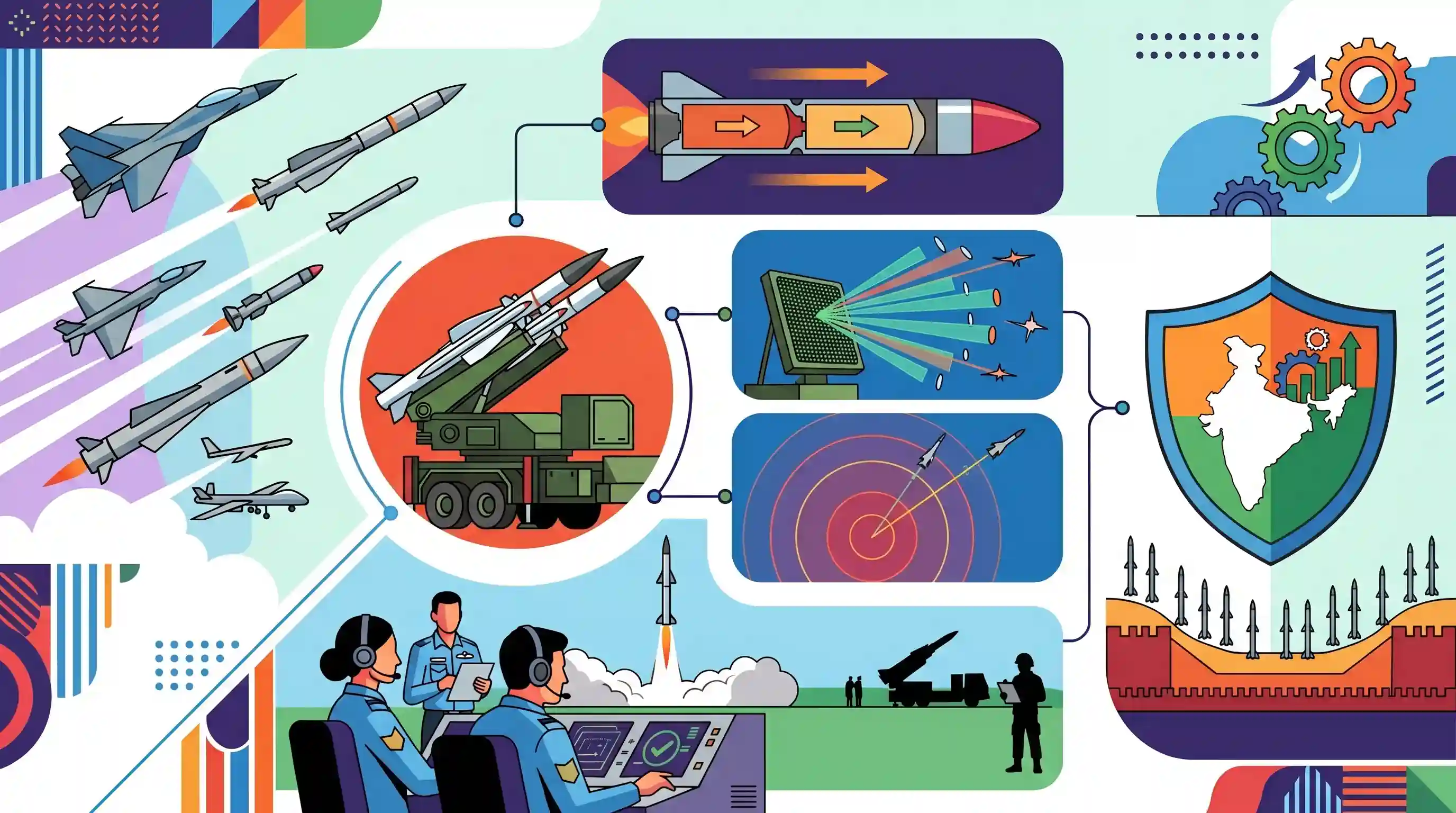
The Defence Research and Development Organisation (DRDO) has successfully completed the user evaluation trials of the Akash-NG (New Generation) Surface-to-Air Missile (SAM) system. Conducted by the end-users (such as the Indian Air Force), these trials validate the weapon's operational capabilities under field conditions, marking the final stage before formal induction and serial production. The Akash-NG features significant upgrades over its predecessor, including a two-pulse solid rocket motor for enhanced kinetic energy during the terminal phase, an Active Electronically Scanned Array (AESA) radar, and an extended range. This successful trial bolsters India's 'Aatmanirbhar Bharat' initiative in defense manufacturing and strengthens the country's air defense network against modern, agile aerial threats.
मुख्य बिंदु
- The Akash-NG is a new-generation Surface-to-Air Missile (SAM) system developed by DRDO to intercept highly maneuverable, low-radar-cross-section aerial threats.
- यूजर इवैल्यूएशन ट्रायल परीक्षण का वह अंतिम चरण है जिसे अंतिम उपयोगकर्ताओं (सशस्त्र बलों) द्वारा औपचारिक रूप से शामिल किए जाने से पहले वास्तविक परिस्थितियों में प्रणाली की परिचालन क्षमता को सत्यापित करने के लिए आयोजित किया जाता है।
- Technological upgrades in the Akash-NG include a two-pulse solid rocket motor for extended range (up to ~80 km) and an Active Electronically Scanned Array (AESA) radar for superior target tracking.
- सफल परीक्षण रक्षा PSUs द्वारा सीरियल प्रोडक्शन का मार्ग प्रशस्त करते हैं, जिससे भारत की स्वदेशी हवाई रक्षा क्षमताओं को महत्वपूर्ण बढ़ावा मिलेगा।
महत्वपूर्ण शब्द
आत्मनिर्भर भारत

विभिन्न क्षेत्रों में भारत को आत्मनिर्भर बनाने के लिए 2020 में शुरू किया गया एक प्रमुख मिशन, जो विशेष रूप से आयात निर्भरता कम करने के लिए स्वदेशी रक्षा विनिर्माण और R&D को प्राथमिकता देता है।
UPSC context
GS Paper 3 (अर्थव्यवस्था/रक्षा); रणनीतिक स्वायत्तता प्राप्त करने और घरेलू विनिर्माण को बढ़ावा देने के लिए नीतिगत ढांचों की समझ का परीक्षण करता है।
एकीकृत निर्देशित मिसाइल विकास कार्यक्रम (IGMDP)
A landmark 1983 program led by Dr. APJ Abdul Kalam that developed five core indigenous missile systems: Prithvi, Agni, Trishul, Akash, and Nag.
UPSC context
GS Paper 3 (Science & Tech); crucial for questions on India's historical milestones in missile technology and self-reliance.
रक्षा अनुसंधान एवं विकास संगठन (DRDO)
The premier research agency under the Ministry of Defence responsible for the indigenous design and development of state-of-the-art military hardware and systems.
UPSC context
GS Paper 3 (Science & Tech); tests awareness of institutional roles in indigenization and military R&D.
भारत डायनेमिक्स लिमिटेड (BDL)
A Defence Public Sector Undertaking (PSU) serving as the lead manufacturing hub and integrator for India's guided missile systems and torpedoes.
UPSC context
GS Paper 3 (Economy/Manufacturing); relevant for topics concerning the military-industrial complex and public sector contributions to defense.
भारत इलेक्ट्रॉनिक्स लिमिटेड (BEL)
A prominent Defence PSU specializing in advanced aerospace and defense electronics, including radars, sonar, and electronic warfare systems for the armed forces.
UPSC context
GS पेपर 3 (विज्ञान और तकनीक/स्वदेशीकरण); रक्षा प्रौद्योगिकी इलेक्ट्रॉनिक्स में विशेषीकृत PSUs की भूमिका पर ध्यान केंद्रित करता है।
Indian Air Force (IAF)
The aerial service branch of the Indian Armed Forces tasked with securing airspace; acts as the primary end-user validating systems like Akash-NG.
UPSC context
GS Paper 3 (Security/Defense Technology); tests understanding of end-user validation and operational requirements of defense systems.
प्रारंभिक ट्रैप
Akash-NG uses an advanced Ramjet propulsion system for extended range.
जहां पुराने आकाश मिसाइल में रामजेट इंजन का उपयोग किया जाता था, वहीं आकाश-NG टर्मिनल चरण के दौरान उच्च गतिज ऊर्जा बनाए रखने के लिए टू-पल्स सॉलिड रॉकेट मोटर का उपयोग करता है।
संबंधित अवधारणाएँ
एकीकृत निर्देशित मिसाइल विकास कार्यक्रम (IGMDP) क्या है?
- उत्पत्ति: डॉ. ए.पी.जे. अब्दुल कलाम द्वारा परिकल्पित और मिसाइल तकनीक में आत्मनिर्भरता प्राप्त करने के लिए 1983 में शुरू किया गया।
- मुख्य मिसाइलें: Developed five core missile systems (PATNA): Prithvi, Agni, Trishul, Nag, and Akash.
- Status: Officially concluded in 2008 after DRDO successfully achieved the strategic objectives for indigenous missile development.
What is an Active Electronically Scanned Array (AESA) radar?
- कार्यप्रणाली: इसमें कई छोटे सॉलिड-स्टेट ट्रांसमिट/रिसीव मॉड्यूल का उपयोग किया जाता है, जो मैकेनिकल एंटीना को घुमाने के बजाय रेडियो तरंगों को इलेक्ट्रॉनिक रूप से निर्देशित करते हैं।
- Advantages: पारंपरिक रडार की तुलना में तेज़ स्कैनिंग, एक साथ कई लक्ष्यों की ट्रैकिंग और इलेक्ट्रॉनिक वारफेयर (जैमिंग) के प्रति बेहतर प्रतिरोध प्रदान करता है।
अंतर-विषय पैटर्न
Defense Exports & Strategic Diplomacy
Akash-NG's success bolsters India's defense export portfolio, bridging 'Aatmanirbhar Bharat' with strategic diplomacy, particularly following original Akash exports to Armenia and interest from Southeast Asia.
Counter-Drone & Low-RCS Aerial Threats
AESA radar integration highlights the shift in air defense priorities toward countering highly maneuverable, low-radar-cross-section threats like drone swarms and loitering munitions.

Expect a multi-statement Prelims question contrasting Akash vs. Akash-NG propulsion systems and AESA radar capabilities.
संबद्ध PYQ · 3
संबद्ध PYQ · 3
- 2023PrelimsGS1
Consider the following statements: 1. Ballistic missiles are jet-propelled at subsonic speeds throughout their flights, while cruise missiles are rocket-powered only in the initial phase of flight. 2. Agni-V is a medium-range supersonic cruise missile, while BrahMos is a solid-fuelled intercontinental ballistic missile. Which of the statements given above is/are correct?
- 2014PrelimsGS1
With reference to Agni-IV Missile, which of the following statements is/are correct? 1. It is a surface-to-surface missile. 2. It is fuelled by liquid propellant only. 3. It can deliver one-tonne nuclear warheads about 7500 km away. Select the correct answer using the code given below.
- 2007PrelimsGS1
Consider the following statements: 1. In November, 2006, DRDO successfully conducted the interception test using Prithvi-II missile. 2. Prithvi-II is a surface-to-surface missile and can be deployed to guard the metros against air attacks. Which of the statements given above is/are correct?
