Akash NG Surface to Air Missile System User Evaluation Trials
Source:Indian Express ↗
Why It Matters
Defense modernization and self-reliance (Aatmanirbhar Bharat) are critical themes in GS3. Understanding specific missile characteristics (Surface-to-Air, Cruise vs. Ballistic, propulsion types) is highly relevant for Prelims, while the broader theme of DRDO's role in indigenization is crucial for Mains answers on national security.
Summary
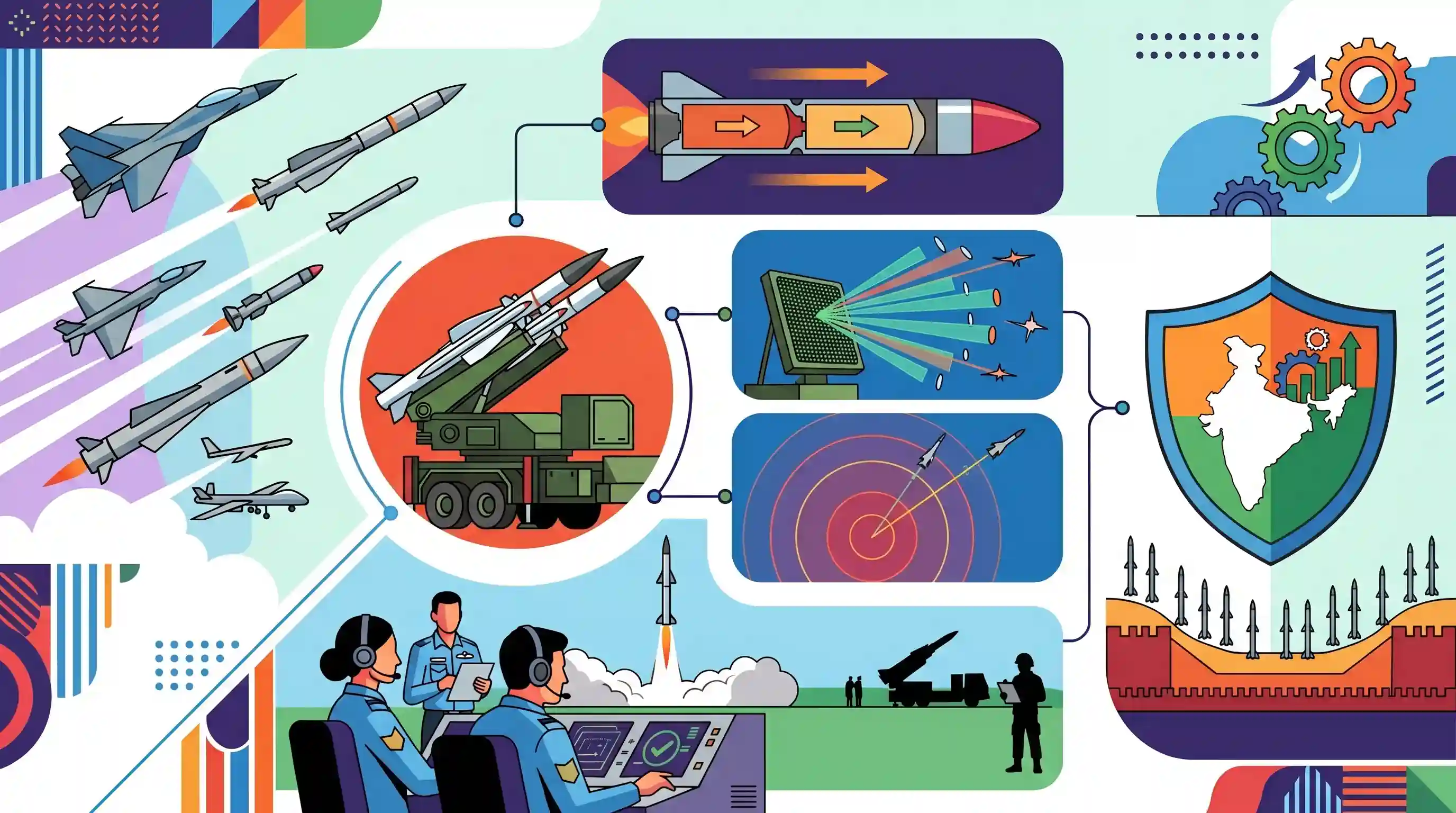
The Defence Research and Development Organisation (DRDO) has successfully completed the user evaluation trials of the Akash-NG (New Generation) Surface-to-Air Missile (SAM) system. Conducted by the end-users (such as the Indian Air Force), these trials validate the weapon's operational capabilities under field conditions, marking the final stage before formal induction and serial production. The Akash-NG features significant upgrades over its predecessor, including a two-pulse solid rocket motor for enhanced kinetic energy during the terminal phase, an Active Electronically Scanned Array (AESA) radar, and an extended range. This successful trial bolsters India's 'Aatmanirbhar Bharat' initiative in defense manufacturing and strengthens the country's air defense network against modern, agile aerial threats.
Key Points
- The Akash-NG is a new-generation Surface-to-Air Missile (SAM) system developed by DRDO to intercept highly maneuverable, low-radar-cross-section aerial threats.
- User evaluation trials are the final phase of testing conducted by the end-users (armed forces) to validate the system's operational capability in real-world scenarios before formal induction.
- Technological upgrades in the Akash-NG include a two-pulse solid rocket motor for extended range (up to ~80 km) and an Active Electronically Scanned Array (AESA) radar for superior target tracking.
- The successful trials pave the way for serial production by defense PSUs, significantly boosting India's indigenous air defense capabilities.
Important Terms
Aatmanirbhar Bharat

A flagship mission launched in 2020 to make India self-reliant across sectors, specifically prioritizing indigenous defense manufacturing and R&D to reduce import dependency.
UPSC context
GS Paper 3 (Economy/Defense); tests understanding of policy frameworks for achieving strategic autonomy and boosting domestic manufacturing.
Integrated Guided Missile Development Programme (IGMDP)
A landmark 1983 program led by Dr. APJ Abdul Kalam that developed five core indigenous missile systems: Prithvi, Agni, Trishul, Akash, and Nag.
UPSC context
GS Paper 3 (Science & Tech); crucial for questions on India's historical milestones in missile technology and self-reliance.
Defence Research and Development Organisation (DRDO)
The premier research agency under the Ministry of Defence responsible for the indigenous design and development of state-of-the-art military hardware and systems.
UPSC context
GS Paper 3 (Science & Tech); tests awareness of institutional roles in indigenization and military R&D.
Bharat Dynamics Limited (BDL)
A Defence Public Sector Undertaking (PSU) serving as the lead manufacturing hub and integrator for India's guided missile systems and torpedoes.
UPSC context
GS Paper 3 (Economy/Manufacturing); relevant for topics concerning the military-industrial complex and public sector contributions to defense.
Bharat Electronics Limited (BEL)
A prominent Defence PSU specializing in advanced aerospace and defense electronics, including radars, sonar, and electronic warfare systems for the armed forces.
UPSC context
GS Paper 3 (Science & Tech/Indigenization); focuses on the role of specialized PSUs in defense technology electronics.
Indian Air Force (IAF)
The aerial service branch of the Indian Armed Forces tasked with securing airspace; acts as the primary end-user validating systems like Akash-NG.
UPSC context
GS Paper 3 (Security/Defense Technology); tests understanding of end-user validation and operational requirements of defense systems.
Prelims Trap
Akash-NG uses an advanced Ramjet propulsion system for extended range.
While the legacy Akash missile used a ramjet engine, the Akash-NG employs a two-pulse solid rocket motor to maintain high kinetic energy during the terminal phase.
Static Concepts Connected
What is the Integrated Guided Missile Development Programme (IGMDP)?
- Origins: Conceived by Dr. A.P.J. Abdul Kalam and launched in 1983 to achieve self-reliance in missile technology.
- Core Missiles: Developed five core missile systems (PATNA): Prithvi, Agni, Trishul, Nag, and Akash.
- Status: Officially concluded in 2008 after DRDO successfully achieved the strategic objectives for indigenous missile development.
What is an Active Electronically Scanned Array (AESA) radar?
- Mechanism: Uses multiple small solid-state transmit/receive modules, steering radio waves electronically rather than rotating a mechanical antenna.
- Advantages: Offers faster scanning, simultaneous multi-target tracking, and superior resistance to electronic warfare (jamming) compared to traditional radars.
Cross-Topic Patterns
Defense Exports & Strategic Diplomacy
Akash-NG's success bolsters India's defense export portfolio, bridging 'Aatmanirbhar Bharat' with strategic diplomacy, particularly following original Akash exports to Armenia and interest from Southeast Asia.
Counter-Drone & Low-RCS Aerial Threats
AESA radar integration highlights the shift in air defense priorities toward countering highly maneuverable, low-radar-cross-section threats like drone swarms and loitering munitions.

Expect a multi-statement Prelims question contrasting Akash vs. Akash-NG propulsion systems and AESA radar capabilities.
Linked PYQs · 3
Linked PYQs · 3
- 2023PrelimsGS1
Consider the following statements: 1. Ballistic missiles are jet-propelled at subsonic speeds throughout their flights, while cruise missiles are rocket-powered only in the initial phase of flight. 2. Agni-V is a medium-range supersonic cruise missile, while BrahMos is a solid-fuelled intercontinental ballistic missile. Which of the statements given above is/are correct?
- 2014PrelimsGS1
With reference to Agni-IV Missile, which of the following statements is/are correct? 1. It is a surface-to-surface missile. 2. It is fuelled by liquid propellant only. 3. It can deliver one-tonne nuclear warheads about 7500 km away. Select the correct answer using the code given below.
- 2007PrelimsGS1
Consider the following statements: 1. In November, 2006, DRDO successfully conducted the interception test using Prithvi-II missile. 2. Prithvi-II is a surface-to-surface missile and can be deployed to guard the metros against air attacks. Which of the statements given above is/are correct?
