Ajnala Attack Accused Arrested at Indo Nepal Border
Source:Indian Express ↗
Why It Matters
This incident serves as a vital case study for the GS-3 Internal Security syllabus, specifically highlighting the operational challenges of managing India's porous borders (e.g., Indo-Nepal). It illustrates how non-state actors, radical secessionist elements (like Waris Punjab De), and foreign-based sympathizers exploit open borders, local logistics, and document forgery (such as fake Aadhaar and PAN cards) to compromise national security. It also demonstrates the critical role of Border Guarding Forces (SSB), interstate police coordination, and intelligence-led operations in neutralizing cross-border security threats.
Summary
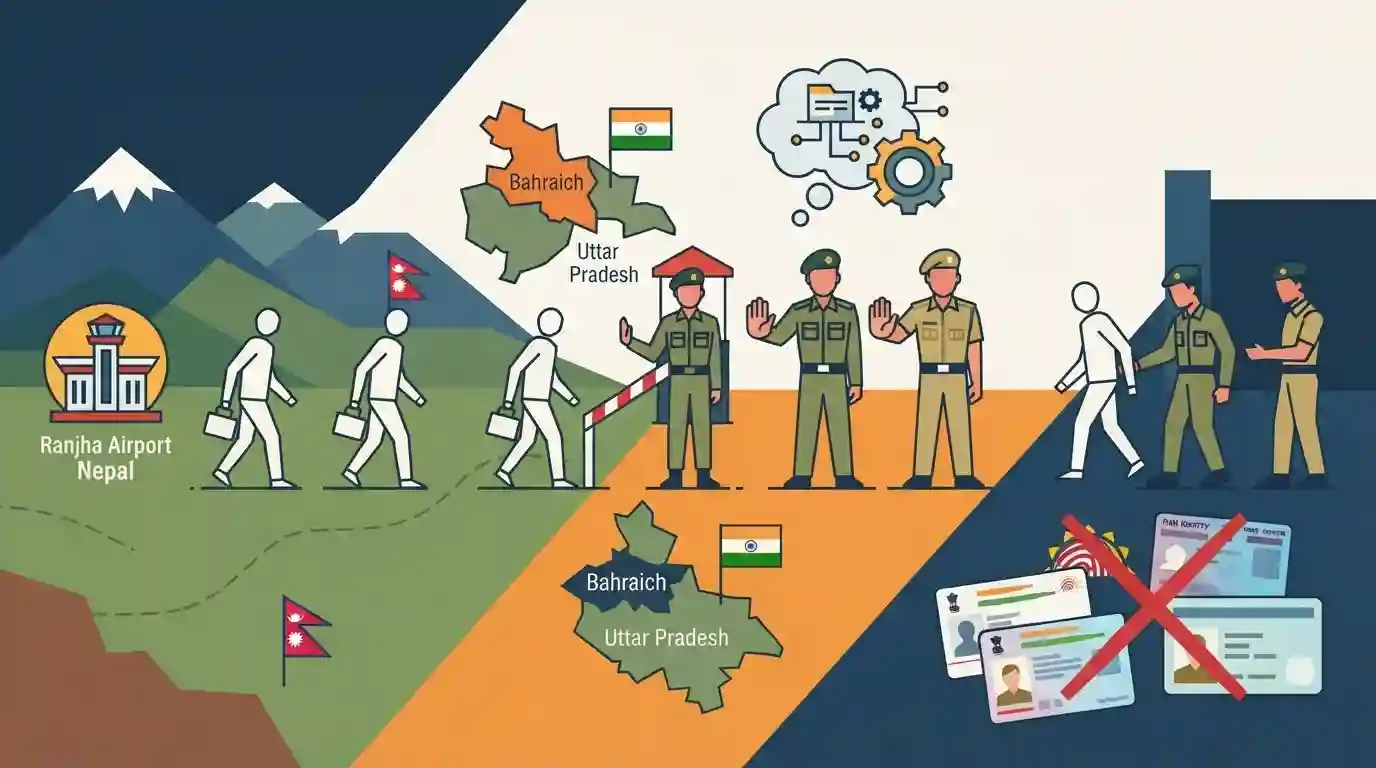
A member of the Sikh extremist group 'Waris Punjab De', Vikramjit Singh, wanted in connection with the violent 2023 Ajnala police station attack in Punjab, was arrested by security forces at the Indo-Nepal border in Bahraich, Uttar Pradesh [1.1]. He was arrested along with Manveer Singh Dhillon, a US citizen of Indian origin also affiliated with the group [1.1]. The accused were attempting to enter India through the Rupaidiha border crossing after landing at Ranjha Airport in Nepal [1.1]. They relied on forged Aadhaar, PAN, and driving licenses provided by local accomplices, and did not possess valid Indian visas [1.1]. The Sashastra Seema Bal (SSB) and local police intercepted them based on intelligence inputs, exposing how porous borders and local facilitation networks are exploited by radical elements with international linkages [1.1].
Key Points
- Vikramjit Singh, a key accused in the 2023 Ajnala police station attack and member of the radical Sikh outfit Waris Punjab De, was arrested at the Indo-Nepal border (Rupaidiha, Bahraich, Uttar Pradesh) while attempting to cross into India.
- Along with him, Manveer Singh Dhillon (a US citizen of Punjab origin and fellow Waris Punjab De member) and three local facilitators were arrested for trying to enter India without valid visas and using forged identity papers.
- The facilitators had forged Aadhaar cards, PAN cards, and driving licenses for the accused to bypass immigration and security checks at the porous border.
- Joga Singh, another key accused in the Ajnala incident who was out on bail, was also arrested from Pilibhit for coordinating the logistics and entry of the accused from Nepal's Ranjha Airport.
- The operation was carried out based on intelligence inputs during a joint checking exercise by the Sashastra Seema Bal (SSB) and local Uttar Pradesh police.
Important Terms
Waris Punjab De

A social-organisation-turned-radical group founded in 2021 by Deep Sidhu and later led by Amritpal Singh, promoting pro-Khalistan secessionist ideology and associated with internal security challenges in Punjab.
UPSC context
GS Paper III (Internal Security). Relevant for topics on extremism, secessionist movements, and challenges to domestic security.
Sashastra Seema Bal (SSB)
A Central Armed Police Force under the Ministry of Home Affairs, established in 1963, primarily mandated to secure India's porous borders with Nepal and Bhutan and prevent cross-border crime.
UPSC context
GS Paper III (Internal Security/Border Management). Tests knowledge of border-guarding forces, their mandates, and challenges of porous borders.
Immigration and Foreigners Act, 2025
A consolidated legislation enacted in 2025 that repealed the Foreigners Act, 1946, centralising the regulation, digital monitoring, and tracking of foreign nationals entering or staying in India.
UPSC context
GS Paper II & III (Polity and Internal Security). Essential for topics on legal frameworks governing migration, security, and citizenship.
Foreigners Act, 1946
A legacy legislative act regulating the entry, presence, and exit of foreigners in India, which placed the onus of proving citizenship on the accused and was repealed by the 2025 Act.
UPSC context
GS Paper II (Polity/Governance). Key for understanding historical legal provisions regarding non-citizens, tribunals, and deportation powers.
Prelims Trap
The open-border policy under the Indo-Nepal Treaty allows visa-free entry for all travelers transiting into India from Nepalese territory.
The 1950 Treaty of Peace and Friendship facilitates reciprocal free movement exclusively for citizens of India and Nepal. It does not grant visa-free entry or transit to third-country nationals (including foreign citizens of Indian origin) crossing the land border.
Static Concepts Connected
What is the 'One Border, One Force' principle and how does it apply to the Indo-Nepal border?
- Origin & Objective: Recommended by the Group of Ministers (GoM) post-1999 Kargil War to eliminate overlapping jurisdictions and ensure clear accountability for border security.
- Strategic Mandate: Under this framework, a single Central Armed Police Force (CAPF) is assigned to guard each of India's international borders.
- Designated Force: The Sashastra Seema Bal (SSB), under the Ministry of Home Affairs, is the designated force guarding the Indo-Nepal (since 2001) and Indo-Bhutan (since 2004) borders.
- Intelligence Role: SSB is also the designated Lead Intelligence Agency (LIA) for both these open borders to check trans-border crimes and infiltration.
How do Integrated Check Posts (ICPs) bolster border security?
- Concept: ICPs are unified border crossings housing customs, immigration, security, and passenger terminals under a single, secured administrative umbrella.
- Nodal Authority: Managed by the Land Ports Authority of India (LPAI), a statutory body under the Ministry of Home Affairs established under the LPAI Act, 2010.
- Security Utility: They secure trade and transit pathways by routing movement through sanitised zones, preventing illicit bypasses through porous terrains.
Cross-Topic Patterns
Diaspora radicalization and bilateral security pacts
Highlights how radical networks exploit soft borders to bypass official immigration channels, linking GS3 internal security threats to GS2 foreign policy and diaspora monitoring.
Trade facilitation vs. border security dualism
Examines how Integrated Check Posts (ICPs) managed by the LPAI must balance economic integration and trade facilitation with robust anti-infiltration security protocols.

Mains 2026: Evaluating how third-country infiltration exploits the 1950 India-Nepal Treaty, requiring a shift in SSB's border policing.
Linked PYQs · 3
Linked PYQs · 3
- 2014MainsGS3
How does illegal transborder migration pose a threat to India's security? Discuss the strategies to curb this, bringing out the factors which give impetus to such migration.
- 2021MainsGS3
Analyse the multidimensional challenges posed by external state and non-state actors, to the internal security of India. Also discuss measures required to be taken to combat these threats.
- 2023MainsGS3
What are the internal security challenges being faced by India? Give out the role of Central Intelligence and Investigative Agencies tasked to counter such threats.
