Civil aviation ministry prepares preliminary report on Learjet crash
Source:Indian Express ↗
Why It Matters
Understanding the roles of bodies like the AAIB and DGCA is crucial for the UPSC GS3 syllabus under 'Infrastructure (Airports/Aviation)' and 'Disaster Management'. It highlights how the government ensures passenger safety and investigates institutional failures or technical snags in the aviation sector.
Summary
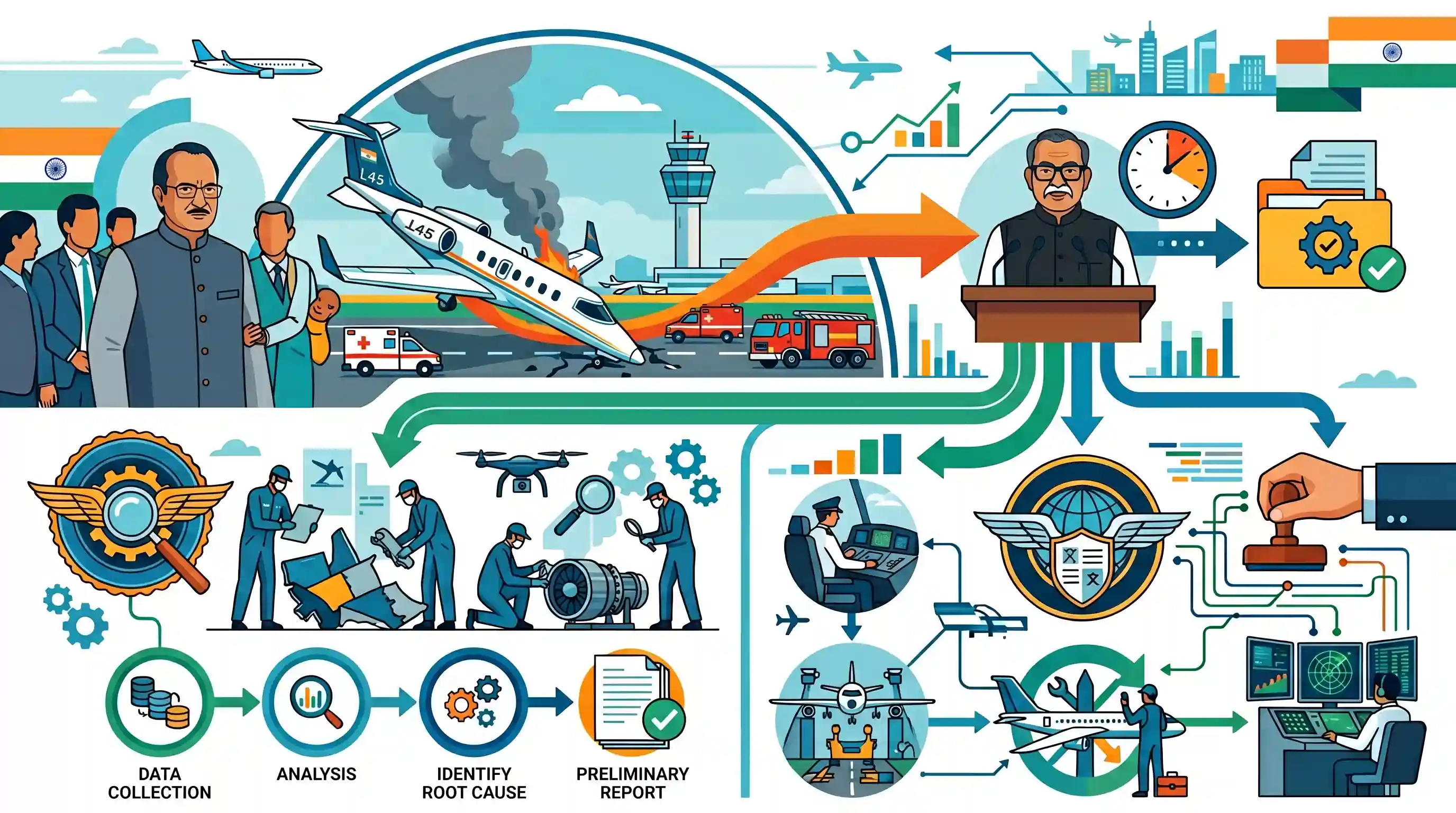
Civil Aviation Minister Ram Mohan Naidu stated that the preliminary report on the Learjet 45 aircraft crash involving NCP leader Ajit Pawar is expected to be released very soon. The incident underscores the critical role of aviation safety protocols and the investigative mechanisms in India's civil aviation sector. The Aircraft Accident Investigation Bureau (AAIB) is primarily responsible for conducting such investigations to determine the root cause and recommend safety measures, while the Directorate General of Civil Aviation (DGCA) regulates and enforces aviation safety standards across the country.
Key Points
- Civil Aviation Minister Ram Mohan Naidu announced that the preliminary report on the Learjet 45 plane crash involving Ajit Pawar will be released very soon.
- The crash highlights the importance of aviation safety and the prompt investigation of accidents to prevent future occurrences.
- The Aircraft Accident Investigation Bureau (AAIB), under the Ministry of Civil Aviation, is the apex body responsible for investigating aviation accidents and serious incidents in India.
- The Directorate General of Civil Aviation (DGCA) remains the primary regulatory body overseeing civil aviation safety and enforcing norms in the country.
Important Terms
Ministry of Civil Aviation (MoCA)

The nodal ministry of the Government of India responsible for formulating national policies, regulation, and development of the civil aviation sector and its infrastructure.
UPSC context
GS Paper 2 & 3: Governance and Infrastructure. Tests understanding of nodal agencies and sector-specific policy frameworks.
Aircraft Accident Investigation Bureau (AAIB)
An independent investigative body under the Ministry of Civil Aviation tasked with probing aircraft accidents and serious incidents to identify root causes and enhance safety.
UPSC context
GS Paper 2 & 3: Regulatory Bodies and Disaster Management. Focuses on institutional mechanisms for safety and technical investigations.
Directorate General of Civil Aviation (DGCA)
India's statutory civil aviation regulator responsible for safety oversight, airworthiness standards, licensing of personnel, and enforcement of aviation regulations.
UPSC context
GS Paper 2: Statutory/Regulatory Bodies. Tests knowledge of the Aircraft (Amendment) Act, 2020 and aviation safety standards.
International Civil Aviation Organization (ICAO)
A United Nations specialized agency that establishes international standards and recommended practices (SARPs) for global aviation safety, security, and environmental protection.
UPSC context
GS Paper 2: International Organizations. Relevant for multilateral cooperation and adherence to global safety norms.
Nationalist Congress Party (NCP)
A major Indian political party; the context refers to the factional split and the involvement of its leadership in aviation safety discussions post-incident.
UPSC context
GS Paper 2: Polity. Tests knowledge of political parties, leadership roles, and their impact on public policy discourse.
Non-Scheduled Operators (NSOP)
Aviation service providers who do not operate on fixed schedules or routes, often used for private, corporate, or VIP charters.
UPSC context
GS Paper 3: Infrastructure. Important for understanding diverse service segments within the aviation industry and their regulatory oversight.
Prelims Trap
"The Directorate General of Civil Aviation (DGCA) is the apex body responsible for investigating aircraft accidents."
Aspirants often confuse regulators with investigators. The DGCA regulates safety, but the independent AAIB actually investigates accidents to prevent conflicts of interest.
Static Concepts Connected
What are the roles of DGCA, AAIB, and BCAS in India?
- DGCA: Statutory body that regulates safety, issues licenses, and ensures airworthiness across the civil aviation sector.
- AAIB: Independent entity formed in 2012 specifically to investigate aviation accidents and serious incidents without bias.
- BCAS: Handles civil aviation security, standardizes security protocols, and oversees anti-hijacking measures at airports.
What is the significance of the 1944 Chicago Convention?
- Airspace Sovereignty: Establishes the core principle that every sovereign state has complete and exclusive sovereignty over its airspace.
- ICAO Foundation: Led to the creation of the International Civil Aviation Organization (ICAO) to coordinate global aviation standards.
Cross-Topic Patterns
Aviation safety & indigenous space tech
Aviation safety directly links to GS-3 Space Technology via GAGAN, an ISRO-AAI developed system ensuring precise navigation over Indian airspace.
Overhauling colonial aviation laws
The replacement of the 1934 Aircraft Act with the Bharatiya Vayuyan Vidheyak 2024 reflects the broader governance trend of repealing archaic colonial legislation.

Expect a multi-statement question contrasting the distinct mandates of DGCA, AAIB, and BCAS under the Bharatiya Vayuyan Vidheyak 2024.
Linked PYQs · 2
Linked PYQs · 2
- 2014MainsGS3
International civil aviation laws provide all countries complete and exclusive sovereignty over the airspace above their territory. What do you understand by 'airspace'? What are the implications of these laws on the space above this airspace? Discuss the challenges which this poses and suggest ways to contain the threat.
- 2025PrelimsGS1
GPS-Aided Geo Augmented Navigation (GAGAN) uses a system of ground stations to provide necessary augmentation. Which of the following statements is/are correct in respect of GAGAN? I. It is designed to provide additional accuracy and integrity. II. It will allow more uniform and high quality air traffic management. III. It will provide benefits only in aviation but not in other modes of transportation. Select the correct answer using the code given below.
