India and China Hold Special Representative Border Talks
Source:The Hindu ↗
Why It Matters
The article highlights a critical pivot in India-China ties, transitioning from post-Galwan hostilities to high-level diplomatic engagement. PM Modi’s upcoming visit to China for the SCO summit and the revival of the SR-level boundary mechanism are vital for UPSC Mains GS-2 (International Relations), while issues like the Brahmaputra dam and rare-earth supply chains cross over into GS-3 security and economy.
Summary
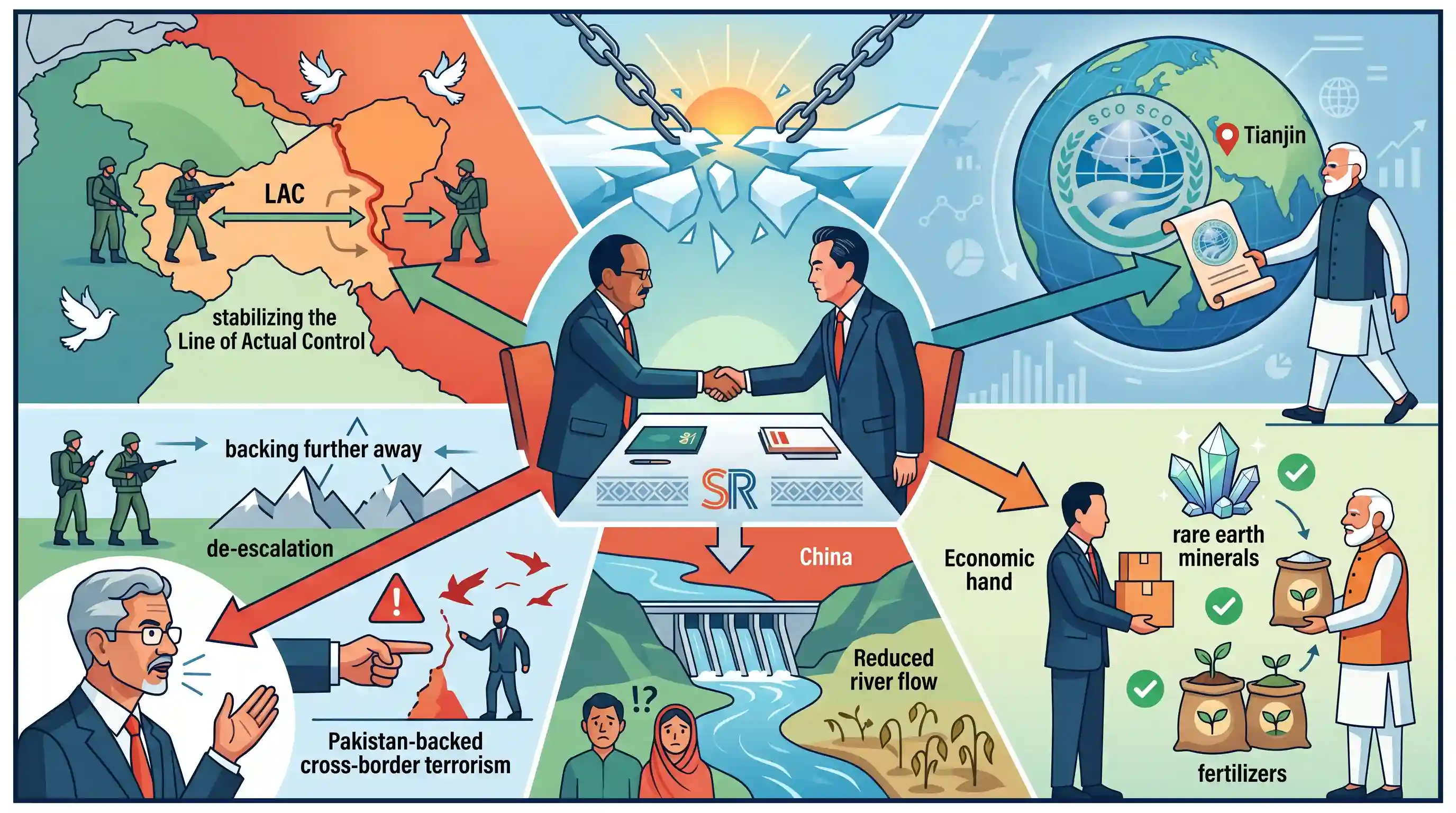
National Security Advisor Ajit Doval and Chinese Foreign Minister Wang Yi engaged in the 24th Special Representatives (SR) talks in New Delhi, signaling a major diplomatic thaw post-Galwan. The meeting emphasized the stabilization of the Line of Actual Control (LAC) and highlighted \'new momentum\' in bilateral relations. Consequently, Prime Minister Narendra Modi accepted an invitation to the upcoming SCO Summit in Tianjin. In parallel, EAM S. Jaishankar pressed China on the need for continued LAC de-escalation, flagged Pakistan-backed cross-border terrorism, and voiced concerns about the mega-dam on the Yarlung Tsangpo (Brahmaputra). Additionally, economic discussions saw China assuring India of steady supplies of rare earth minerals and fertilizers.
Key Points
- NSA Ajit Doval and Chinese Foreign Minister Wang Yi held the 24th round of Special Representative-level talks, noting positive momentum for resolving India-China border issues.
- Prime Minister Narendra Modi accepted President Xi Jinping\'s invitation to attend the SCO Summit in Tianjin, emphasizing that stable bilateral ties contribute to global peace.
- EAM S. Jaishankar highlighted the need to move forward on troop disengagement at the LAC and raised concerns over cross-border terrorism originating from Pakistan.
- India formally raised concerns over China\'s construction of a mega-dam on the Yarlung Tsangpo (Brahmaputra) river, demanding \'utmost transparency\'.
- China assured India it would address supply-chain requirements for fertilizers, rare earth minerals, and tunnel boring machines.
Important Terms
Special Representatives (SR) mechanism on the Boundary Question

A high-level diplomatic dialogue established in 2003 between India and China to seek a fair, reasonable, and mutually acceptable political solution to their boundary dispute.
UPSC context
GS Paper II: International Relations. Tests mechanisms for bilateral dispute resolution and border management strategies.
Shanghai Cooperation Organisation (SCO)
A permanent intergovernmental organization of Eurasian nations (est. 2001) focusing on regional security, counter-terrorism (via RATS), and economic cooperation. India joined in 2017.
UPSC context
GS Paper II: International Relations. Tests understanding of regional groupings and India's 'Extended Neighborhood' policy.
Line of Actual Control (LAC)
The 3,488-kilometer-long de facto border line separating Indian-controlled territory from Chinese-controlled territory, characterized by differing perceptions of its exact alignment.
UPSC context
GS Paper II & III: International Relations and Internal Security. Tests territorial sovereignty and border defense challenges.
Rare Earth Minerals
A group of 17 metallic elements essential for high-tech applications, including defense systems and green energy, currently dominated by Chinese supply and processing chains.
UPSC context
GS Paper III: Economy & S&T. Tests supply chain resilience, critical mineral security, and strategic autonomy.
Yarlung Tsangpo (Brahmaputra) Dispute
A transboundary water dispute involving China's construction of a massive hydropower project on the upper Brahmaputra, raising downstream concerns for India's water security.
UPSC context
GS Paper II: International Relations. Tests riparian rights, transboundary river governance, and environmental security.
BRICS
A coalition of major emerging economies (Brazil, Russia, India, China, South Africa, and recent expandees) advocating for global governance reform and a multipolar order.
UPSC context
GS Paper II: International Relations. Tests South-South cooperation and alternatives to Western-led financial institutions.
Ministry of External Affairs (MEA)
The central government agency responsible for formulating and implementing India's foreign policy, managing diplomatic missions, and conducting international negotiations.
UPSC context
GS Paper II: International Relations. Tests the institutional framework and conduct of India’s diplomacy.
Prelims Trap
"India lacks natural reserves of Rare Earth Elements and completely depends on China for raw material."
India actually holds the world's 5th largest REE reserves (approx 6% of global). The dependency on China is for processing technology and finished products, not raw reserves.
Static Concepts Connected
What is the geographical trajectory of the Brahmaputra (Yarlung Tsangpo) river system?
- Origin: Originates at the Chemayungdung glacier in the Kailash range, near Mansarovar lake in Tibet.
- Entry into India: Takes a hairpin U-turn at Namcha Barwa ('Great Bend') to enter Arunachal Pradesh as the Siang/Dihang river.
- Nomenclature: Known as Yarlung Tsangpo in Tibet, Siang/Dihang in Arunachal Pradesh, Brahmaputra in Assam, and Jamuna in Bangladesh.
What is the Special Representatives (SR) Mechanism for the India-China border dispute?
- Genesis: Established in 2003 during PM Atal Bihari Vajpayee's visit to China.
- Mandate: Elevated border discussions to a political and strategic level, moving beyond purely military or diplomatic working groups.
- Objective: Tasked with exploring a fair, reasonable, and mutually acceptable framework for a final boundary settlement.
Cross-Topic Patterns
Lack of formal water treaty
Unlike the Indus Water Treaty, India and China only have MoUs for monsoon hydrological data sharing, creating downstream vulnerabilities to mega-dams like the one at the Great Bend.
Strategic balancing: SCO vs Quad
India exercises multi-alignment by balancing Eurasian continental security via the China-led SCO, while concurrently promoting Indo-Pacific maritime security through the US-backed Quad grouping.
Green transition and REE vulnerability
India's 500 GW non-fossil capacity target is threatened by its dependence on Chinese processed rare earth elements and permanent magnets, crucial for EVs and wind turbines.

Expect a multi-statement prelims question linking Brahmaputra's 'Great Bend' geography, India-China water agreements, and REE processing.
Linked PYQs · 4
Linked PYQs · 4
- 2023MainsGS2
‘Virus of Conflict is affecting the functioning of the SCO’ In the light of the above statement point out the role of India in mitigating the problems.
- 2014MainsGS2
With respect to the South China sea, maritime territorial disputes and rising tension affirm the need for safeguarding maritime security to ensure freedom of navigation and over flight throughout the region. In this context, discuss the bilateral issues between India and China.
- 2024MainsGS2
‘Terrorism has become a significant threat to global peace and security.’ Evaluate the effectiveness of the United Nations Security Council's Counter Terrorism Committee (CTC) and its associated bodies in addressing and mitigating this threat at the international level.
- 2021MainsGS2
Critically examine the aims and objectives of SCO. What importance does it hold for India?
