IndiaChina Special Representatives Hold Boundary Dispute Talks
Source:The Hindu ↗
Why It Matters
The article highlights the geopolitical mechanisms (Special Representatives talks, WMCC) used to resolve border disputes between nuclear-armed neighbors. The prospect of normalizing ties, border delimitation phases, and related geography (Himalayan passes, LAC sectors) are critically relevant for both GS2 (IR) and GS3 (Border Management).
Summary
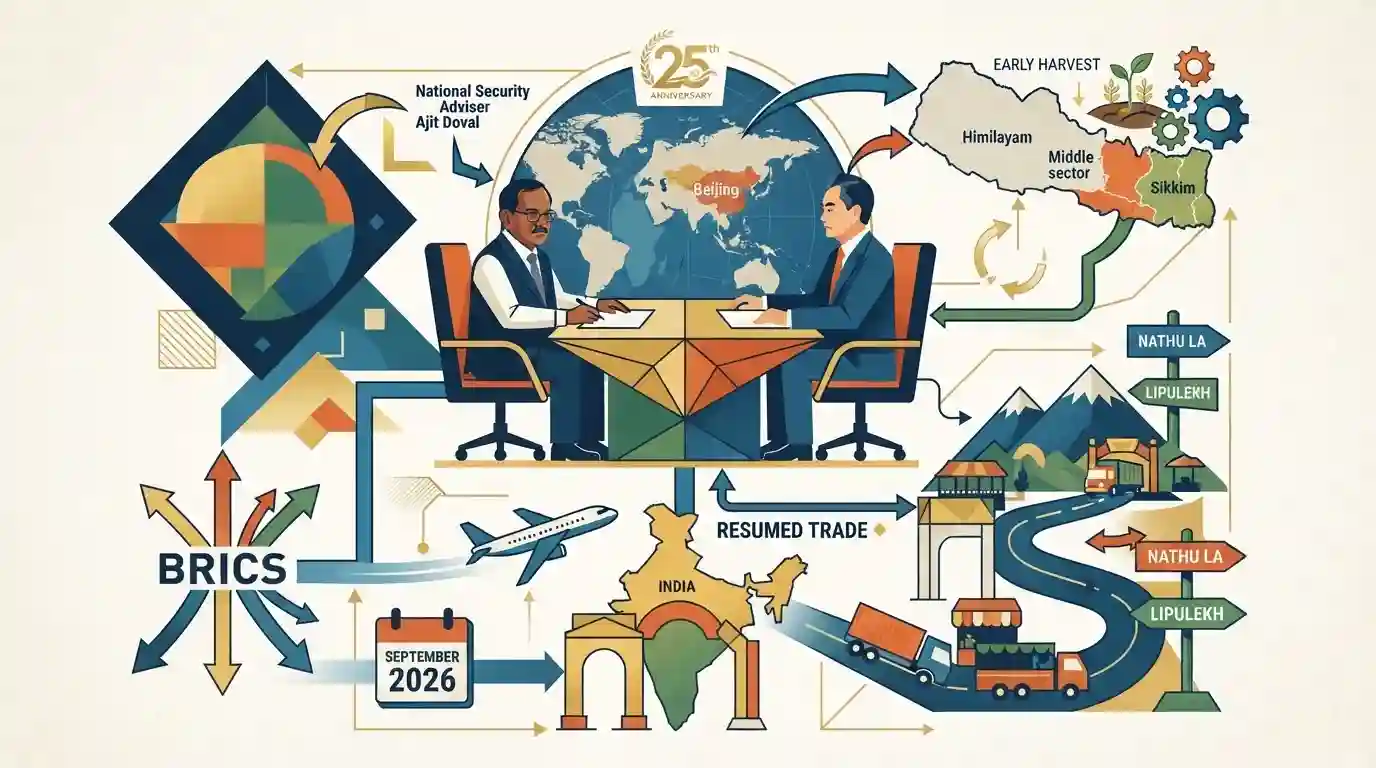
National Security Adviser Ajit Doval is set to travel to Beijing for the 25th round of Special Representatives (SRs) talks with Chinese Foreign Minister Wang Yi to negotiate a resolution to the India-China boundary dispute. The talks are expected to focus on an "early harvest" agreement in the relatively less disputed Middle and Sikkim sectors to foster goodwill and momentum. A successful negotiation could lead to Chinese President Xi Jinping visiting India for the BRICS Summit in September 2026, marking a significant step toward the normalization of bilateral relations and the potential resumption of border trade through Himalayan passes like Nathu La and Lipulekh.
Key Points
- NSA Ajit Doval is visiting Beijing for the 25th round of Special Representatives (SRs) talks with Chinese Foreign Minister Wang Yi on the boundary question.
- The talks aim to secure an "early harvest" agreement focusing on less contentious border areas like the Middle Sector (Uttarakhand, Himachal Pradesh) and Sikkim, setting aside the complex Western and Eastern sectors.
- A successful outcome could pave the way for Chinese President Xi Jinping to visit India for the upcoming BRICS Summit on September 12, marking his first visit in seven years.
- An early agreement could also facilitate the resumption of cross-border trade at Nathu La (Sikkim) and Lipulekh (Uttarakhand) passes, aiding the gradual normalization of bilateral ties.
Important Terms
Special Representatives (SRs) mechanism

A high-level bilateral framework created in 2003 to negotiate a political settlement to the India-China boundary dispute, led by India's National Security Adviser and China's Foreign Minister.
UPSC context
GS Paper II (IR) — tests India-China diplomatic mechanisms and border dispute resolution.
Working Mechanism for Consultation and Coordination on India-China Border Affairs (WMCC)
An institutional framework established in 2012, led by joint secretary-level diplomats and military officials, to facilitate communication and maintain peace and tranquillity along the Line of Actual Control.
UPSC context
GS Paper III (Security) — tests border management mechanisms and conflict prevention along the LAC.
2005 Agreement on Political Parameters and Guiding Principles for Settlement of the India-China Boundary Question
A bilateral agreement signed in 2005 under the SR mechanism, establishing a three-stage roadmap and political parameters to guide a peaceful and mutually acceptable border settlement.
UPSC context
GS Paper II (IR) — tests bilateral agreements, diplomatic history, and border dispute resolution.
BRICS
An intergovernmental group of major emerging economies (originally Brazil, Russia, India, China, South Africa) working to reform global governance, promote economic cooperation, and amplify Global South representation.
UPSC context
GS Paper II (IR) — tests global groupings, strategic autonomy, and multilateral diplomatic engagements.
SCO
A permanent Eurasian intergovernmental organization focused on political, economic, and military cooperation, regional security, and counter-terrorism through its RATS mechanism.
UPSC context
GS Paper II (IR) — tests regional security, relations with Central Asia, and multilateral balancing.
Prelims Trap
"The current SR talks aim to immediately demarcate the Western Sector (Eastern Ladakh)."
The current 'early harvest' strategy explicitly focuses on the least contested Middle and Sikkim sectors, deferring the highly complex Western Sector (Ladakh) for later.
Static Concepts Connected
What is the 3-Stage Formula of the Special Representatives (SR) Mechanism?
- Stage 1 (Completed): Agreeing on political parameters and guiding principles. This was successfully completed via the landmark 2005 Agreement.
- Stage 2 (Ongoing): Establishing a comprehensive framework for a final package settlement encompassing all sectors of the boundary dispute.
- Stage 3 (Pending): Physically delineating and demarcating the final mutually-agreed boundary on maps and on the ground.
Which are the 3 designated Himalayan passes for India-China border trade?
- Nathu La: Located in Sikkim; historically part of the ancient Silk Road connecting India to Tibet's Chumbi Valley.
- Lipulekh Pass: Located in Uttarakhand at the highly strategic territorial tri-junction of India, China (Tibet), and Nepal.
- Shipki La: Located in Himachal Pradesh; it serves as the geographical point where the Sutlej River enters India.
Cross-Topic Patterns
Border Geography + Trade Normalization
Linking physical geography (mountain passes) to local economic revitalization and bilateral confidence-building measures (CBMs) is a classic GS2 and GS3 intersection.
Multilateral Summits + Bilateral Thaw
Multilateral host obligations (like the BRICS Summit in India) often accelerate bilateral negotiations, utilizing multilateral event deadlines to force bilateral 'early harvest' breakthroughs.

Match-the-following on LAC sectors (Western, Middle, Eastern) and Himalayan trade passes (Lipulekh, Shipki La) is highly probable.
Linked PYQs · 3
Linked PYQs · 3
- 2024MainsGS3
India has a long and troubled border with China and Pakistan fraught with contentious issues. Examine the conflicting issues and security challenges along the border. Also give out the development being undertaken in these areas under the Border Area Development Programme (BADP) and Border Infrastructure and Management (BIM) Scheme.
- 2014MainsGS2
With respect to the South China sea, maritime territorial disputes and rising tension affirm the need for safeguarding maritime security to ensure freedom of navigation and over flight throughout the region. In this context, discuss the bilateral issues between India and China.
- 2007PrelimsGS1
Which one of the following Himalayan passes was reopened around in the middle of the year 2006 to facilitate trade between India and China?
