Industry perspective on socioeconomic and environmental impacts of AI
Source:The Hindu ↗
Why It Matters
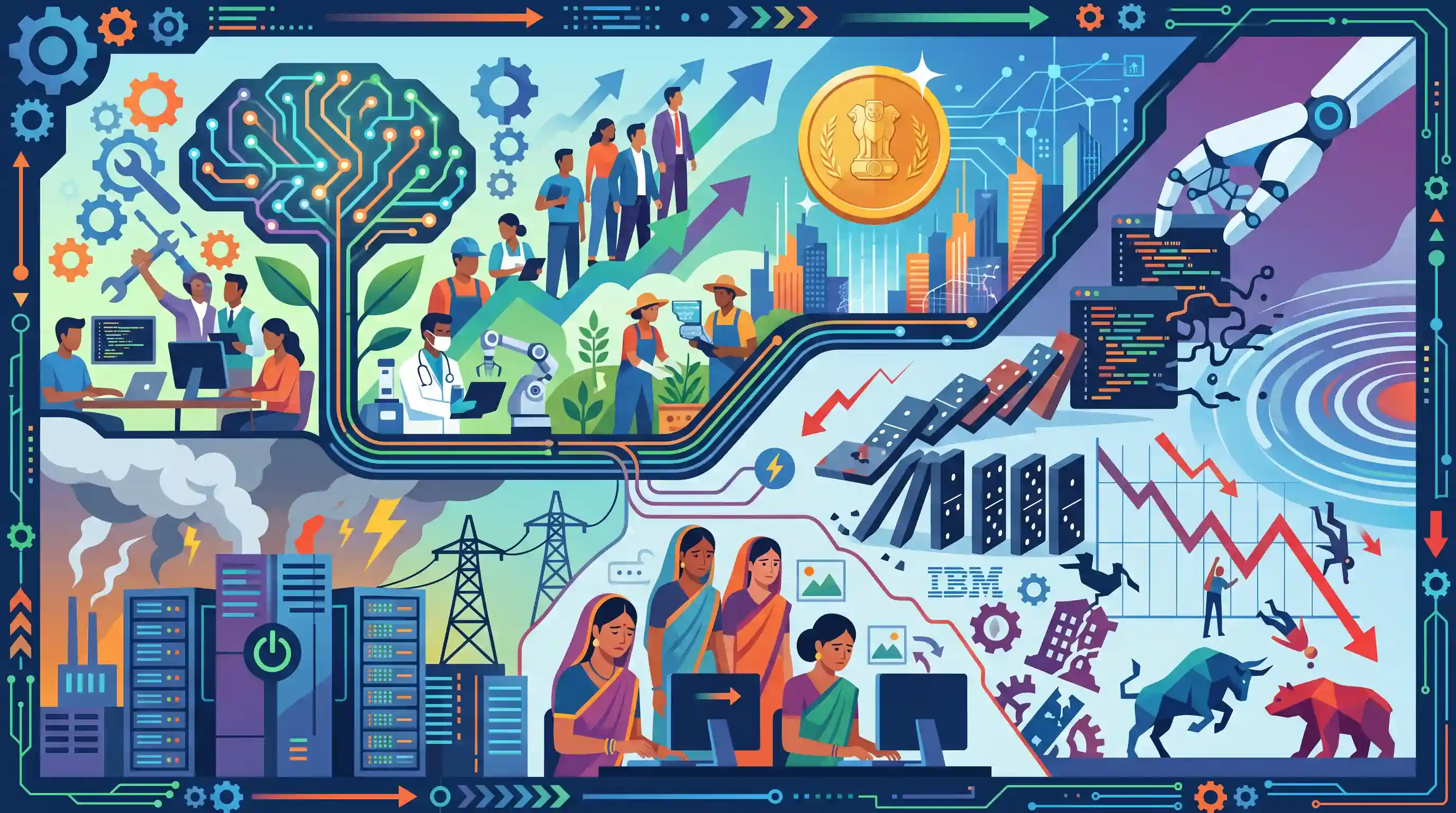
It provides a critical industry perspective balancing the optimistic view of AI as a net job creator against valid socio-economic concerns—such as the psychological toll on gig workers training AI, the climate costs of data centers, and the market disruption of traditional tech models. This is highly relevant for GS3 (Technology, Economy, Environment) and GS4 (Ethics in Tech).
Summary
The article highlights NASSCOM's perspective that the positive impacts of AI, such as unprecedented job creation and advancements in the human condition, far outweigh its negative effects. While acknowledging the environmental costs of data centers and the ethical concerns surrounding the mental trauma of rural Indian women employed to train AI systems for safety, NASSCOM asserts AI acts as a net job creator rather than a destroyer. Concurrently, the Indian IT industry is projected to reach $300 billion in revenue by 2026. However, fears of AI-induced disruptions in global markets persist, as seen by the recent 5% decline in the Nifty IT index triggered by Anthropic's announcement of modernizing COBOL, impacting traditional tech players like IBM.
Key Points
- NASSCOM asserts that AI's benefits in driving human progress and job creation outweigh its negative climate and human impacts.
- The organization acknowledged the severe mental trauma experienced by rural Indian women who annotate and train AI models for safety.
- While data centers contribute significantly to climate change, NASSCOM argues this is offset by overall improvements in the human condition.
- The Indian IT industry is projected to reach $300 billion in revenue by 2026, continuing to be a net hirer despite slower growth.
- AI-driven disruption caused the Nifty IT index to fall by nearly 5% following Anthropic's announcement about modernizing legacy COBOL code, which threatens traditional players like IBM.
Important Terms
NASSCOM

The apex trade association for the Indian IT-BPM industry. It advocates for policy, facilitates skill development, and projects India as a global hub for digital innovation and software services.
UPSC context
GS Paper III: IT & Economy; relevant for questions on India’s digital growth, employment trends, and industry-government policy advocacy.
Anthropic
A prominent AI research lab and creator of the Claude AI model. Its tools for automating legacy code modernization (e.g., COBOL) have recently disrupted global tech markets and IT service stocks.
UPSC context
GS Paper III: Awareness in IT; signifies the shift from AI pilots to disruptive enterprise applications and its impact on traditional industries.
COBOL
(Common Business-Oriented Language) A 1959-era programming language that remains the critical backbone for global banking, insurance, and government mainframe systems despite a dwindling pool of expert developers.
UPSC context
GS Paper III: Science & Technology; tests awareness of legacy digital infrastructure and the challenges of technological transition in governance and finance.
IBM
A technology giant and leader in mainframe computing. Its high-margin business in maintaining legacy systems (like COBOL) is currently facing competition from AI-driven automated modernization tools.
UPSC context
GS Paper III: Economy & IT; example of how established tech players must adapt to generative AI disruption in global service markets.
Global Capability Centers (GCCs)
Offshore centers established by multinational companies in India to perform core business functions like R&D and IT, now serving as a major growth engine for India's digital economy.
UPSC context
GS Paper III: Indian Economy; essential for understanding the shift from low-cost outsourcing to high-value digital services and global tech integration.
Nifty IT Index
A benchmark index on the National Stock Exchange (NSE) representing the performance of major Indian IT companies. It reflects investor sentiment regarding global tech demand and AI-induced disruptions.
UPSC context
GS Paper III: Indian Economy; indicator of the health and volatility of India’s critical export-oriented software services sector.
Prelims Trap
"AI adoption in India is officially projected to result in a net loss of IT sector jobs."
NASSCOM officially asserts AI is a net job creator. Aspirants often mistake news of legacy tech disruptions (like COBOL automation) as evidence of overall job destruction.
Static Concepts Connected
How do AI data centers impact the environment compared to traditional IT infrastructure?
- Energy Intensity: AI training and inference require specialized GPUs, consuming 10 to 100 times more electricity than traditional servers, heavily burdening power grids.
- Water Footprint: Massive quantities of freshwater are consumed continuously in cooling towers to prevent high-density data center equipment from overheating.
- E-Waste Generation: The rapid obsolescence of AI hardware leads to an accelerated accumulation of complex electronic waste.
What is 'microtasking' in the context of the gig economy?
- Fragmented Labor: Large AI training processes are broken down into tiny, repetitive tasks (like tagging toxic images) outsourced to low-wage informal workers.
- No Social Security: These workers are classified as independent contractors, depriving them of formal labor rights, minimum wage guarantees, and health benefits.
Cross-Topic Patterns
AI Ethics meets the Gig Economy
The psychological trauma faced by women annotating toxic data bridges GS3 (Employment) and GS4 (Corporate Ethics), highlighting the dark underbelly of 'ghost labor' powering modern AI.
Generative AI + Capital Market Volatility
Generative AI automating legacy languages like COBOL directly impacts the Nifty IT index, linking global technological obsolescence to domestic capital market fluctuations.

Mains 2026: Expect a GS3 question evaluating the trade-off between India's IT growth ambitions and the ecological/ethical costs of AI.
Linked PYQs · 4
Linked PYQs · 4
- 2020PrelimsGS1
With the present state of development, Artificial Intelligence can effectively do which of the following? 1. Bring down electricity consumption in industrial units 2. Create meaningful short stories and songs 3. Disease diagnosis 4. Text-to-Speech Conversion 5. Wireless transmission of electrical energy Select the correct answer using the code given below:
- 2023MainsGS3
Introduce the concept of Artificial Intelligence (AI). How does Al help clinical diagnosis? Do you perceive any threat to privacy of the individual in the use of Al in healthcare?
- 2024MainsGS4
The application of Artificial Intelligence as a dependable source of input for administrative rational decision-making is a debatable issue. Critically examine the statement from the ethical point of view.
- 2023MainsGS3
What is the status of digitalization in the Indian economy? Examine the problems faced in this regard and suggest improvements.
