Institutional Role of Aircraft Accident Investigation Bureau in Safety
Source:Indian Express ↗
Why It Matters
Understanding the distinction between regulatory bodies and independent investigative agencies is crucial for GS2. The creation of the AAIB exemplifies the necessity of institutional autonomy to prevent conflicts of interest and ensure unbiased oversight in critical infrastructure sectors like aviation.
Summary
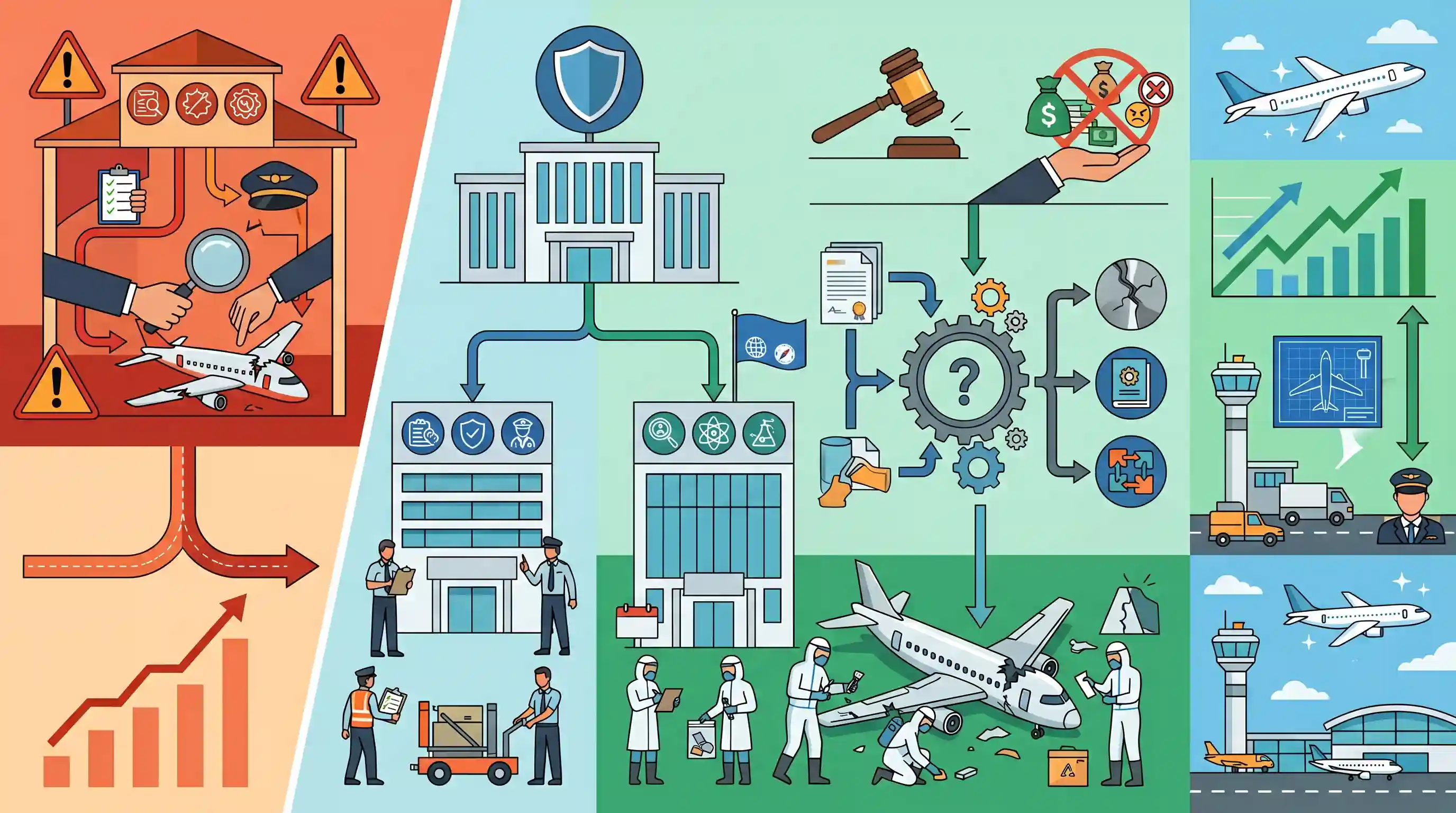
The Aircraft Accident Investigation Bureau (AAIB) is an independent body under the Ministry of Civil Aviation established in 2012 to investigate aircraft accidents and serious incidents in India. Its creation aimed to separate the investigation process from the Directorate General of Civil Aviation (DGCA) to eliminate conflicts of interest, as the DGCA serves as the sector's regulatory authority. By functioning autonomously in alignment with the Chicago Convention, the AAIB focuses objectively on identifying the root causes of accidents to improve aviation safety, rather than determining liability.
Key Points
- The Aircraft Accident Investigation Bureau (AAIB) was established in 2012 as an independent entity under the Ministry of Civil Aviation.
- Its primary objective is to investigate aircraft accidents and serious incidents in India, in accordance with the Standards and Recommended Practices of Annex 13 to the Chicago Convention.
- Previously, the Directorate General of Civil Aviation (DGCA) investigated such accidents, which created a conflict of interest since the DGCA is also the industry regulator.
- The separation ensures independent and autonomous investigations, focusing on discovering root causes to enhance aviation safety without apportioning blame or liability.
Important Terms
Aircraft Accident Investigation Bureau (AAIB)

Independent agency under India's Civil Aviation Ministry that probes aircraft accidents. Established in 2012, it focuses on identifying technical causes to prevent future crashes rather than fixing legal blame or liability.
UPSC context
GS Paper 2 (Regulatory Bodies). Tests understanding of independent oversight mechanisms and safety governance in critical infrastructure.
Directorate General of Civil Aviation (DGCA)
India's chief regulatory body for civil aviation. It enforces safety rules, manages pilot licensing, and ensures aircraft airworthiness. It operates as a statutory body under the Ministry of Civil Aviation.
UPSC context
GS Paper 2 (Regulatory Bodies). Important for understanding the role of sectoral regulators and administrative structures in India.
Chicago Convention (Annex 13)
An international treaty annex setting global standards for aircraft accident investigations. It mandates that probes focus on enhancing safety and preventing future tragedies rather than deciding legal liability.
UPSC context
GS Paper 2 (International Treaties). Tests awareness of international legal frameworks influencing Indian domestic aviation laws.
International Civil Aviation Organisation (ICAO)
A United Nations specialized agency that coordinates international air navigation and safety. It sets the global Standards and Recommended Practices (SARPs) followed by 193 member states, including India.
UPSC context
GS Paper 2 (International Organizations). Vital for questions on UN specialized agencies and global technical cooperation.
Ministry of Civil Aviation
The Indian government department responsible for national civil aviation policy. It oversees airports, air safety regulators (DGCA), and accident investigation bodies (AAIB) to ensure a safe aviation sector.
UPSC context
GS Paper 2 (Government Ministries). Relevant for studying executive functions and the administration of transport infrastructure.
Prelims Trap
"The AAIB is an investigative arm of the DGCA with the authority to penalize airlines for safety violations."
AAIB is independent of the DGCA (reporting directly to the Ministry) to avoid conflicts of interest. Furthermore, its mandate is strictly non-punitive—it investigates root causes for safety, not to apportion blame.
Static Concepts Connected
What is the Chicago Convention and how does it relate to the ICAO?
- 1944 Treaty: Signed in 1944, it established the core principles of international air navigation, transport, and airspace sovereignty.
- ICAO Creation: It led to the creation of the International Civil Aviation Organization (ICAO), a UN specialized agency that coordinates international air travel.
- Annex 13 Mandate: Annex 13 of the Convention requires member states to establish an independent aviation accident investigation authority (prompting India to create the AAIB).
Why is separating regulatory and investigative functions crucial in governance?
- Conflict of Interest: If a regulator (like DGCA) investigates an accident, it risks investigating its own regulatory or oversight failures, leading to institutional bias.
- Objective Fact-Finding: Independent bodies can focus purely on transparent root-cause analysis without needing to protect the reputation of the regulatory framework.
- Non-punitive focus: Separating roles ensures the investigation remains focused on safety improvement and systemic fixes, rather than liability apportionment or punitive actions.
Cross-Topic Patterns
Regulatory vs Investigative Independence
Just as the AAIB is separated from the DGCA to prevent the regulator from investigating its own oversight failures, similar governance reforms advocate separating investigative and prosecution wings in law enforcement.
Aviation Treaties: Chicago vs Montreal Convention
UPSC often tests international agreements. While the Chicago Convention established ICAO and airspace safety standards, the Montreal Convention dictates airline liability for passenger injury or lost baggage.

Expect a 2026 Prelims question mapping aviation bodies (DGCA, AAIB, BCAS) to distinct roles, testing their statutory vs executive status.
Linked PYQs · 2
Linked PYQs · 2
- 2024MainsGS3
What is the need for expanding the regional air connectivity in India? In this context, discuss the government's UDAN Scheme and its achievements.
- 2015MainsGS2
For achieving the desired objectives, it is necessary to ensure that the regulatory institutions remain independent and autonomous. Discuss in the light of the experiences in recent past.
