Airbound to deploy autonomous delivery drone network in Andhra Pradesh
Source:dronelife ↗
Why It Matters
Highlights India's emerging capabilities in indigenous autonomous Unmanned Aerial Vehicles (UAVs) and innovative logistics solutions. It is highly relevant for APPSC as it directly involves infrastructure and technology rollout in Andhra Pradesh, specifically targeting critical last-mile delivery issues in healthcare and e-commerce.
Summary
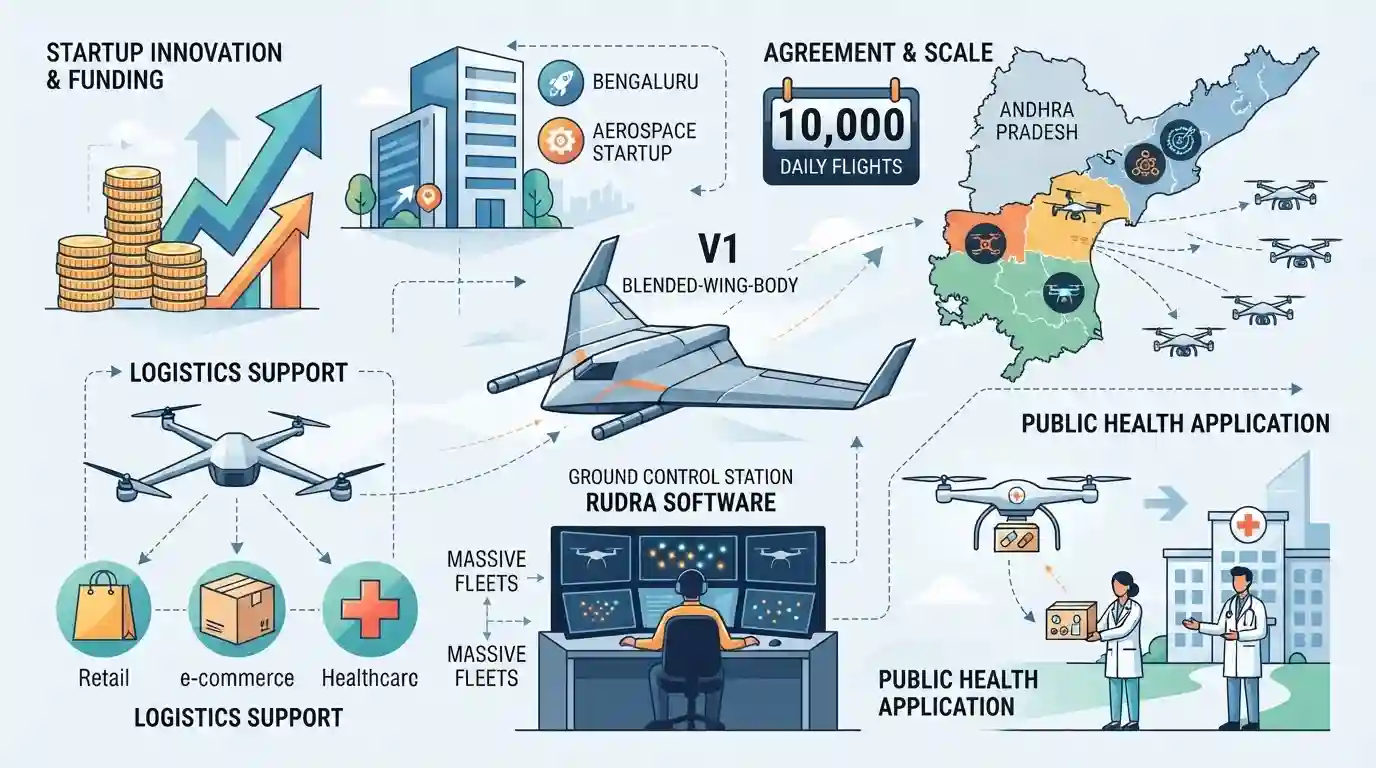
Bengaluru-based aerospace startup Airbound has raised $37 million in Series A funding to expand its autonomous drone delivery operations. The company has signed an agreement with the state of Andhra Pradesh to roll out an aerial delivery network across three districts, with plans to scale to 10,000 daily flights supporting retail, e-commerce, and healthcare logistics. The operations rely on Airbound's innovative 'V1' blended-wing-body tailsitter drone and its 'RUDRA' ground control software, which enables a single operator to oversee massive autonomous fleets. The firm is already demonstrating public health applications by transporting medical diagnostic samples for Narayana Health in Bengaluru.
Key Points
- Airbound, a Bengaluru-based aerospace startup, has secured $37 million in Series A funding and entered an agreement with Andhra Pradesh for commercial drone delivery.
- The initiative plans to establish an aerial network across three districts in Andhra Pradesh, eventually scaling up to 10,000 drone flights daily for retail, e-commerce, and healthcare logistics.
- Airbound’s proprietary 'V1' drone features a highly efficient blended-wing-body tailsitter design, capable of carrying a 1kg payload with an empty weight of just 1.5kg.
- The company utilizes an in-house fleet ground control system called 'RUDRA', which allows a single operator to manage over 100 aircraft simultaneously with real-time deconfliction.
- The technology is already proving effective in public health, operating a drone delivery corridor for diagnostic samples with Narayana Health in Bengaluru.
Important Terms
Airbound

A Bengaluru-based aerospace startup specializing in autonomous delivery drones. It recently raised $37 million to scale its zero-infrastructure, low-cost logistics network for healthcare, e-commerce, and retail.
UPSC context
Relevant to Science & Technology and Economy topics, illustrating India's growing startup ecosystem, deep-tech development, and commercial drone applications.
Narayana Health
A major Indian hospital network that partnered with Airbound to pioneer autonomous drone deliveries for medical diagnostic samples, bypassing urban traffic to slash transport times and costs.
UPSC context
Crucial for Public Health Infrastructure, demonstrating how emerging technologies can optimize medical supply chains, diagnostic accessibility, and emergency response.
RUDRA Ground Control System
Airbound’s proprietary ground control software. It processes real-time telemetry to allow a single operator to simultaneously manage over 100 autonomous drone flights with automated deconfliction.
UPSC context
Tests knowledge of indigenous aviation software under GS Paper 3 (IT and Robotics), highlighting advancements in autonomous fleet management.
Blended-Wing-Body Tailsitter Drone
An innovative drone design combining vertical takeoff and landing (VTOL) capability with the aerodynamic efficiency of fixed-wing horizontal flight for high-payload, long-range missions.
UPSC context
Important for Science & Technology (GS Paper 3) regarding aerospace engineering breakthroughs and modern logistics infrastructure applications.
Prelims Trap
RUDRA is an indigenous delivery drone developed by the Andhra Pradesh government for healthcare logistics.
'RUDRA' in this context is private fleet ground control software, not a government drone. Also, HAL Rudra is a military attack helicopter.
Static Concepts Connected
What are the key objectives of the Andhra Pradesh Drone Policy 4.0 (2024-29)?
- Financial Outlay: Allocates ₹500 crores to establish Andhra Pradesh as a global drone technology and manufacturing hub.
- Ecosystem Targets: Aims to establish 100 drone companies within the state to attract substantial private investments.
- Skill Development: Sets targets to train 25,000 remote pilots, enhancing youth employability and supporting the UAV sector.
How are commercial drone operations regulated under the Drone Rules, 2021 in India?
- Digital Sky Platform: A single-window online platform for airspace map visualization (green, yellow, red zones) and flight permissions.
- Payload & Clearance: Rules cover drones up to 500 kg, facilitating commercial logistics, with no prior security clearance needed for registration.
- Pilot Certification: Requires a remote pilot certificate for commercial operations, though non-commercial micro and nano drones are generally exempt.
Cross-Topic Patterns
Healthcare logistics & rural connectivity
The use of drones for diagnostic sample transport connects to universal health coverage goals, bridging last-mile connectivity gaps in rural Andhra Pradesh public health infrastructure.
Startups driving state infrastructure
Private venture capital funding public-utility logistics highlights a shift towards startup-led solutions and tech-driven PPP models for core state infrastructure challenges.

Expect a statement-based question confusing 'RUDRA' drone software with HAL's Rudra helicopter, alongside AP Drone Policy 4.0 targets.
Linked PYQs · 2
Linked PYQs · 2
- 2023APPSC_PRELIMSGS1
Recently, the term 'Chicago Convention' is frequently seen in the news. Which of the following sector is it associated with?
- 2024APPSC_PRELIMSGS1
Which of the following statements are valid regarding the interventions of the Government of Andhra Pradesh in the context of Healthcare ? I. Telemedicine facility is available in all Ayushman Bharat Health and Wellness Centres (AB-HWCs) to avail specialist services through district hub. II. The Family Doctor Programme has been planned to be implemented as a standalone project without the need to be integrated with Primary Health Centres (PHCs). III. Dr. YSR Aarogyasri Scheme has been revamped, by increasing the income limit from ₹ 2.5 lakh to ₹ 5 lakh per annum per family. IV. 'Aarogya Aasara' Scheme is intended to provide post-operative sustenance allowance with certain eligible conditions complied with. Select the correct answer using the codes given below :
