Civil aviation consumer protection and air ticket refund guidelines
Source:Indian Express ↗
Why It Matters
Understanding civil aviation regulations is crucial for UPSC aspirants, as it touches upon both infrastructure development (GS3) and consumer protection/governance (GS2). It demonstrates how regulatory bodies step in to safeguard citizens against unfair trade practices in rapidly growing service sectors.
Summary
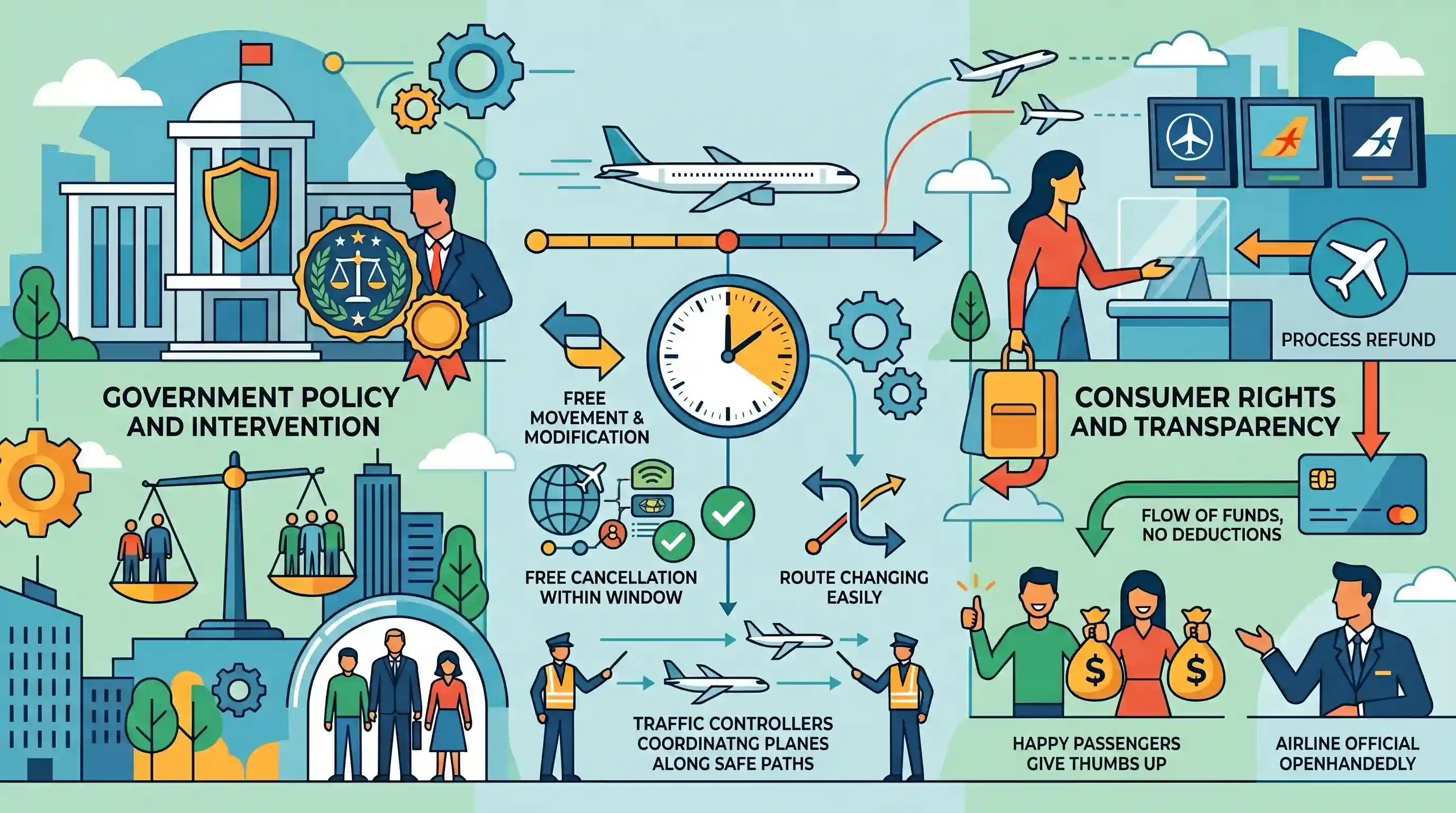
Recent guidelines regarding air ticket refund rules state that passengers can cancel or modify their flight bookings within a 48-hour window without incurring any additional cancellation charges. Formulated to enhance consumer protection in the civil aviation sector, these rules mandate airlines to process refunds efficiently and transparently. This regulatory step restricts arbitrary deductions, ensuring fair treatment of passengers and aligning aviation industry practices with broader consumer rights standards.
Key Points
- Passengers are now entitled to cancel or modify their flight tickets without any extra cancellation fees if done within a specific window (e.g., 48 hours) of booking.
- The updated refund rules aim to protect consumer interests against arbitrary cancellation deductions and predatory pricing by airlines.
- The regulations ensure greater transparency and predictability for travelers, enforcing strict compliance on the part of airline operators.
- This move reflects a broader governance focus on balancing rapid growth in the civil aviation sector with robust consumer protection mechanisms.
Important Terms
Directorate General of Civil Aviation (DGCA)

The statutory regulatory authority in India responsible for air safety, licensing, and airworthiness. It oversees airline operations and enforces regulations to ensure safe and efficient air transport.
UPSC context
GS Paper II: Regulatory bodies and GS Paper III: Infrastructure (Aviation). Essential for questions on civil aviation governance.
Civil Aviation Requirements (CAR)
A set of technical standards and legally binding regulations issued by the DGCA. These rules cover safety management, licensing, and passenger facilities, including ticket refund and cancellation norms.
UPSC context
GS Paper II: Government policies and GS Paper III: Economy. Tests understanding of sector-specific regulatory frameworks and consumer rights.
Ministry of Civil Aviation
The nodal Union ministry responsible for formulating national policies and programmes for the development of civil aviation. It oversees administrative and regulatory bodies like the DGCA and AAI.
UPSC context
GS Paper II: Structure and functioning of the Executive. Relevant for administrative hierarchy and infrastructure policy questions.
Consumer Protection Act, 2019
Legislation that strengthens consumer rights by establishing the Central Consumer Protection Authority (CCPA). it empowers consumers to seek redressal against unfair trade practices and service deficiencies in sectors like aviation.
UPSC context
GS Paper II: Statutory bodies and citizen-centric governance. Crucial for topics regarding consumer welfare and legal grievance mechanisms.
Prelims Trap
Passengers can cancel any flight ticket without extra charges within 48 hours of booking, regardless of the flight departure date.
The 48-hour free cancellation is conditional. It only applies if the departure is more than 7 days (domestic) or 15 days (international) away, preventing last-minute booking exploitation.
Static Concepts Connected
What are the regulatory functions of the DGCA compared to the Airports Authority of India (AAI)?
- DGCA (Regulatory): Enforces civil air regulations, air safety, airworthiness standards, and issues Civil Aviation Requirements (CAR) for passenger rights.
- AAI (Operational): Creates, upgrades, maintains, and manages civil aviation infrastructure, passenger terminals, and airspace across India.
- Ministry Oversight: The Ministry of Civil Aviation oversees both entities, guiding national aviation policies and broader bilateral air service agreements.
What are the key statutory fees levied on air passengers in India?
- User Development Fee (UDF): A revenue-generating fee levied at specific airports to fund ongoing maintenance or future infrastructural development.
- Passenger Service Fee (PSF): Collected specifically to cover the costs of aviation security deployment (like CISF) and passenger facilitation at terminals.
- Mandatory Refundability: By law, these statutory taxes must be fully refunded to the passenger upon cancellation, even if the base fare is entirely non-refundable.
Cross-Topic Patterns
Sectoral regulators vs CCPA on consumer rights
While DGCA issues aviation-specific mandates like the Passenger Charter, the Central Consumer Protection Authority (CCPA) enforces broader rules against unfair trade practices like "dark patterns" in online flight ticketing.
PPP Airport models and Development Fees
The mandatory refund of User Development Fee (UDF) ties into how privatized airports under Public-Private Partnerships (PPP) fund their capital expenditure and operational maintenance.

Expect a 2026 Prelims statement-based question contrasting DGCA's aviation passenger charter with the CCPA's rules on dark patterns.
Linked PYQs · 2
Linked PYQs · 2
- 2012PrelimsGS1
With reference to consumers' rights/privileges under the provisions of law in India, which of the following statements is/are correct? 1. Consumers are empowered to take samples for food testing. 2. When a consumer files a complaint in any consumer forum, no fee is required to be paid. 3. In case of death of a consumer, his/her legal heir can file a complaint in the consumer forum on his/her behalf. Select the correct answer using the codes given below:
- 2024MainsGS3
What is the need for expanding the regional air connectivity in India? In this context, discuss the government's UDAN Scheme and its achievements.
