Delhi Air Quality Deteriorates to Poor Category Reading
Source:The Hindu ↗
Why It Matters
Understanding the Air Quality Index (AQI), the pollutants it tracks, and the classification bands laid out by the CPCB is essential for the UPSC examination. Air pollution is a major environmental and public health crisis in India, frequently tested in Prelims (e.g., questions on AQI pollutants) and Mains (evaluating mitigation measures).
Summary
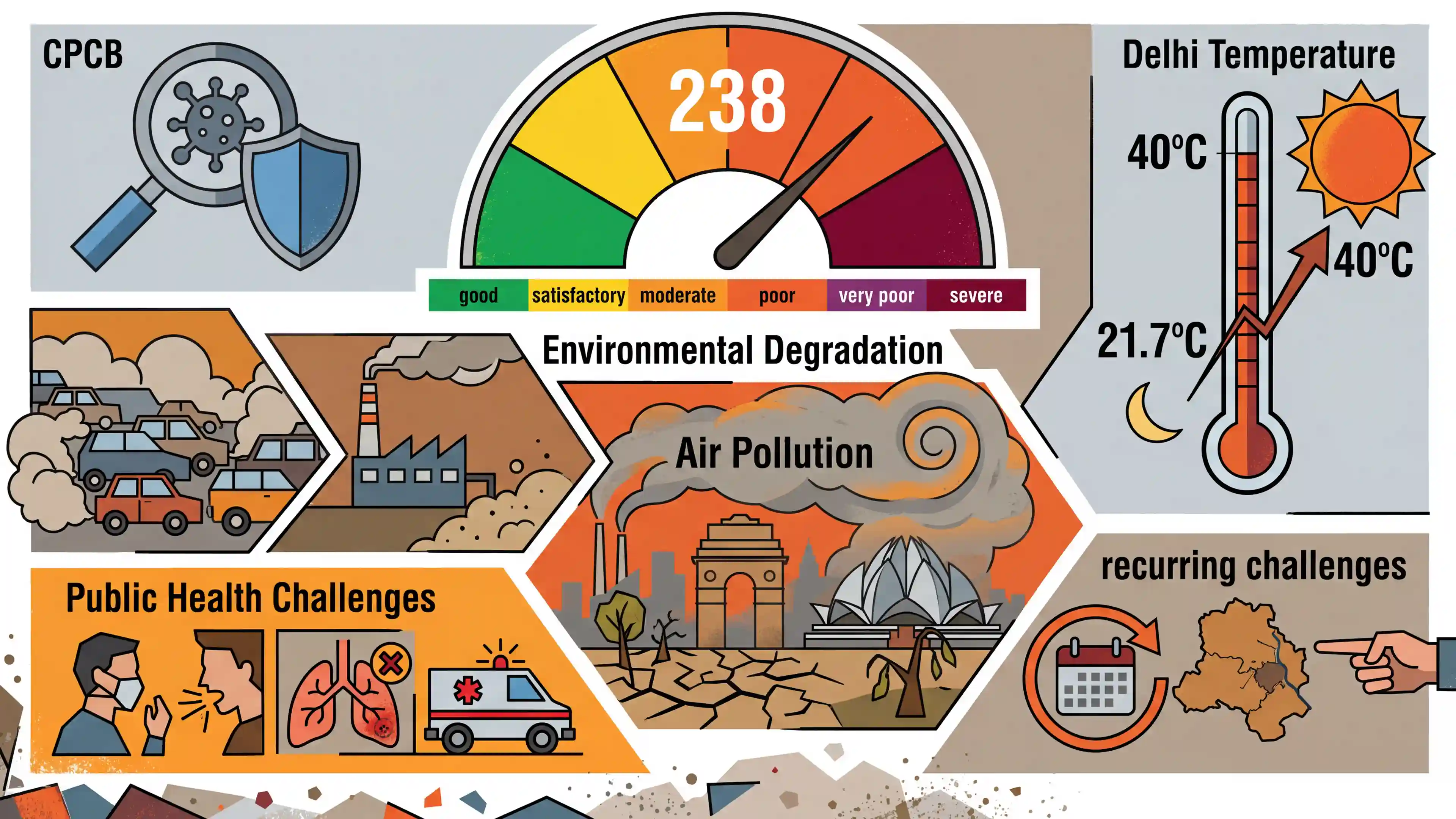
Delhi recently reported an Air Quality Index (AQI) of 238, falling into the 'poor' category based on readings by the Central Pollution Control Board (CPCB). Along with the declining air quality, the city recorded a minimum temperature of 21.7°C, with daytime maximums forecasted to reach 40°C by the India Meteorological Department. The recurring poor air quality in the capital underscores significant environmental and public health challenges related to urban air pollution.
Key Points
- Delhi's Air Quality Index (AQI) was recorded in the 'poor' category with a reading of 238, as per Central Pollution Control Board (CPCB) data.
- The CPCB classifies AQI from 0-50 as 'good', 51-100 as 'satisfactory', 101-200 as 'moderate', 201-300 as 'poor', 301-400 as 'very poor', and 401-500 as 'severe'.
- Delhi experienced a minimum temperature of 21.7 degrees Celsius, and the IMD predicted a maximum temperature of around 40 degrees Celsius.
Important Terms
Air Quality Index (AQI)

A tool developed by the CPCB to communicate air quality status. It tracks eight pollutants (PM2.5, PM10, NO2, SO2, CO, O3, NH3, Pb) and categorizes them into six color-coded levels from 'Good' to 'Severe'.
UPSC context
GS Paper III: Environment. Essential for understanding pollution monitoring frameworks and health-based policy interventions like the Graded Response Action Plan (GRAP).
Central Pollution Control Board (CPCB)
A statutory organization under the Ministry of Environment, Forest and Climate Change. Established in 1974, it coordinates state boards and provides technical services for the prevention and control of air and water pollution.
UPSC context
GS Paper II & III: Statutory Bodies. A key institutional framework for environmental governance and national pollution standards in India.
India Meteorological Department (IMD)
The principal agency under the Ministry of Earth Sciences for meteorological observations and weather forecasting. It monitors phenomena like monsoons, cyclones, and temperatures, and provides early warnings for disaster management.
UPSC context
GS Paper I & III: Geography and Disaster Management. Crucial for understanding India's climate, monsoon variability, and earthquake monitoring (seismology).
Prelims Trap
"The CPCB is a statutory body constituted under the Air (Prevention and Control of Pollution) Act, 1981."
CPCB was originally constituted under the Water (Prevention and Control of Pollution) Act, 1974. It was only later entrusted with additional powers under the 1981 Air Act.
Static Concepts Connected
Which 8 pollutants are measured to calculate the National Air Quality Index (NAQI)?
- Particulate Matter: Includes PM10 and PM2.5, which are microscopic inhalable particles that can penetrate deep into the respiratory tract.
- Toxic Gases: Nitrogen Dioxide (NO2), Sulphur Dioxide (SO2), Carbon Monoxide (CO), Ozone (O3), and Ammonia (NH3).
- Heavy Metals: Lead (Pb) is the only heavy metal tracked. Crucially, major greenhouse gases like Carbon Dioxide (CO2) and Methane are excluded from the index.
What is the statutory framework managing severe pollution spikes in the Delhi-NCR region?
- CAQM: The Commission for Air Quality Management (CAQM) is a statutory body established in 2021 to oversee NCR pollution, holding overriding powers over CPCB and state pollution boards.
- GRAP Mechanism: CAQM enforces the Graded Response Action Plan (GRAP), a dynamic mechanism that triggers progressive emergency measures (like halting construction) as AQI moves from Poor to Severe+.
Cross-Topic Patterns
NAAQS vs WHO guideline disparities
India's National Ambient Air Quality Standards (NAAQS) remain much more lenient (PM2.5 limit of 60 µg/m³) than the revised WHO guidelines (15 µg/m³), impacting urban health outcomes and environmental policy alignments.
Meteorology and winter temperature inversions
Delhi's landlocked geography, combined with winter temperature inversions and north-westerly winds carrying stubble-burning emissions, routinely creates a 'pollution dome', linking atmospheric meteorology directly to public health crises.

Expect a Prelims question contrasting the 8 NAQI pollutants with greenhouse gases, alongside a catch on CPCB's statutory origins.
Linked PYQs · 2
Linked PYQs · 2
- 2016PrelimsGS1
In the cities of our country, which among the following atmospheric gases are normally considered in calculating the value of Air Quality Index? 1. Carbon dioxide 2. Carbon monoxide 3. Nitrogen dioxide 4. Sulfur dioxide 5. Methane Select the correct answer using the code given below.
- 2022PrelimsGS1
In the context of WHO Air Quality Guidelines, consider the following statements: 1. The 24-hour mean of PM2.5 should not exceed 15 µg/m³ and annual mean of PM2.5 should not exceed 5 µg/m³. 2. In a year, the highest levels of ozone pollution occur during the periods of inclement weather. 3. PM10 can penetrate the lung barrier and enter the bloodstream. 4. Excessive ozone in the air can trigger asthma. Which of the statements given above are correct?
