प्रदूषण कम करने के लिए सीमावर्ती टोल प्लाजा पर सुप्रीम कोर्ट के निर्देश
स्रोत:द हिंदू ↗
क्यों मायने रखता है
The article is critical for UPSC aspirants as it demonstrates the multidimensional approach required to tackle urban air pollution. It links environmental regulations (CAQM, GRAP, BS emission norms) with infrastructure governance (NHAI, MCD toll plazas) and highlights the socio-economic impacts of environmental policies on vulnerable groups like unorganized construction workers.
सारांश
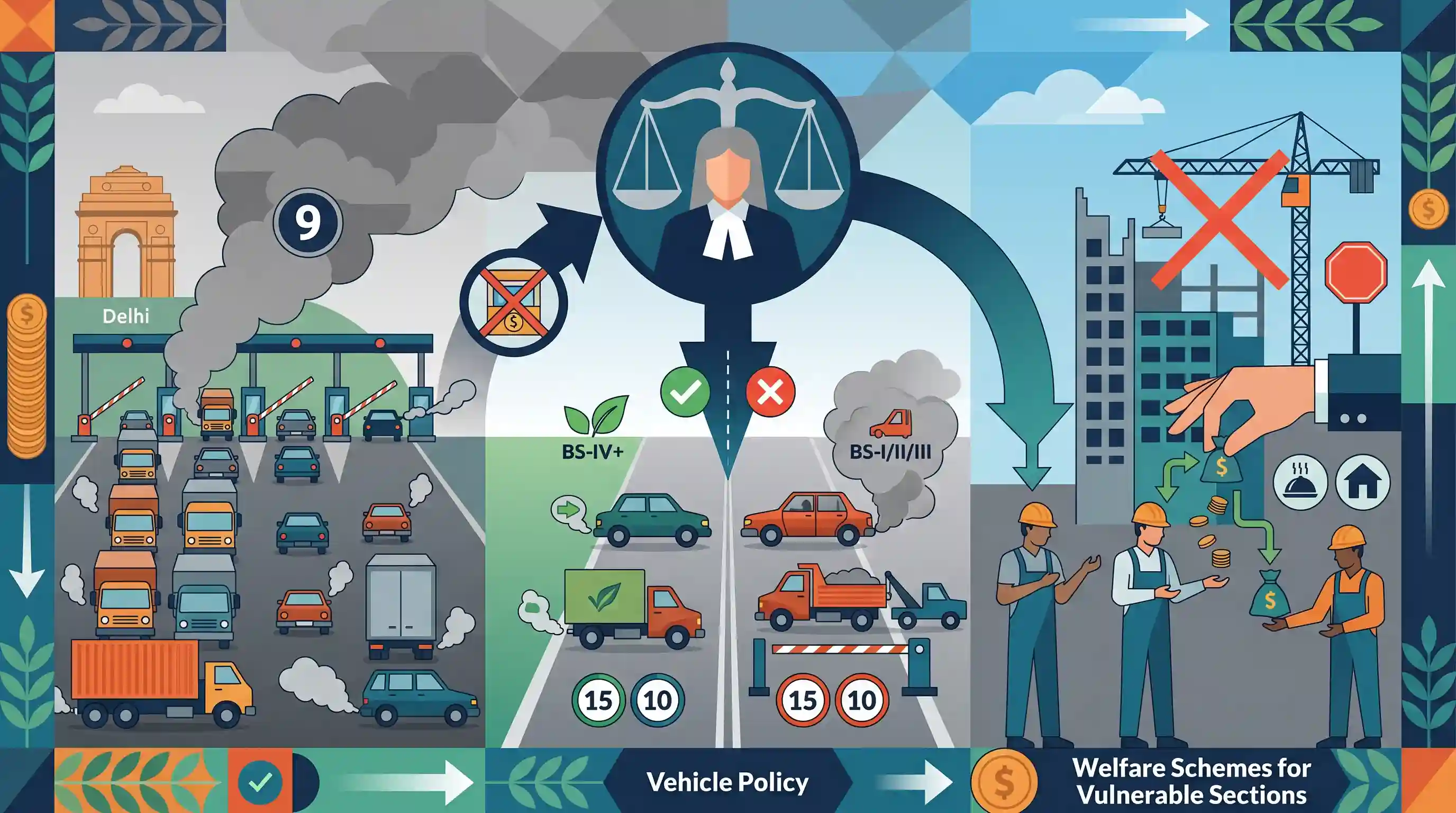
The Supreme Court of India has intervened to address Delhi's severe winter air pollution by targeting vehicular emissions and administrative bottlenecks. It directed the MCD and NHAI to explore suspending or relocating nine toll plazas at Delhi borders to prevent vehicle idling. Furthermore, the Court provided relief to owners of 15-year-old petrol and 10-year-old diesel vehicles complying with BS-IV or higher norms, while maintaining strict action against older BS-I to BS-III vehicles. Highlighting the socio-economic fallout of environmental policies, the SC also ordered authorities to ensure that construction workers receive their subsistence allowance when construction activities are banned under the Graded Response Action Plan (GRAP).
मुख्य बिंदु
- The Supreme Court asked the MCD and NHAI to consider suspending or shifting nine toll collection booths at Delhi's borders to reduce vehicular congestion and air pollution.
- The Court suggested that NHAI could manage these booths during the critical winter pollution months (October to January).
- Modifying its previous order on end-of-life vehicles, the SC directed that no coercive action should be taken against petrol and diesel vehicles over 15 and 10 years old respectively, provided they meet BS-IV or higher emission standards.
- BS-III, II और I मॉडलों के पुराने और अधिक प्रदूषण फैलाने वाले वाहनों के खिलाफ दंडात्मक कार्रवाई नियमों के अनुसार जारी रहेगी।
- The Court also directed the labour welfare department to monitor and ensure the payment of subsistence allowances to construction workers who lose their livelihoods during GRAP-induced construction bans.
महत्वपूर्ण शब्द
Graded Response Action Plan (GRAP)

An emergency framework of stage-wise measures (Stage I to IV) activated based on Air Quality Index levels to curb seasonal air pollution in the Delhi-NCR region.
UPSC context
GS Paper III (Environment); tests administrative mechanisms for pollution control and crisis management in urban settings.
Bharat Stage (BS) emission standards
National regulatory standards, based on European norms, that set permissible limits for pollutants emitted by internal combustion engine vehicles, with BS-VI being the current requirement.
UPSC context
GS Paper III (Environment/S&T); focuses on policy transitions to reduce vehicular emissions and improve air quality.
Commission for Air Quality Management (CAQM)
2021 में स्थापित एक सांविधिक निकाय, जिसका कार्य दिल्ली, हरियाणा, पंजाब, राजस्थान और उत्तर प्रदेश में वायु गुणवत्ता प्रबंधन रणनीतियों का समन्वय, अनुसंधान और प्रवर्तन करना है।
UPSC context
GS Paper II (Statutory Bodies); tests understanding of specialized governance and inter-state environmental regulation.
National Highways Authority of India (NHAI)
An autonomous statutory body under the Ministry of Road Transport and Highways responsible for developing, maintaining, and managing India's National Highways network and toll systems.
UPSC context
GS Paper III (Infrastructure/Economy); relevant for transportation planning and statutory body functions.
Municipal Corporation of Delhi (MCD)
One of the world's largest municipal bodies, responsible for providing civic services and managing local infrastructure, including toll collection at border entry points, in Delhi.
UPSC context
GS Paper II (Local Governance); tests roles of urban local bodies in implementing environmental and infrastructure directives.
Subsistence Allowance
A mandatory financial aid provided to registered construction workers to compensate for loss of wages when construction activities are prohibited under pollution control measures.
UPSC context
GS Paper II (Social Justice); tests knowledge of welfare protections for vulnerable labor groups during environmental emergencies.
प्रारंभिक ट्रैप
दिल्ली-NCR में बिना किसी अपवाद के सभी 10 साल पुराने डीजल और 15 साल पुराने पेट्रोल वाहनों के परिचालन पर कड़ाई से प्रतिबंध है।
The Supreme Court recently modified this blanket ban, exempting vehicles that meet BS-IV or higher emission standards from coercive phase-out actions.
संबंधित अवधारणाएँ
What is the statutory backing for CAQM and GRAP?
- Statutory Status: CAQM is a statutory body established under the CAQM in NCR and Adjoining Areas Act, 2021, replacing the earlier Supreme Court-mandated EPCA.
- GRAP Enforcement: GRAP is a stage-wise emergency response mechanism triggered by AQI thresholds (Stages I to IV), enforced by CAQM to combat severe air pollution.
How does the Building and Other Construction Workers (BOCW) Act function?
- Cess Collection: It levies a 1-2% cess on the total cost of construction projects to fund social security schemes for unorganized construction workers.
- राज्य कल्याण बोर्ड: The Act mandates State Governments to constitute Welfare Boards, which register workers and disburse benefits like subsistence allowances during work stoppages.
अंतर-विषय पैटर्न
Eco-conservation vs. Labor Welfare
Environmental bans (like GRAP halting construction) disproportionately hit the unorganized sector. The SC's push for BOCW cess utilization bridges ecology with social security mandates.
Bharat Stage Norms and Fuel Tech
Transitioning from BS-IV to BS-VI (skipping BS-V) slashed sulphur content from 50 ppm to 10 ppm, requiring concurrent upgrades in both fuel refineries and vehicle engines.

Expect a multi-statement question interlinking CAQM's statutory powers under GRAP with the utilization of BOCW cess for unorganized workers.
संबद्ध PYQ · 3
संबद्ध PYQ · 3
- 2021MainsGS3
Describe the key points of the revised Global Air Quality Guidelines (AQGs) recently released by the World Health Organisation (WHO). How are these different from its last update in 2005? What changes in India's National Clean Air Programme are required to achieve these revised standards?
- 2023MainsGS2
“Development and welfare schemes for the vulnerable, by its nature, are discriminatory in approach.” Do you agree? Give reasons for your answer.
- 2025PrelimsGS1
Artificial way of causing rainfall to reduce air pollution makes use of
