Judicial intervention on relocating coal industries from Delhi NCR
Source:The Hindu ↗
Why It Matters
Highlights the persistent air pollution crisis in Delhi-NCR and the critical roles played by judicial oversight (Supreme Court) and statutory bodies (CAQM) in pushing for systemic, long-term environmental reforms, such as phasing out coal dependency in thermal plants and industries.
Summary
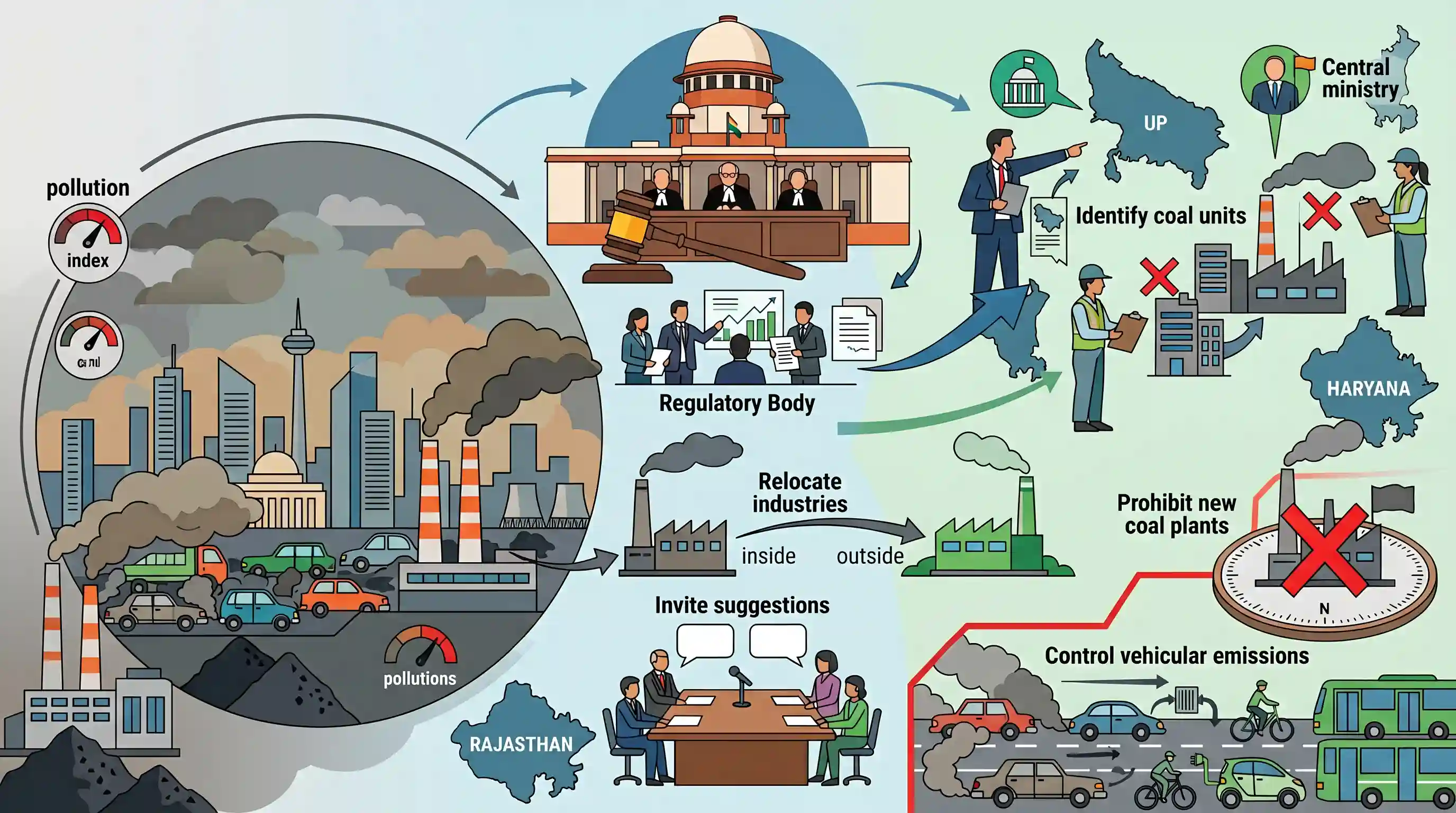
The Supreme Court has sought responses from the Centre regarding a proposal by the Commission for Air Quality Management (CAQM) to relocate coal-based industries out of the Delhi-NCR region. A three-judge Bench headed by CJI Surya Kant directed the Ministries of Environment, Power, and Petroleum, as well as the states of Uttar Pradesh, Haryana, and Rajasthan, to identify coal-dependent units and invite stakeholder suggestions. The Court will also examine CAQM’s recommendation to prohibit new coal-based thermal power plants within 300 km of Delhi and its long-term measures for controlling vehicular emissions.
Key Points
- The Supreme Court asked the Centre to consider a proposal to shift coal-based industries out of the Delhi-NCR region to ensure clean air.
- A three-judge Bench headed by CJI Surya Kant sought responses from the Ministries of Environment, Power, and Petroleum.
- The recommendations were originally mooted by the Commission for Air Quality Management (CAQM).
- CAQM also recommended barring the establishment of any new coal-based thermal power plants within a 300-km radius of Delhi.
- The Centre has been asked to identify coal-dependent industries, while Uttar Pradesh, Haryana, and Rajasthan were directed to issue public notices inviting stakeholder suggestions.
Important Terms
Commission for Air Quality Management (CAQM)

A statutory body established under the 2021 Act to coordinate and oversee air quality management in Delhi-NCR and adjoining states (Punjab, Haryana, Rajasthan, and UP).
UPSC context
GS Paper 3: Environmental Pollution; GS Paper 2: Statutory/Regulatory Bodies. Tests knowledge of institutional frameworks for pollution control.
National Capital Region (NCR)
A multi-state planning region centered on Delhi, encompassing districts of Haryana, Uttar Pradesh, and Rajasthan, treated as a single unit for air quality and industrial regulation.
UPSC context
GS Paper 1: Urbanization/Geography; GS Paper 3: Environmental Governance. Essential for understanding regional jurisdiction of pollution norms.
Thermal Power Plants (TPPs)
Facilities generating electricity through coal combustion; identified as major stationary sources of air pollutants (SOx, NOx, PM) subject to stringent 300km-radius restrictions around Delhi.
UPSC context
GS Paper 3: Energy and Infrastructure. Tests understanding of coal dependency and emission-control technologies (like FGD).
Ministry of Environment, Forest and Climate Change (MoEFCC)
The nodal central agency for planning, promotion, and coordination of environmental and forestry programs; responsible for implementing the Environment (Protection) Act, 1986.
UPSC context
GS Paper 2: Government Policies. Tests knowledge of the executive’s role in environmental policy-making and enforcement.
Judicial Activism in Environmental Matters
The judiciary’s proactive role in environmental policy through Public Interest Litigations (PILs), often directing the executive to implement specific pollution abatement measures.
UPSC context
GS Paper 2: Separation of Powers; Judiciary. Evaluates the impact of court orders on executive policy and environmental rights.
Piped Natural Gas (PNG)
A cleaner hydrocarbon alternative to coal for industrial use; its infrastructure expansion is mandated by CAQM to transition NCR industries away from polluting fuels.
UPSC context
GS Paper 3: Energy Transition. Tests knowledge of cleaner fuel alternatives in the context of industrial pollution control.
Prelims Trap
"CAQM directions are merely advisory and are subordinate to the Central Pollution Control Board (CPCB)."
CAQM is a powerful statutory body. By law, its orders and directives explicitly override those of the CPCB and State Pollution Control Boards in case of conflict over NCR pollution.
Static Concepts Connected
What are the statutory powers and jurisdiction of the CAQM?
- Statutory Backing: Established under the Commission for Air Quality Management in National Capital Region and Adjoining Areas Act, 2021.
- Overriding Powers: In case of conflict regarding air quality management, CAQM's orders legally prevail over both the CPCB and State Pollution Control Boards.
- Geographic Jurisdiction: Covers Delhi and adjoining states (Punjab, Haryana, Rajasthan, UP) specifically for issues impacting air quality within the NCR.
Why is domestic Indian coal highly polluting for NCR industries?
- High Ash Content: Indian coal averages 30-45% ash content, leading to massive particulate matter (PM2.5/PM10) generation and severe fly ash disposal challenges.
- Low Calorific Value: Due to lower energy yield, industries must burn significantly larger quantities of coal to generate equivalent power, multiplying total emission volumes.
Cross-Topic Patterns
Judicial Intervention & Article 21
The SC directing ministries to identify coal units highlights GS2 judicial activism, using Article 21's Right to Clean Environment to compel executive action on climate policy and pollution control.
Just Transition for MSMEs
Shifting coal-dependent industries links to GS3 Economy. Forced green transitions risk sudden capital expenditure burdens, stranded assets, and job losses in unorganized MSME clusters in the NCR.

Expect a multi-statement Prelims question comparing the overriding statutory powers of CAQM against the CPCB and State Pollution Boards.
Linked PYQs · 5
Linked PYQs · 5
- 2014MainsGS3
Environmental Impact Assessment studies are increasingly undertaken before a project is cleared by the Government. Discuss the environmental impacts of coal-fired thermal plants located at coal pitheads.
- 2021MainsGS3
Describe the key points of the revised Global Air Quality Guidelines (AQGs) recently released by the World Health Organisation (WHO). How are these different from its last update in 2005? What changes in India's National Clean Air Programme are required to achieve these revised standards?
- 2022MainsGS2
“The most significant achievement of modern law in India is the constitutionalization of environmental problems by the Supreme Court.” Discuss this statement with the help of relevant case laws.
- 2020PrelimsGS1
Consider the following statements: 1. Coal ash contains arsenic, lead and mercury. 2. Coal-fired power plants release sulphur dioxide and oxides of nitrogen into the environment. 3. High ash content is observed in Indian coal. Which of the statements given above is/are correct?
- 2023PrelimsGS1
Consider the following statements regarding mercury pollution: 1. Gold mining activity is a source of mercury pollution in the world. 2. Coal-based thermal power plants cause mercury pollution. 3. There is no known safe level of exposure to mercury. How many of the above statements are correct?
