Supreme Court Notice on Shifting Coal Industries out of NCR
Source:The Hindu ↗
Why It Matters
Illustrates the evolving judicial and regulatory approach toward tackling systemic air pollution in urban centers, specifically targeting heavy industry and coal dependency. Important for GS3 Environment and GS2 Governance (role of statutory bodies like CAQM).
Summary
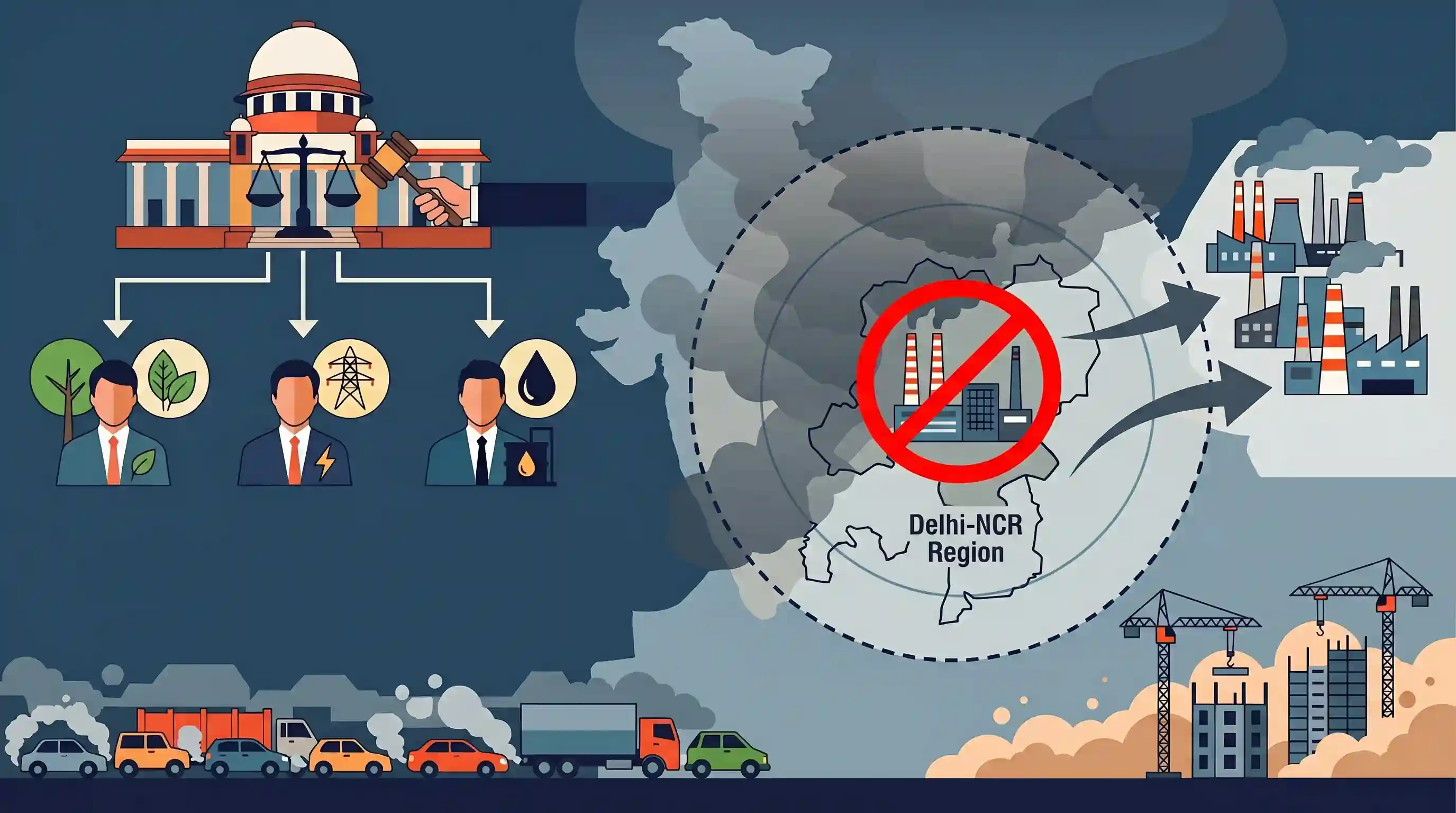
The Supreme Court has directed the Union Ministries of Environment, Power, and Petroleum to respond to a Commission for Air Quality Management (CAQM) proposal aimed at addressing severe air pollution in Delhi-NCR. The proposal recommends shifting coal-reliant industries outside the NCR and prohibiting new coal-based thermal power plants within 300 km of Delhi. The top court's scrutiny also encompasses broader pollution vectors, including vehicular emissions and construction dust.
Key Points
- The Supreme Court has sought a response from the Union Government on a proposal to shift coal-based industries outside the Delhi-NCR to curb air pollution.
- The recommendation was formulated by the Commission for Air Quality Management (CAQM), an expert body addressing the capital's recurring air quality crisis.
- The CAQM proposal further recommends barring the establishment of new coal-based thermal power plants within a 300 km radius of Delhi.
- The Supreme Court is concurrently seeking updates on strategies to mitigate vehicular emissions and manage dust pollution stemming from construction and demolition activities.
Important Terms
Commission for Air Quality Management (CAQM)

A statutory body established under the CAQM Act 2021 to coordinate and oversee air quality management in Delhi-NCR and adjoining states, possessing overriding authority over other pollution boards.
UPSC context
GS Paper 2/3: Important for statutory bodies, environmental governance, and cooperative federalism in pollution control.
Ministry of Environment, Forest and Climate Change (MoEFCC)
The nodal ministry for planning and overseeing India’s environmental and forest policies. It formulates the National Clean Air Programme (NCAP) and notifies the Graded Response Action Plan (GRAP).
UPSC context
GS Paper 2/3: Key executive body for environmental regulation and policy implementation.
Graded Response Action Plan (GRAP)
An emergency framework of measures implemented in stages based on Delhi-NCR's Air Quality Index (AQI), ranging from dust control to banning coal-based industries and heavy vehicle entry.
UPSC context
GS Paper 3: Environmental Pollution. Critical for understanding urban air quality crisis management.
Supreme Court of India (Environmental Jurisdiction)
Acts as the custodian of the Constitution, interpreting Article 21 (Right to Life) to include the right to a healthy environment, thereby driving policy through judicial activism and continuing mandamus.
UPSC context
GS Paper 2: Judicial activism, Fundamental Rights, and the separation of powers in environmental law.
Ministry of Power
The ministry responsible for the power sector and energy transition. In NCR, it monitors coal-based plants for emission compliance and enforces biomass co-firing targets to reduce pollution.
UPSC context
GS Paper 3: Infrastructure and Energy. Relevant for the shift from coal to renewable/cleaner energy.
Ministry of Petroleum and Natural Gas (MoPNG)
Responsible for exploring and distributing natural gas. In the pollution context, it facilitates shifting NCR industries from coal to gas and promotes Compressed Biogas (CBG) infrastructure.
UPSC context
GS Paper 3: Energy transition and industrial pollution mitigation through cleaner fuel alternatives.
Prelims Trap
"CAQM is a Supreme Court-appointed body drawing its powers from the Environment (Protection) Act, 1986."
CAQM is a statutory body created by its own 2021 Act, replacing the SC-appointed EPCA. Its orders explicitly override CPCB and State Pollution Control Boards in the NCR.
Static Concepts Connected
What is the jurisdiction and authority of the Commission for Air Quality Management (CAQM)?
- Statutory Status: Established under the CAQM Act 2021, marking a shift from executive bodies by replacing the Supreme Court-appointed EPCA.
- Jurisdiction: Covers Delhi and NCR districts in adjoining states (Punjab, Haryana, Rajasthan, and Uttar Pradesh).
- Overriding Power: In matters of air quality in the NCR, CAQM directives supersede orders from the CPCB and respective State PCBs.
What pollutants do coal thermal plants emit and how are they mitigated?
- Primary Emissions: They release massive quantities of SO2, NOx, particulate matter, and toxic heavy metals including mercury, arsenic, and lead.
- Secondary Aerosols: Emitted SO2 and NOx chemically react with atmospheric ammonia to form dangerous secondary particulate matter (like ammonium sulphate).
- Mitigation (FGD): Flue Gas Desulphurisation (FGD) systems are legally mandated to scrub SO2 from exhaust gases before release, though implementation lags.
Cross-Topic Patterns
Energy Transition vs Grid Stability
Banning coal plants near Delhi shifts the baseload burden to renewables and distant grids, highlighting the GS-3 tension between clean air mandates and summer peak power security.
Judicial continuous mandamus in environment
The Supreme Court's ongoing scrutiny of executive action on pollution reflects 'continuous mandamus', a staple GS-2 theme where courts persistently monitor administrative compliance in environmental jurisprudence.

CAQM's statutory override over CPCB, combined with FGD technology and secondary aerosol formation, is a prime multi-statement Prelims target.
Linked PYQs · 5
Linked PYQs · 5
- 2021MainsGS3
Describe the key points of the revised Global Air Quality Guidelines (AQGs) recently released by the World Health Organisation (WHO). How are these different from its last update in 2005? What changes in India's National Clean Air Programme are required to achieve these revised standards?
- 2024MainsGS3
Industrial pollution of river water is a significant environmental issue in India. Discuss the various mitigation measures to deal with this problem and also the government's initiatives in this regard.
- 2020PrelimsGS1
Consider the following statements: 1. Coal ash contains arsenic, lead and mercury. 2. Coal-fired power plants release sulphur dioxide and oxides of nitrogen into the environment. 3. High ash content is observed in Indian coal. Which of the statements given above is/are correct?
- 2025PrelimsGS1
Consider the following statements : I. Carbon dioxide (CO2) emissions in India are less than 0.5 t CO2/ capita. II. In terms of CO2 emissions from fuel combustion, India ranks second in Asia-Pacific region. III. Electricity and heat producers are the largest sources of CO2 emissions in India. Which of the statements given above is/are correct?
- 2014MainsGS3
Environmental Impact Assessment studies are increasingly undertaken before a project is cleared by the Government. Discuss the environmental impacts of coal-fired thermal plants located at coal pitheads.
