Delhi air pollution public health crisis and policy priorities
Source:The Hindu ↗
Why It Matters
Delhi's air pollution is a recurring theme in UPSC exams, spanning GS3 (Environment, Infrastructure) and GS2 (Urban Governance, Public Health). The debate over infrastructure investment versus populist subsidies is highly relevant for Mains questions on governance and economic priorities.
Summary
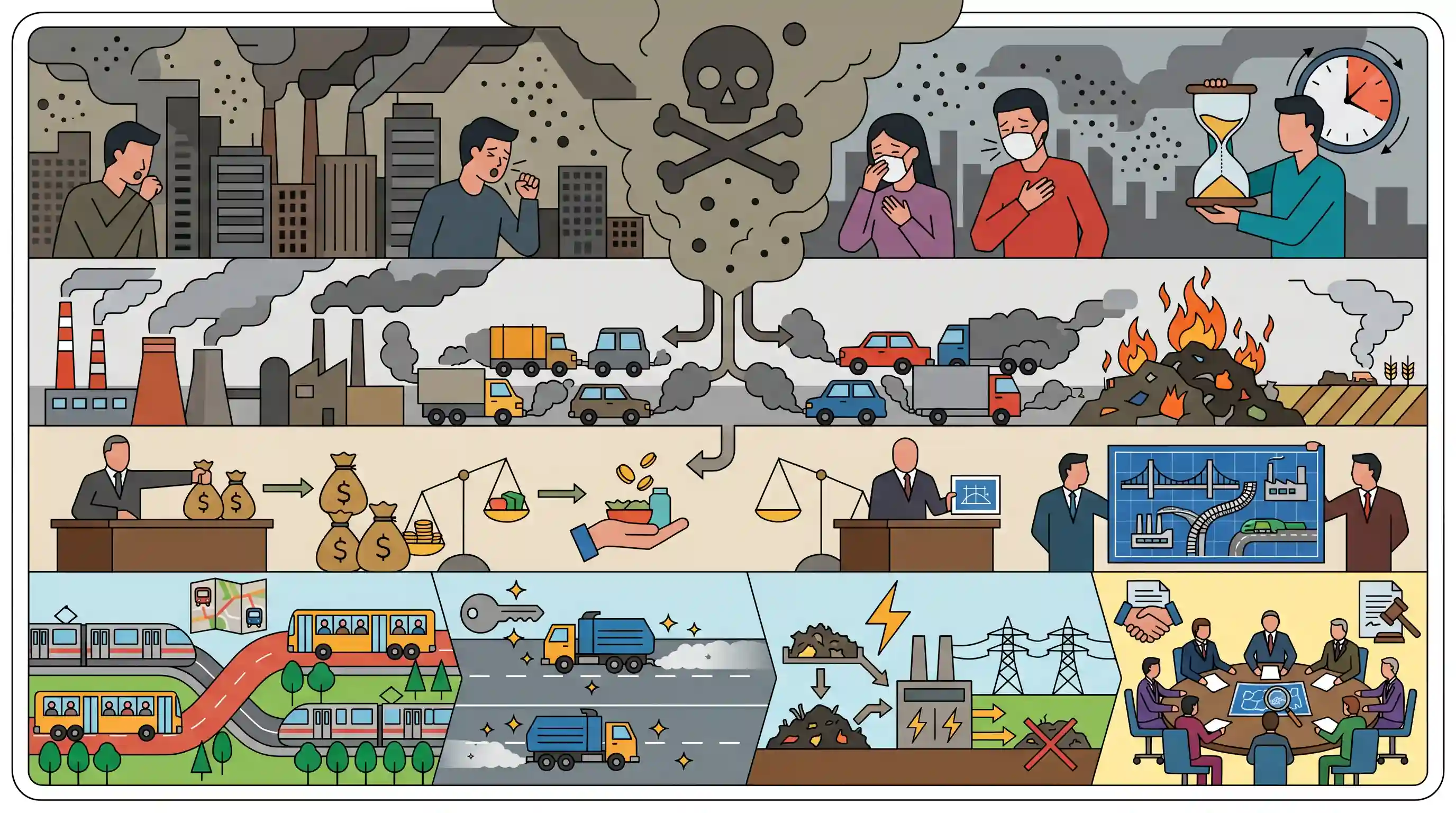
The article underscores the critical public health crisis posed by air pollution in Delhi, which a Congress leader characterized as a "slow poison" significantly reducing life expectancy. The critique targets the incumbent AAP and BJP governments, accusing them of prioritizing populist "freebies" over crucial infrastructural investments needed to combat pollution. It argues that vehicular emissions, industrial waste, and garbage burning are the core contributors, rather than seasonal issues like stubble burning. Suggested long-term solutions include a massive expansion of public transportation (buses and metro), modernizing road maintenance (vacuum cleaning), adopting waste-to-energy plants to replace landfills, and establishing a bipartisan MP-level committee to address the crisis comprehensively.
Key Points
- Delhi's severe air pollution is described as a 'slow poison' responsible for reducing the average lifespan by 6-7 years.
- Congress leader Sandeep Dikshit asserts that vehicular emissions (about 35%), industrial pollution, and garbage burning are the primary causes, minimizing the impact of stubble burning and firecrackers.
- Proposed interventions include doubling the public bus fleet to 15,000-20,000, expanding the metro network, and adopting waste-to-energy plants instead of dumping waste in landfills.
- Dikshit called for an MP-level committee involving all stakeholders to collaboratively address the environmental crisis in a non-partisan manner.
- The article highlights the tension between governance priorities, criticizing the AAP and BJP for prioritizing 'populist politics' and freebies over long-term infrastructure investment.
Important Terms
Stubble Burning

Intentional burning of crop residue (paddy straw) by farmers to quickly clear fields for the next sowing season, notably in Punjab and Haryana.
UPSC context
GS Paper III (Environment/Agriculture); crucial for understanding seasonal air pollution in North India and crop residue management.
PM 2.5 (Particulate Matter)
Fine inhalable particles (diameter ≤ 2.5 micrometers) that penetrate deep into the lungs and bloodstream, causing severe respiratory and cardiovascular health issues.
UPSC context
GS Paper III (Environment); key indicator for Air Quality Index (AQI) and public health impact of pollution.
Waste-to-Energy (WTE) Plants
Facilities that convert non-recyclable solid waste into electricity or heat through processes like incineration, gasification, or biomethanation.
UPSC context
GS Paper III (Environment/SWM); tests knowledge of scientific waste disposal and renewable energy solutions.
Solid Waste Management (SWM)
The systematic process of collecting, segregating (at source), and treating solid waste to minimize environmental impact and landfill use.
UPSC context
GS Paper III (Environment); critical for urban governance and sustainability under the SWM Rules 2016/2026.
Fiscal Populism (Freebies)
Economic policies prioritizing immediate relief (e.g., cash transfers, free utilities) to win votes, often at the expense of long-term infrastructure and fiscal discipline.
UPSC context
GS Paper II/III (Governance/Economy); explores the debate between welfare spending vs. developmental capital expenditure.
Prelims Trap
Stubble burning from neighboring states is the primary contributor to Delhi's year-round PM2.5 pollution.
Stubble burning is a severe but seasonal aggravator (Oct-Nov). Year-round baseline pollution is predominantly local, driven by vehicular emissions, road dust, and industrial activities.
Static Concepts Connected
How does rising revenue expenditure impact environmental governance?
- Revenue Overrun: Un-targeted subsidies (freebies) rapidly increase state revenue expenditure, often pushing state finances close to mandatory FRBM borrowing limits.
- Capital Crowding Out: High revenue spending drastically crowds out essential capital expenditure required for long-term green infrastructure, such as expanded metro networks and public buses.
What are the core mechanisms and impacts of Waste-to-Energy (WtE) plants?
- Thermal Conversion: WtE combusts municipal solid waste to generate electricity and heat, effectively reducing landfill waste volume by up to 80 percent.
- Methane Mitigation: Diverting waste from traditional landfills prevents the anaerobic decomposition of organic matter, directly mitigating the release of potent methane gas.
- Toxic Byproducts: Incineration generates bottom ash and toxic fly ash, necessitating stringent emission scrubbers and specialized hazardous waste disposal protocols.
Cross-Topic Patterns
Federal Friction in NCR Management
Delhi's pollution highlights 7th Schedule overlaps. Transport and municipal governance fall to the state, while NCR air quality management involves the Union, creating persistent accountability voids.
Urban Fiscal Deficit and Mobility
India's acute public bus shortage (1.2 per 1000 people) reflects a broader crisis where urban local bodies lack the fiscal autonomy to fund capital-intensive green mobility.

Expect a 2026 Mains question linking state fiscal deficit (freebies vs capex) to the chronic failure of urban environmental infrastructure.
Linked PYQs · 5
Linked PYQs · 5
- 2020MainsGS3
What are the key features of the National Clean Air Programme (NCAP) initiated by the Government of India?
- 2021MainsGS3
Describe the key points of the revised Global Air Quality Guidelines (AQGs) recently released by the World Health Organisation (WHO). How are these different from its last update in 2005? What changes in India's National Clean Air Programme are required to achieve these revised standards?
- 2018MainsGS3
What are the impediments in disposing the huge quantities of discarded solid wastes which are continuously being generated? How do we remove safely the toxic wastes that have been accumulating in our habitable environment?
- 2022PrelimsGS1
In the context of WHO Air Quality Guidelines, consider the following statements: 1. The 24-hour mean of PM2.5 should not exceed 15 µg/m³ and annual mean of PM2.5 should not exceed 5 µg/m³. 2. In a year, the highest levels of ozone pollution occur during the periods of inclement weather. 3. PM10 can penetrate the lung barrier and enter the bloodstream. 4. Excessive ozone in the air can trigger asthma. Which of the statements given above are correct?
- 2019PrelimsGS1
As per the Solid Waste Management Rules, 2016 in India, which one of the following statements is correct?
