NDRF and Paramilitary Deployment in Aviation Disaster Response
Source:Indian Express ↗
Why It Matters
Understanding the mobilization and coordination of forces like the NDRF and paramilitary units during a crisis is crucial for the Disaster Management syllabus. It evaluates India's institutional capacity, standard operating procedures (SOPs), and inter-agency coordination in responding to sudden, large-scale transportation disasters.
Summary
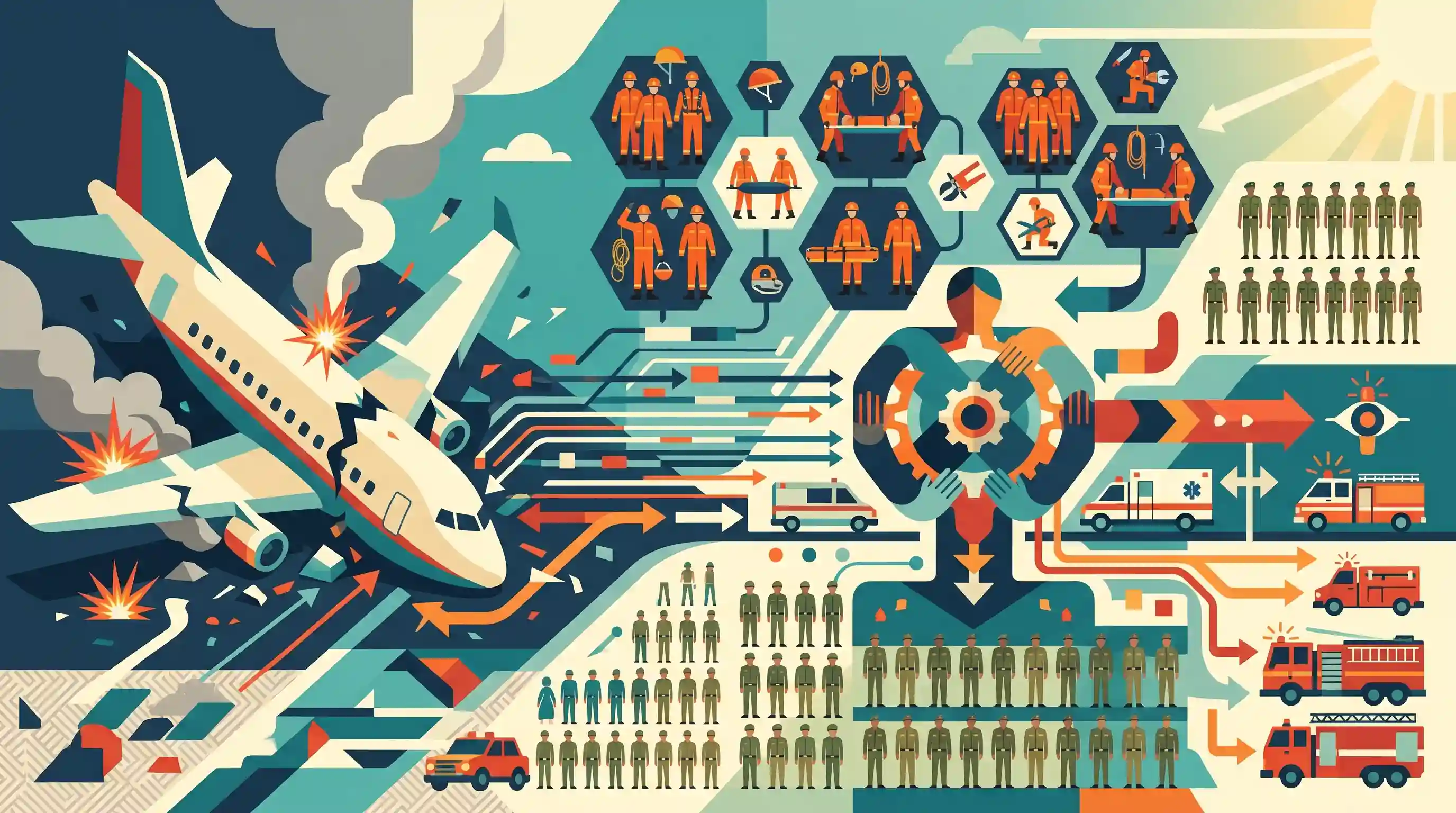
In response to an Air India plane crash, massive rescue and relief operations were rapidly initiated. The deployment included 700 paramilitary personnel alongside six National Disaster Response Force (NDRF) teams to manage the emergency, conduct search and rescue operations, and provide immediate assistance at the crash site. This large-scale mobilization demonstrates the critical role of specialized disaster management forces in handling complex aviation accidents.
Key Points
- Following an Air India plane crash, a massive rescue and relief operation was launched, deploying 700 paramilitary personnel and six NDRF teams to the site.
- The rapid mobilization of these national forces highlights the critical importance of a coordinated, inter-agency response to manage large-scale transportation disasters efficiently.
- This incident underscores the role of robust disaster management frameworks and the readiness of specialized response units in mitigating the fallout from aviation emergencies.
Important Terms
National Disaster Response Force (NDRF)

India's specialized force for responding to natural and man-made disasters. Established in 2006, it operates under the Ministry of Home Affairs and is manned by personnel from Central Armed Police Forces.
UPSC context
GS Paper III: Disaster Management. Tests knowledge of institutional frameworks for emergency response and specialized rescue operations.
Paramilitary Forces
Includes forces like BSF, CRPF, and CISF that provide critical manpower and specialized skills (e.g., firefighting, crowd control) for rapid deployment during large-scale emergencies and disaster relief.
UPSC context
GS Paper III: Security Forces and Disaster Management. Tests understanding of the role of various security agencies in internal crises.
Disaster Management Act, 2005
The primary legal framework in India for managing disasters. It mandated the creation of the National Disaster Management Authority (NDMA) and the National Disaster Response Force (NDRF).
UPSC context
GS Paper III: Disaster Management. Fundamental legislation governing disaster response, mitigation, and institutional structure in India.
Aircraft Accident Investigation Bureau (AAIB)
An attached office of the Ministry of Civil Aviation responsible for investigating serious aircraft accidents and incidents in India to enhance aviation safety.
UPSC context
GS Paper III: Infrastructure/Aviation Safety. Important for understanding post-disaster investigation mechanisms and regulatory oversight.
Directorate General of Civil Aviation (DGCA)
The statutory body of the Indian government that regulates civil aviation. It is responsible for safety oversight, licensing, and enforcing aviation standards in India.
UPSC context
GS Paper III: Infrastructure/Aviation. Key regulatory body for transport safety and standards.
Humanitarian Assistance and Disaster Relief (HADR)
Operations conducted by armed and paramilitary forces to provide aid, search and rescue, and essential services to populations affected by natural or man-made disasters.
UPSC context
GS Paper III: Disaster Management/Security. Relevant for discussing the military's role in non-combat civil aid missions.
Prelims Trap
"The Centre holds primary disaster response responsibility, executing it through directly-recruited NDRF cadres."
Disaster response is primarily a State responsibility. Furthermore, NDRF has no direct recruitment; it consists entirely of personnel on deputation from CAPFs.
Static Concepts Connected
What is the institutional structure for Disaster Management under the DMA 2005?
- Apex Body: The National Disaster Management Authority (NDMA), headed by the Prime Minister, is the apex body laying down policies and guidelines.
- Executive Wing: The National Executive Committee (NEC), headed by the Union Home Secretary, assists the NDMA in coordinating response and implementing policies.
- State & District: SDMAs are headed by Chief Ministers, while DDMAs are headed by District Collectors/Magistrates, decentralizing the response mechanism.
How is the National Disaster Response Force (NDRF) constituted and mandated?
- Statutory Origin: It is a statutory force established under Section 44 of the Disaster Management Act, 2005.
- Deputation Only: It has no direct civilian recruitment; battalions are exclusively formed by personnel on deputation from Central Armed Police Forces (CAPFs).
- Supplementary Role: Provides specialized response to natural and man-made disasters, acting as supplementary support when an incident exceeds local coping capacities.
Cross-Topic Patterns
Sendai Framework + Aviation Safety
Links Priority 4 of the Sendai Framework (enhancing disaster preparedness) with the statutory role of the Aircraft Accident Investigation Bureau (AAIB) in post-crash institutional learning.
CAPFs in non-combat roles
Highlights the evolving dual-use of Central Armed Police Forces (CAPFs)—transitioning seamlessly from border management and internal security to critical infrastructure rescue and disaster mitigation.

Expect a multi-statement question on NDRF composition (CAPF deputation vs direct recruitment) and the AAIB's independence from the DGCA.
Linked PYQs · 2
Linked PYQs · 2
- 2020MainsGS3
Discuss the recent measures initiated in disaster management by the Government of India departing from the earlier reactive approach.
- 2019MainsGS3
Disaster preparedness is the first step in any disaster management process. Explain how hazard zonation mapping will help disaster mitigation in the case of landslides.
