Commercial Aviation Fleet Recurring Defects and Safety Oversight
Source:Indian Express ↗
Why It Matters
Highlights the operational and regulatory challenges in India's booming civil aviation sector, emphasizing passenger experience, safety oversight, and airline maintenance standards.
Summary
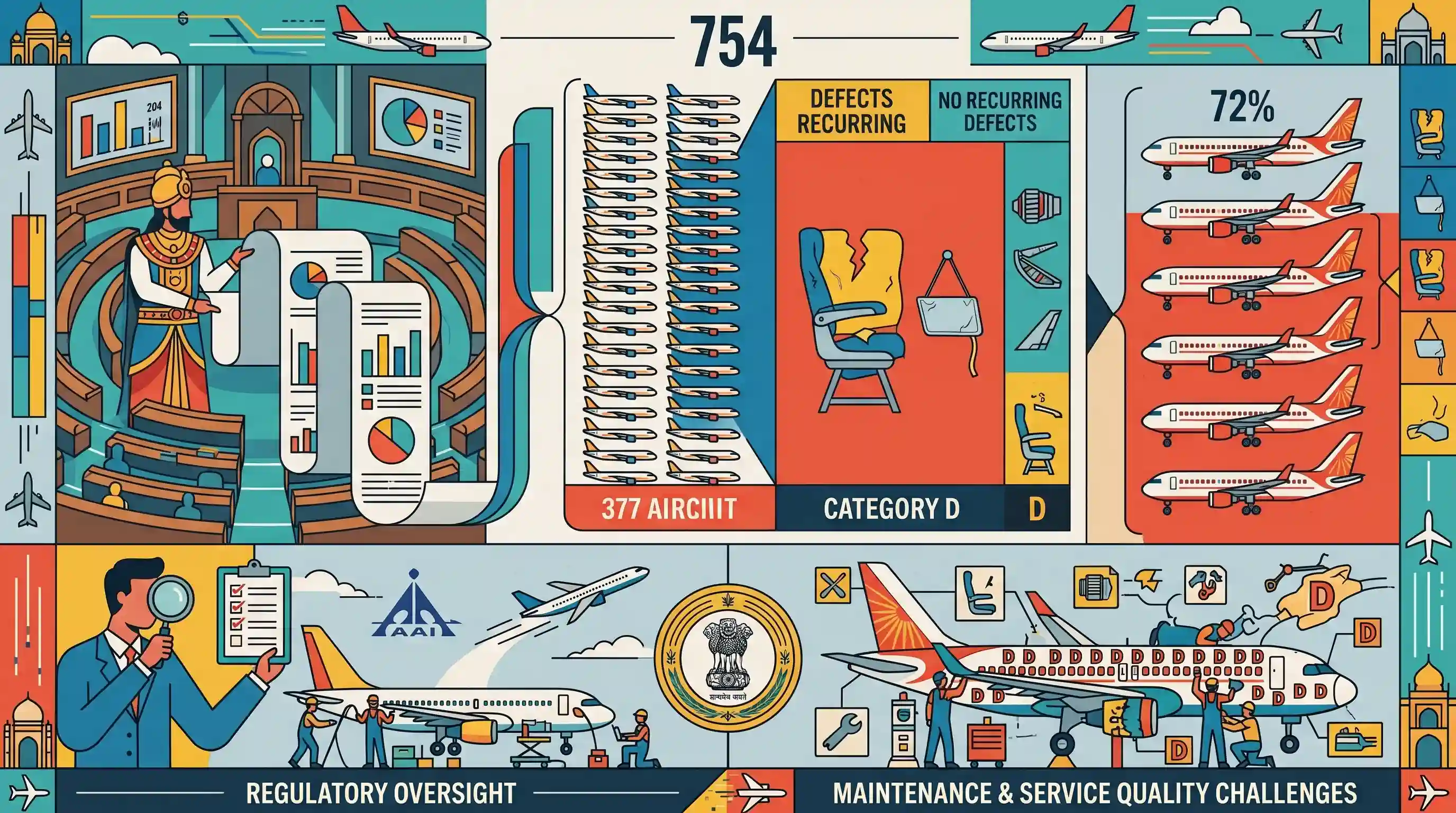
Government data presented in the Lok Sabha revealed that a significant portion of India's commercial aviation fleet, including 72% of the Air India Group's aircraft, has been flagged for recurring defects. Out of 754 aircraft across six scheduled airlines, 377 reported such issues. Most of these defects fall under 'Category D', which pertains to passenger convenience items like seats and tray tables, rather than critical airworthiness or safety issues. This highlights the ongoing maintenance and service quality challenges in the civil aviation sector.
Key Points
- 377 out of 754 aircraft operated by six scheduled Indian airlines were flagged for recurring aircraft defects.
- Approximately 72% of the Air India Group's fleet reported such issues, alongside 148 aircraft from IndiGo.
- The majority of the recurring defects were classified under Category D, which involves non-safety critical passenger amenities like seats, tray tables, and entertainment screens.
- The data underscores the operational and maintenance challenges within India's rapidly expanding civil aviation sector, affecting passenger experience.
Important Terms
Directorate General of Civil Aviation (DGCA)

India's primary civil aviation regulatory body responsible for safety oversight, airworthiness standards, and licensing personnel. It operates as a statutory body under the Ministry of Civil Aviation.
UPSC context
GS-2: Statutory/regulatory bodies; GS-3: Infrastructure. Key for questions on aviation safety reforms and institutional autonomy.
Category D defects
A classification for non-critical aircraft defects that pertain to passenger convenience items—such as broken seats or tray tables—rather than critical flight safety or airworthiness.
UPSC context
GS-3: Infrastructure and Safety. Tests the ability to distinguish between service quality issues and core aviation safety risks.
Air India Group
A private aviation conglomerate owned by Tata Sons, comprising Air India and its low-cost subsidiary Air India Express; currently undergoing a massive post-privatisation restructuring.
UPSC context
GS-3: Economy (Privatisation). Important for discussing disinvestment, market duopolies, and challenges in transitioning from public to private management.
IndiGo
India's largest domestic airline by market share (~60%), known for its low-cost model and significant role in domestic connectivity and market concentration.
UPSC context
GS-3: Infrastructure/Economy. Relevant for topics on market dominance, "duopoly" risks in aviation, and operational resilience.
Lok Sabha
The lower house of India's Parliament where the Ministry of Civil Aviation presented this data, exercising its role of executive oversight and accountability.
UPSC context
GS-2: Parliament—Structure, functioning, and conduct of business. Demonstrates parliamentary oversight of the executive via the "Question Hour."
Ministry of Civil Aviation (MoCA)
The nodal ministry for formulating national policies and programs for the development and regulation of civil aviation in India.
UPSC context
GS-2: Government policies and interventions. Central to discussions on the National Civil Aviation Policy and UDAN scheme.
Prelims Trap
All aircraft defects flagged by the DGCA compromise airworthiness and require immediate grounding.
DGCA classifies defects into categories (A to D). Category D defects involve non-safety-critical passenger amenities like seats and screens, which do not affect immediate airworthiness.
Static Concepts Connected
What is the regulatory and FDI framework for India's aviation MRO sector?
- 100% Automatic FDI: Permitted for MRO facilities, airports, and helicopter services, unlike scheduled passenger domestic airlines which face specific FDI caps.
- NCAP 2016 push: Aims to make India a global MRO hub by rationalizing taxes, such as introducing a uniform 5% IGST on MRO services.
- DGCA CAR alignment: The sector operates under Civil Aviation Requirements (CAR), aligning strictly with international airworthiness standards set by UN-ICAO.
What are the distinct roles of India's aviation regulatory bodies?
- DGCA: Focuses primarily on safety standards, airworthiness, crew licensing, and defect tracking under the Aircraft Rules, 1937.
- AERA: The Airports Economic Regulatory Authority determines tariffs, development fees, and passenger service fees at major airports.
- BCAS: The Bureau of Civil Aviation Security handles security protocols, anti-hijacking measures, and safeguarding aviation infrastructure.
Cross-Topic Patterns
Domestic MRO vs. Make in India
India's lack of robust domestic MRO infrastructure forces airlines to send planes abroad for maintenance, causing forex drain and contradicting indigenous manufacturing and Make in India goals.
Sectoral Regulators and Consumer Rights
The high volume of 'Category D' amenity defects links to ongoing debates over the MoCA's Passenger Charter and DGCA's enforcement of compensation for substandard consumer services.

Prelims 2026 may test aviation FDI limits, specifically contrasting the caps on scheduled airlines versus 100% automatic route for MROs.
Linked PYQs · 2
Linked PYQs · 2
- 2017MainsGS3
Examine the development of Airports in India through joint ventures under Public-Private Partnership (PPP) model. What are the challenges faced by the authorities in this regard?
- 2025PrelimsGS1
GPS-Aided Geo Augmented Navigation (GAGAN) uses a system of ground stations to provide necessary augmentation. Which of the following statements is/are correct in respect of GAGAN? I. It is designed to provide additional accuracy and integrity. II. It will allow more uniform and high quality air traffic management. III. It will provide benefits only in aviation but not in other modes of transportation. Select the correct answer using the code given below.
