Jodhpur Airport Terminal Upgrades Enhance Aviation Services
Source:abplive ↗
Why It Matters
Development of transport infrastructure, particularly airports and civil aviation in key tourist hubs like Jodhpur, directly influences Rajasthan's economic growth, capital formation, and tourism sectors. These developments are highly relevant to RPSC RAS infrastructure and economy syllabus areas.
Summary
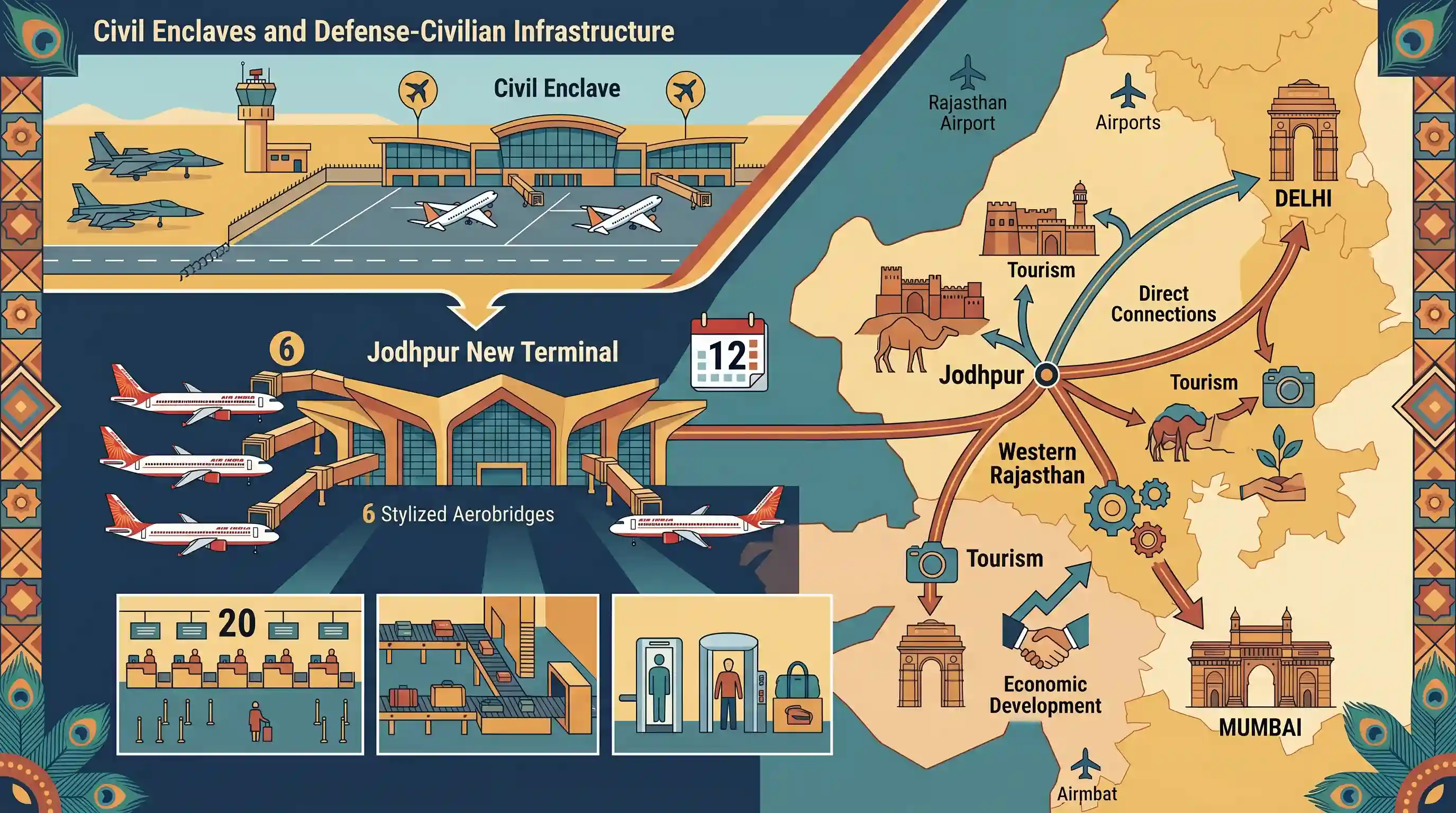
Beginning July 12, 2026, Air India will shift all flight operations at Jodhpur Airport in Rajasthan to its newly built terminal building. Spanning 23,342 square meters, the modern terminal is designed to significantly improve passenger experience with 20 check-in counters, six aerobridges, and advanced security and baggage systems. Air India operates direct connections from Jodhpur to Delhi and Mumbai, facilitating critical tourism and economic links for western Rajasthan.
Key Points
- All Air India flights at Jodhpur Airport will transition to the newly constructed terminal building beginning July 12, 2026.
- The new terminal spans 23,342 square meters and is equipped with modern infrastructure, including 20 check-in counters, advanced security screening, and six aerobridges.
- Air India operates 14 weekly flights between Jodhpur and Mumbai, and 12 weekly flights between Jodhpur and Delhi, linking western Rajasthan to major domestic and international aviation hubs.
- Jodhpur Airport is a key civil enclave in Rajasthan, operating alongside the Indian Air Force base, making civil infrastructure upgrades crucial for dual-use operational efficiency.
Important Terms
Civil Enclave

An area allotted at a military airbase for civilian aviation use, featuring passenger facilities like terminal buildings and check-in counters, typically managed by the Airports Authority of India.
UPSC context
GS Paper 3 (Infrastructure); tests understanding of dual-use civil-military transport facilities and coordination.
Airports Authority of India
A statutory body under the Ministry of Civil Aviation established in 1995, responsible for creating, upgrading, maintaining, and managing India's civil aviation infrastructure and air traffic services.
UPSC context
GS Paper 3 (Infrastructure) and GS Paper 2 (Statutory Bodies); tests knowledge of aviation infrastructure governance.
UDAN Scheme
A flagship regional airport development and air connectivity initiative launched in 2016, aimed at making air travel affordable to the common citizen through Viability Gap Funding.
UPSC context
GS Paper 3 (Infrastructure and inclusive growth); tests knowledge of government initiatives for regional connectivity.
Indian Air Force
The aerial warfare branch of the Indian Armed Forces, responsible for securing Indian airspace, conducting aerial warfare, and co-managing civil enclaves at its strategic airbases.
UPSC context
GS Paper 3 (Security challenges); tests knowledge of civil-military coordination and defense infrastructure.
Air India
India's premier flag carrier, founded by J.R.D. Tata in 1932, nationalised in 1953, and privatised back to the Tata Group in 2022, operating major domestic and international routes.
UPSC context
GS Paper 3 (Privatisation); tests understanding of disinvestment policies and aviation market dynamics.
Prelims Trap
All military airbases in Rajasthan that permit civilian commercial flights are operationalized under the federal UDAN scheme.
Aspirants often assume all civilian-using military airports in Rajasthan operate under the subsidized UDAN scheme. However, high-traffic hubs like Jodhpur operate outside the primary UDAN framework, and dedicated civil airports like Kishangarh are not civil enclaves.
Static Concepts Connected
What is a "Civil Enclave" under Indian aviation law and how is jurisdiction shared?
- Statutory Definition: Defined under Section 2(i) of the Airports Authority of India (AAI) Act, 1994 as an area allotted at a military airfield for civilian use.
- Airside Control: Core airfield assets like runways, air traffic control (ATC), and airside navigation remain under military jurisdiction (e.g., IAF or Navy).
- Landside Management: Passenger terminals, civilian parking aprons, and passenger handling facilities are managed and developed by the Airports Authority of India (AAI).
What is Gross Fixed Capital Formation (GFCF) and its composition in Rajasthan?
- Economic Definition: Measures the net increase in physical assets (infrastructure, machinery, buildings) within an economy, reflecting its overall investment and productive capacity.
- Sectoral Order: Construction activities contribute the highest share (over 54%), followed by Manufacturing (Machinery and Equipment), with Mining & Quarrying contributing the lowest.
Cross-Topic Patterns
Defense-Civilian dual-use asset optimization
Utilizing military airfields as Civil Enclaves demonstrates strategic optimization, reducing public capital expenditure while maintaining national security preparedness in forward border states.
Energy infrastructure driving aviation demand
The conversion of Uttarlai military airbase to serve the HPCL-Rajasthan refinery highlights how heavy industrial clusters dictate modern regional civil aviation planning.

Statements on Civil Enclaves under the AAI Act, 1994, paired with dual-use defense airfield policies, are highly likely for Prelims 2026.
Linked PYQs · 2
Linked PYQs · 2
- 2024RPSC_PRELIMSGS1
In Rajasthan's Gross Fixed Capital Formation of 2022-23, what is the order in which sectors are arranged from highest to lowest share? A. Construction B. Transport C. Agriculture D. Manufacturing
- 2025RPSC_PRELIMSGS1
The correct order of decreasing contribution of different sectors in Rajasthan’s Gross Fixed Capital Formation is
