DGCA Penalizes Air India for Expired Airworthiness Review Certificate
Source:Indian Express ↗
Why It Matters
Demonstrates the functional role of the DGCA as the primary regulatory body ensuring safety and compliance in India's rapidly expanding civil aviation sector, relevant for GS2 (Statutory/Regulatory Bodies) and GS3 (Infrastructure).
Summary
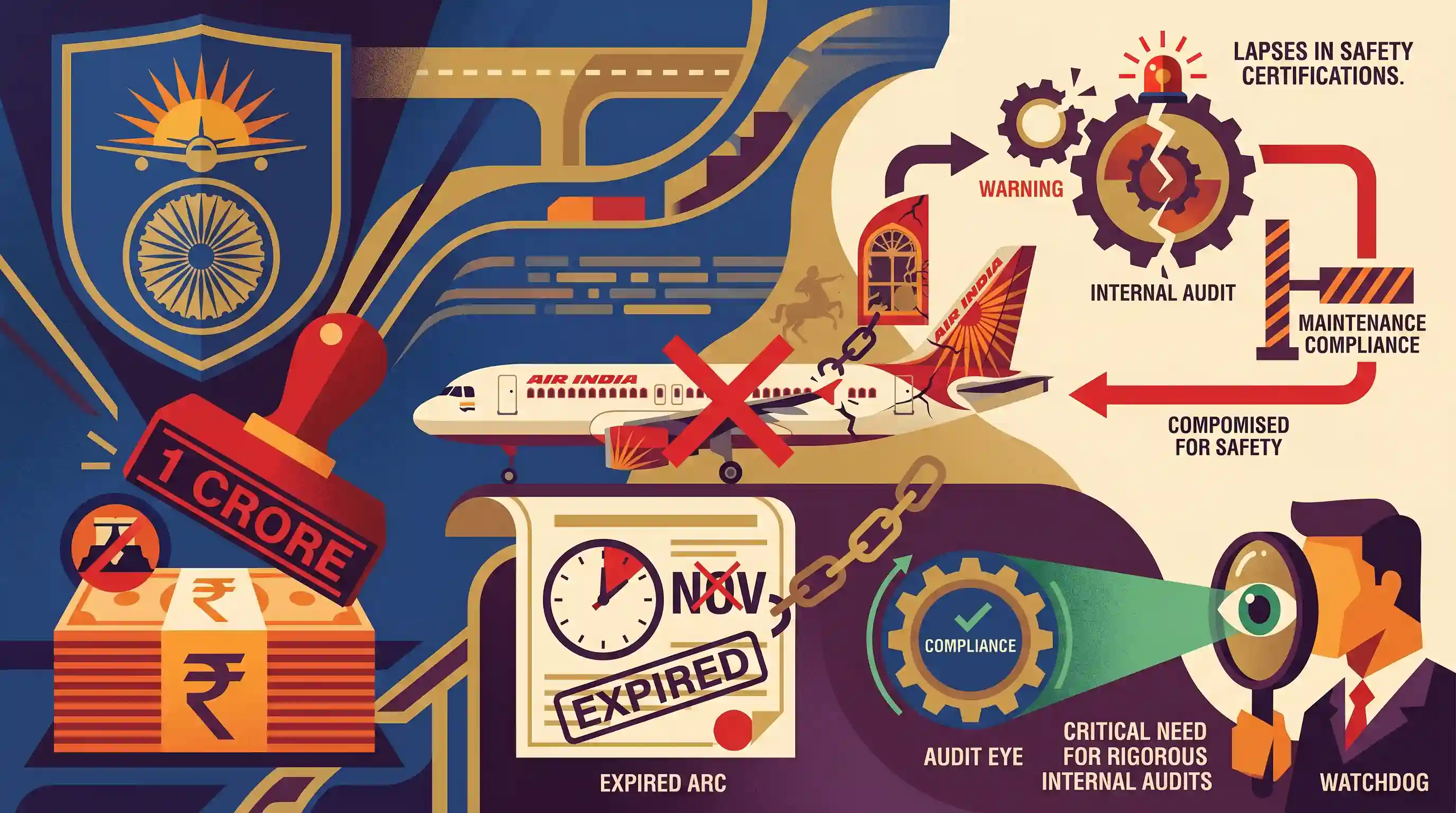
The Directorate General of Civil Aviation (DGCA) has fined Air India Rs 1 crore for operating an aircraft with an expired Airworthiness Review Certificate (ARC) in November. This regulatory action highlights the aviation watchdog's strict approach toward passenger safety and mandatory maintenance compliance. It also underscores the critical need for airlines to maintain rigorous internal audits to prevent lapses in crucial safety certifications.
Key Points
- The Directorate General of Civil Aviation (DGCA) imposed a Rs 1 crore penalty on Air India for operating a flight with an expired Airworthiness Review Certificate (ARC).
- An ARC is a mandatory certification that verifies an aircraft has undergone required maintenance and is technically safe for operations.
- The penalty demonstrates the DGCA's strict enforcement of aviation safety protocols and zero-tolerance policy for compliance lapses.
- The incident highlights the need for robust internal safety audits and compliance-tracking mechanisms within airline operations.
Important Terms
Directorate General of Civil Aviation (DGCA)

The apex statutory body under the Ministry of Civil Aviation responsible for regulating safety, licensing, and airworthiness. It ensures India's compliance with International Civil Aviation Organization (ICAO) standards.
UPSC context
GS Paper II (Statutory/Regulatory Bodies). Tests knowledge of administrative structures and safety oversight in the aviation sector.
Airworthiness Review Certificate (ARC)
A mandatory annual validation of an aircraft's Certificate of Airworthiness. It is issued after a comprehensive review of maintenance records and physical condition to ensure the aircraft is safe to fly.
UPSC context
GS Paper III (Infrastructure). Relevant for technical safety standards and maintenance compliance in the commercial aviation industry.
Aircraft Rules, 1937
Comprehensive regulations framed under the Aircraft Act, 1934. They establish the legal framework for aircraft registration, personnel licensing, and safety standards, and empower the regulator to impose penalties.
UPSC context
GS Paper II (Government Policies/Legislation). Tests awareness of the statutory frameworks governing specialized infrastructure sectors.
Civil Aviation Requirements (CAR)
A series of detailed technical standards and guidelines issued by the DGCA. They ensure that all aviation operations in India comply with both national laws and international benchmarks.
UPSC context
GS Paper III (Infrastructure). Important for understanding the regulatory environment and international alignment of Indian aviation.
Ministry of Civil Aviation
The Union ministry responsible for formulating national policies, managing infrastructure development, and providing administrative oversight for civil aviation bodies like the DGCA and AAI.
UPSC context
GS Paper II (Executive/Ministries). Tests knowledge of policy-making and the executive hierarchy in transport infrastructure.
Prelims Trap
"The DGCA is an attached executive office under the Ministry of Civil Aviation without statutory backing."
DGCA was formally elevated to a statutory body via the Aircraft (Amendment) Act, 2020. Outdated study materials often incorrectly list it as a mere executive/attached office.
Static Concepts Connected
What are the specific mandates of India's three primary civil aviation bodies?
- DGCA: Enforces civil aviation safety, airworthiness standards, and issues licenses for pilots, aircraft, and engineers.
- BCAS: Focuses strictly on aviation security, framing protocols to prevent unlawful interference, such as hijacking.
- AAIB: Independently investigates aviation accidents and serious incidents to recommend and improve future safety protocols.
Which key international conventions dictate global civil aviation rules?
- Chicago Convention (1944): Established the ICAO (a UN specialized agency) and cemented the principle that every state holds complete and exclusive sovereignty over its airspace.
- Montreal Convention (1999): Standardized international carriage rules, specifically outlining airline liability for passenger injury, death, flight delays, or baggage loss.
- Cape Town Convention: An international treaty intended to standardize transactions involving movable property, facilitating asset-based financing and leasing of aircraft.
Cross-Topic Patterns
Decolonisation of aviation laws
The Bhartiya Vayuyan Vidheyak 2024 replacing the colonial 1934 Aircraft Act mirrors the broader governance theme of updating pre-independence legislation, similar to the recent overhaul of India's criminal codes.
ICAO oversight and Cape Town Convention
India's performance in ICAO's Universal Safety Oversight Audit Programme (USOAP) and its accession to the Cape Town Convention directly dictate the insurance and aircraft leasing costs for domestic airlines.

Bhartiya Vayuyan Vidheyak 2024 and the distinct statutory roles of DGCA vs BCAS will likely form a paired multi-statement Prelims question.
Linked PYQs · 2
Linked PYQs · 2
- 2014MainsGS3
International civil aviation laws provide all countries complete and exclusive sovereignty over the airspace above their territory. What do you understand by 'airspace'? What are the implications of these laws on the space above this airspace? Discuss the challenges which this poses and suggest ways to contain the threat.
- 2017MainsGS3
Examine the development of Airports in India through joint ventures under Public-Private Partnership (PPP) model. What are the challenges faced by the authorities in this regard?
