AAIB Probe on Air India Crash and Aviation Safety Protocols
Source:Indian Express ↗
Why It Matters
The article highlights the functioning of the Aircraft Accident Investigation Bureau (AAIB) and brings attention to aviation safety protocols, a critical component of national infrastructure and disaster management (GS Paper 3).
Summary
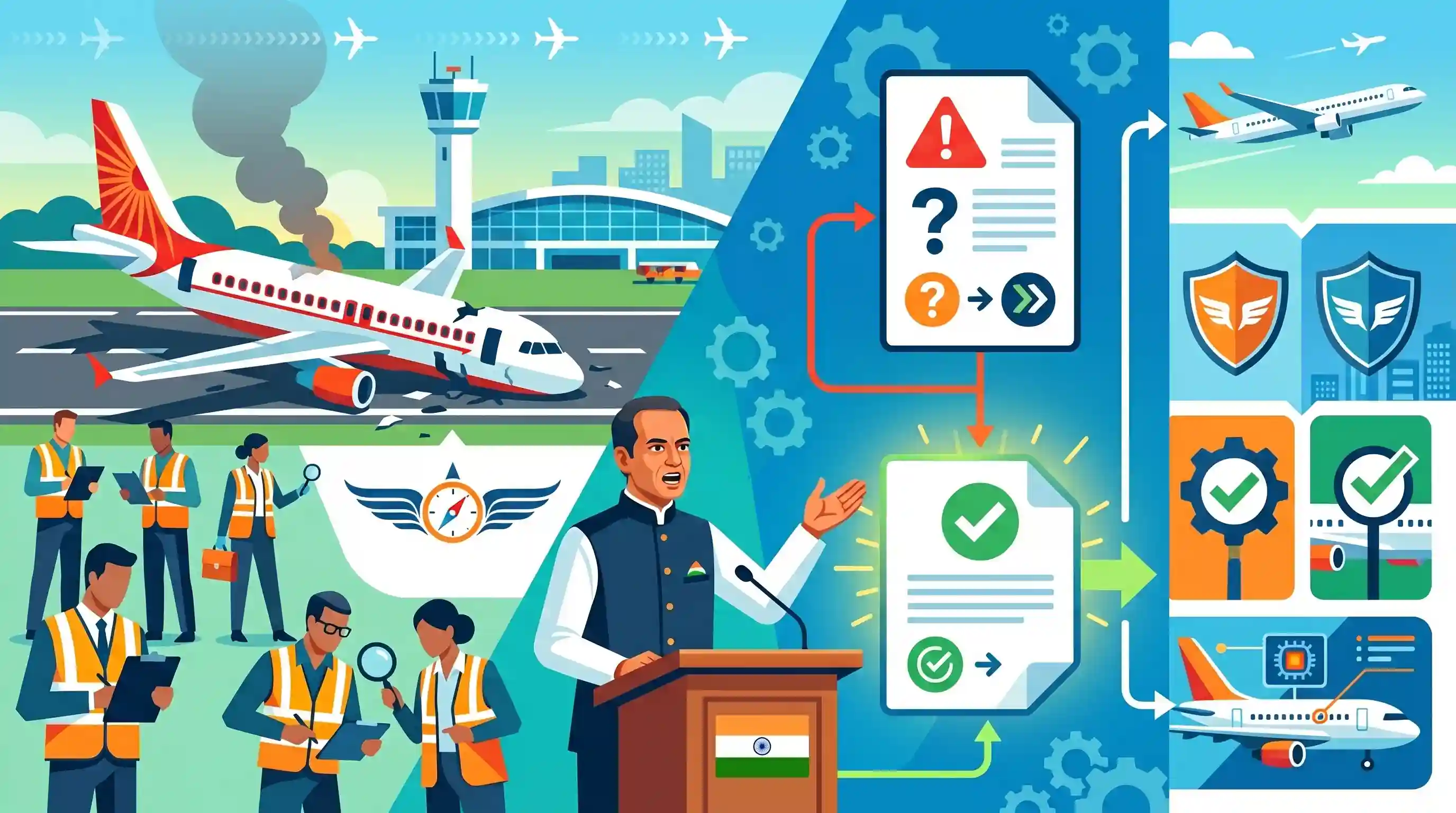
Minister of State for Civil Aviation Murlidhar Mohol has stated that no definitive conclusions should be drawn from the preliminary report by the Aircraft Accident Investigation Bureau (AAIB) regarding the Air India flight AI 171 crash. He emphasized that the investigation is still ongoing and a comprehensive final report is pending. The incident highlights the role of the AAIB in investigating aviation accidents to enhance safety protocols and prevent future occurrences.
Key Points
- The Aircraft Accident Investigation Bureau (AAIB) released a preliminary report on the crash of Air India flight AI 171.
- Minister of State for Civil Aviation Murlidhar Mohol cautioned against drawing definitive conclusions from the preliminary findings, stating that the probe is still ongoing.
- The AAIB functions as an independent agency under the Ministry of Civil Aviation responsible for investigating aviation accidents and incidents to improve safety protocols.
Important Terms
Aircraft Accident Investigation Bureau (AAIB)

A statutory body under the Ministry of Civil Aviation responsible for investigating civil aviation accidents. It functions independently of the regulator (DGCA) to focus on safety improvements rather than assigning blame.
UPSC context
GS-2: Statutory/Regulatory Bodies; GS-3: Disaster Management. Tests knowledge of institutional safety frameworks and the independence of accident investigations from regulatory oversight.
Directorate General of Civil Aviation (DGCA)
The primary regulatory authority for civil aviation in India, responsible for safety oversight, licensing, and airworthiness. It handled accident investigations until the AAIB was established in 2012.
UPSC context
GS-2: Statutory Bodies/Governance. Tests understanding of the civil aviation regulatory architecture and the separation of regulation from investigation.
Ministry of Civil Aviation
The nodal administrative ministry responsible for formulating national policies and programs for the development and regulation of civil aviation in India. It oversees bodies like the AAIB and DGCA.
UPSC context
GS-2: Government Policies and Interventions. Tests understanding of the executive structure managing critical infrastructure and aviation safety.
Aircraft Act, 1934
The foundational legislation governing the manufacture, possession, use, and operation of aircraft in India. It provides the legal basis for creating rules on aviation safety and accident investigations.
UPSC context
GS-2: Important Acts/Legislation. Tests knowledge of the legal framework underpining India's aviation sector and the government's regulatory powers.
International Civil Aviation Organization (ICAO)
A UN specialized agency that coordinates international air navigation and sets global standards for aviation safety. India follows its Annex 13 protocols for conducting aircraft accident investigations.
UPSC context
GS-2: International Organizations. Tests awareness of global aviation governance and India’s commitment to international safety standards.
Prelims Trap
The AAIB functions under the DGCA and its primary mandate is to establish criminal liability for aviation accidents.
The AAIB operates independently of the DGCA under the Ministry of Civil Aviation. Per ICAO Annex 13, its sole objective is to prevent future accidents, not to apportion blame.
Static Concepts Connected
How is India's aviation safety framework divided between the DGCA and AAIB?
- DGCA's Role: The Directorate General of Civil Aviation (DGCA) is the primary regulatory body responsible for enforcing civil aviation regulations, licensing, and safety standards.
- AAIB's Autonomy: Established in 2012 under the Aircraft Act 1934, the AAIB is a statutory investigative body functioning independently of the DGCA to avoid conflicts of interest in safety probes.
- Core Objective: The AAIB's strict legal mandate is to identify systemic issues to prevent future occurrences, not to apportion criminal liability or blame.
What does the Chicago Convention state regarding aircraft accident investigations?
- ICAO Annex 13: Adopted under the 1944 Chicago Convention, Annex 13 governs aircraft accident investigations globally, mandating that investigations focus solely on aviation safety improvements.
- State of Occurrence: The primary right and responsibility to institute and conduct an aircraft crash investigation lies with the country where the accident happened.
- Participating States: The country where the aircraft is registered, operated, or designed holds the right to appoint accredited representatives to participate in the investigation.
Cross-Topic Patterns
Independent investigative vs regulatory bodies
Similar to the Commission of Railway Safety acting independently of the Railway Board, the AAIB's autonomy from the DGCA ensures unbiased safety investigations without regulatory conflicts of interest.
International treaties shaping domestic laws
India's Aircraft Investigation Rules under the 1934 Act directly translate the international mandate of ICAO's 1944 Chicago Convention (Annex 13) into enforceable domestic policy.

Expect a 2026 Prelims multi-statement question comparing the structural independence of the AAIB with the Commission of Railway Safety.
Linked PYQs · 2
Linked PYQs · 2
- 2019MainsGS3
Disaster preparedness is the first step in any disaster management process. Explain how hazard zonation mapping will help disaster mitigation in the case of landslides.
- 2023MainsGS2
‘Sea is an important Component of the Cosmos’ Discuss in the light of the above statement the role of the IMO (International Maritime Organisation) in protecting environment and enhancing maritime safety and security.
