Aircraft accident investigation capabilities and civil aviation safety
Source:Indian Express ↗
Why It Matters
Enhancing indigenous capabilities in aircraft accident investigation ensures better safety standards and regulatory oversight in India's booming aviation market. Familiarity with the AAIB's mandate and the technology behind black boxes is relevant for GS-3 Science & Technology and Infrastructure modules.
Summary
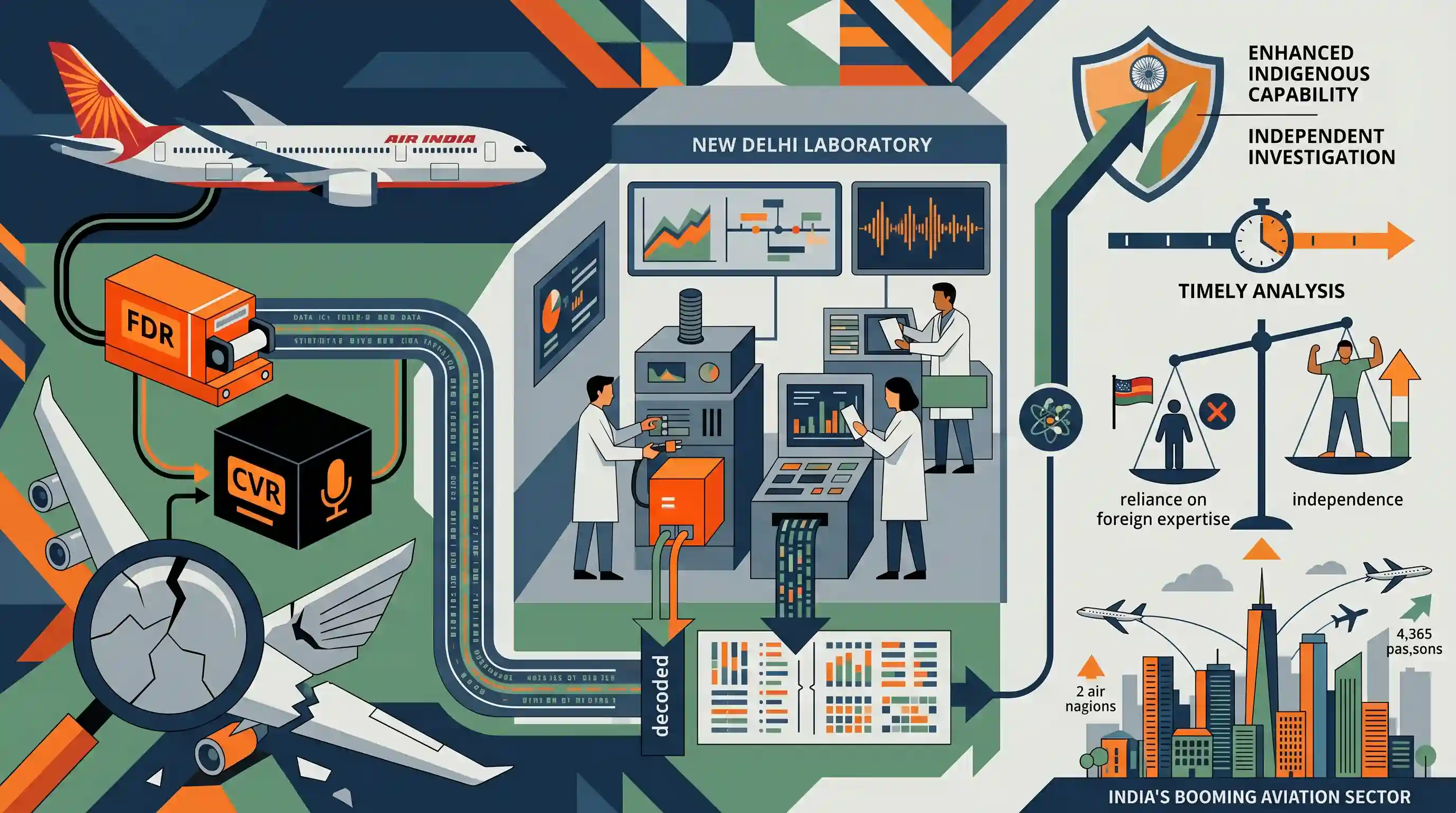
The Aircraft Accident Investigation Bureau (AAIB) has commenced the extraction and analysis of flight data from the black boxes (Flight Data Recorder and Cockpit Voice Recorder) of an Air India Boeing 787 aircraft at its newly established laboratory in Delhi. This new facility significantly enhances India's indigenous capability to investigate aviation accidents independently and ensures the timely analysis of critical crash data. The development marks a crucial upgrade in India's civil aviation safety infrastructure, reducing reliance on foreign expertise and catering to the needs of the country's booming aviation sector.
Key Points
- The Aircraft Accident Investigation Bureau (AAIB) is analyzing data from the black boxes of an Air India Boeing 787 at its newly established laboratory in Delhi.
- Black boxes comprise the Flight Data Recorder (FDR) and Cockpit Voice Recorder (CVR), which are critical for determining the sequence of events and causes of aviation accidents.
- The new AAIB facility enhances India's domestic aviation safety infrastructure, allowing for rapid and independent crash data extraction without relying on foreign agencies.
- This indigenous capability is a significant step in supporting India's rapidly expanding civil aviation sector by ensuring robust safety investigation mechanisms.
Important Terms
Aircraft Accident Investigation Bureau (AAIB)

An independent body under the Ministry of Civil Aviation responsible for investigating serious aircraft accidents and incidents in India, ensuring impartial safety analysis separate from regulatory functions.
UPSC context
GS Paper II: Statutory/Regulatory Bodies; GS Paper III: Infrastructure/Disaster Management. Tests institutional independence and safety oversight frameworks.
Black Box (FDR & CVR)
The collective term for the Flight Data Recorder (FDR) and Cockpit Voice Recorder (CVR), which store technical parameters and cockpit audio respectively to reconstruct flight events after a crash.
UPSC context
GS Paper III: Science and Technology. Tests knowledge of aviation forensics, data extraction, and technology for disaster investigation.
Directorate General of Civil Aviation (DGCA)
India's primary civil aviation regulator responsible for safety oversight, licensing, airworthiness standards, and enforcing civil air regulations (CARs) under the Ministry of Civil Aviation.
UPSC context
GS Paper II/III: Regulatory Bodies/Infrastructure. Tests understanding of civil aviation regulation and safety compliance in India.
International Civil Aviation Organization (ICAO)
A specialized United Nations agency that establishes international standards and recommended practices (SARPs) for aviation safety, security, and accident investigation (notably Annex 13).
UPSC context
GS Paper II: International Institutions. Tests India’s compliance with global aviation norms and international treaty obligations.
Bhartiya Vayuyan Adhiniyam, 2024
The 2024 legislation replacing the Aircraft Act of 1934 to modernize India's civil aviation framework, enhance regulatory powers of the DGCA, and align with global safety standards.
UPSC context
GS Paper II: Government Policies/Legislations. Tests knowledge of legal reforms in critical infrastructure sectors.
Prelims Trap
"The Directorate General of Civil Aviation (DGCA) conducts aircraft accident investigations in India."
AAIB (created in 2012) conducts investigations to ensure they remain strictly independent of the DGCA, which handles regulatory oversight. This aligns with ICAO norms.
Static Concepts Connected
What is the Chicago Convention and the role of ICAO?
- Chicago Convention (1944): Established the core principles of global air navigation and transport, leading to the creation of the International Civil Aviation Organization.
- ICAO mandate: A UN specialized agency that sets international standards, including Annex 13 which requires strictly independent safety investigations for aviation accidents.
- Investigation jurisdiction: The 'State of Occurrence' (where the crash happened) holds primary jurisdiction to lead the investigation, regardless of the aircraft's registry.
How do aircraft 'Black Boxes' function in crash investigations?
- Dual components: Consists of the Flight Data Recorder (FDR) for technical metrics like airspeed/altitude, and the Cockpit Voice Recorder (CVR) for cockpit communications.
- Design and placement: Painted high-visibility 'blaze orange' (not black) and installed in the aircraft's tail section, which statistically sustains the least physical impact during a crash.
Cross-Topic Patterns
Aviation infrastructure and indigenous capability
Domestic black box extraction labs reduce reliance on foreign agencies like the US NTSB, aligning with India's broader Atmanirbhar push across critical infrastructure, space, and defense sectors.
Regulatory vs Investigative segregation
The institutional separation between the DGCA (regulator) and AAIB (investigator) highlights a crucial governance pattern of avoiding conflicts of interest in safety oversight and enforcement.

Multi-statement question in 2026 likely pairing AAIB vs DGCA functions with ICAO 'State of Occurrence' jurisdiction rules.
Linked PYQs · 2
Linked PYQs · 2
- 2014MainsGS3
International civil aviation laws provide all countries complete and exclusive sovereignty over the airspace above their territory. What do you understand by 'airspace'? What are the implications of these laws on the space above this airspace? Discuss the challenges which this poses and suggest ways to contain the threat.
- 2025PrelimsGS1
With reference to 'Direct Air Capture', an emerging technology, which of the following statements is/are correct? I. It can be used as a way of carbon sequestration. II. It can be a valuable approach for plastic production and in food processing. III. In aviation, it can be a source of carbon for combining with hydrogen to create synthetic low-carbon fuel. Select the correct answer using the code given below.
