Emergency Response and Investigation in Aviation Accidents
Source:The Hindu ↗
Why It Matters
This tragic event serves as a practical case study for India's disaster response framework, highlighting the critical need for inter-agency coordination (NDRF, state, and aviation bodies) during mass casualty transport emergencies. It also draws attention to civil aviation safety regulations and the diplomatic protocols required when foreign nationals are involved.
Summary
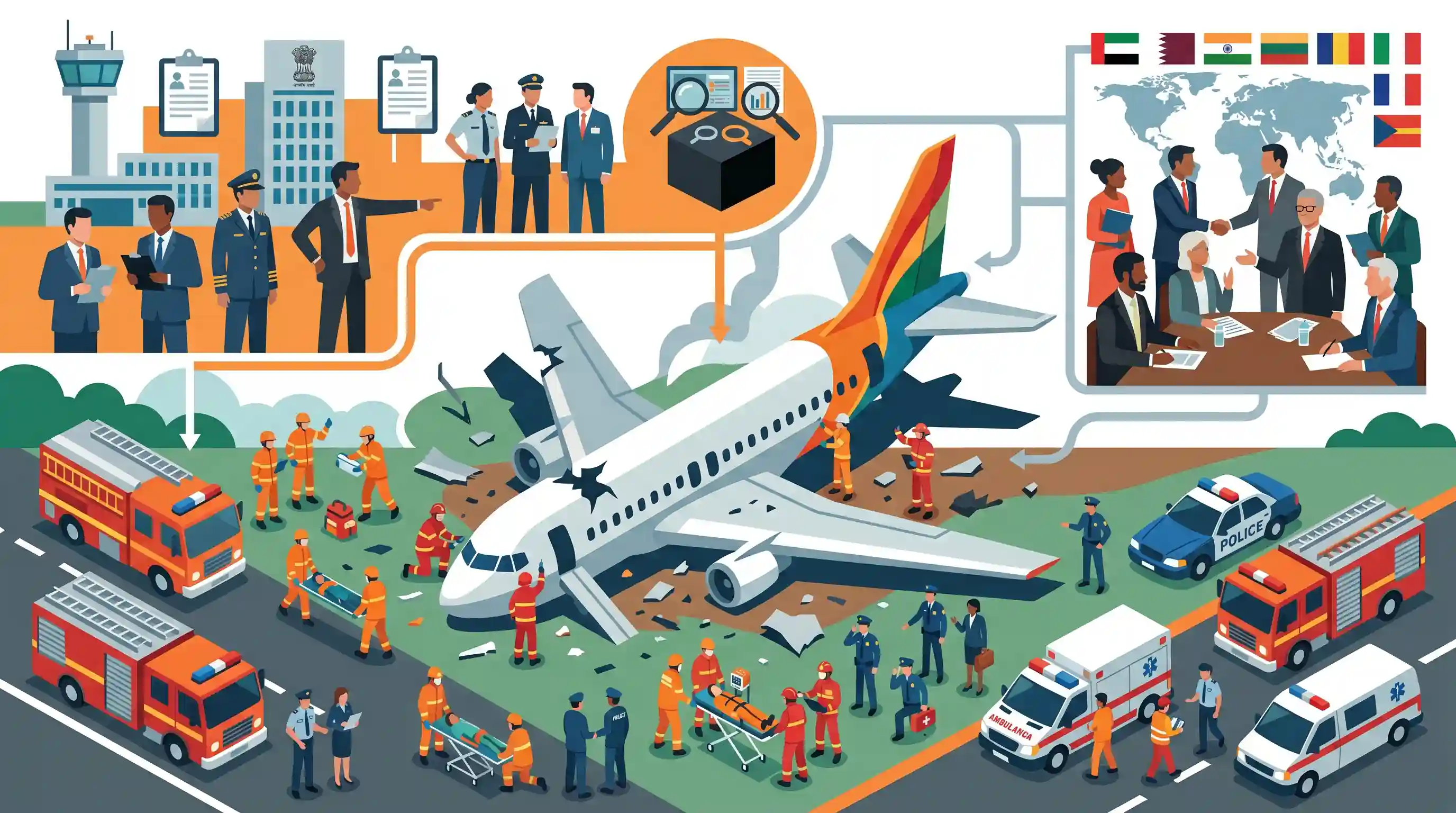
An Air India Boeing 787-8 flight bound for London crashed shortly after departing Ahmedabad, leading to a tragic mass casualty event involving 242 passengers of multiple nationalities. The incident triggered a massive multi-agency disaster response featuring the NDRF, state police, and specialized aviation and railway rescue teams. The Ministry of Civil Aviation, alongside the DGCA and AAI, is overseeing the response and investigation, while international diplomatic channels have been activated to assist foreign nationals.
Key Points
- Air India flight AI171 (Ahmedabad to London) crashed shortly after take-off, resulting in a mass casualty event with over 200 bodies retrieved.
- The flight carried 242 individuals of various nationalities, including Indian, British, Portuguese, and Canadian citizens, necessitating urgent diplomatic and consular coordination.
- A swift multi-agency rescue operation was launched involving the NDRF, CISF, RAF, state police, fire brigades, and Western Railway disaster management teams.
- The Ministry of Civil Aviation activated an Operational Control Room, while the DGCA and AAI began coordinating the investigation into the aviation disaster.
Important Terms
Aircraft Accident Investigation Bureau (AAIB)

A statutory body under the Ministry of Civil Aviation responsible for investigating civil aviation accidents and serious incidents. Established in 2012 to ensure investigative independence from the regulatory body (DGCA).
UPSC context
Relevant for GS Paper 3 (Infrastructure and Aviation Safety) regarding the institutional framework for accident probes.
Directorate General of Civil Aviation (DGCA)
The statutory regulatory authority for civil aviation in India, responsible for safety oversight, airworthiness standards, and licensing. It functions as an attached office of the Ministry of Civil Aviation.
UPSC context
Tested in GS Paper 2 (Statutory Bodies) and GS Paper 3 (Infrastructure/Safety) for its regulatory and safety functions.
Airports Authority of India (AAI)
A statutory body under the Ministry of Civil Aviation responsible for managing aviation infrastructure, including airports and Air Traffic Management (ATM) services across Indian airspace.
UPSC context
Important for GS Paper 3 (Infrastructure) regarding airport development, air traffic control, and regional connectivity.
National Disaster Response Force (NDRF)
A specialized force established under the Disaster Management Act, 2005, for dedicated response to natural and man-made disasters. It operates under the Ministry of Home Affairs.
UPSC context
Crucial for GS Paper 3 (Disaster Management) and the legal framework under the DM Act, 2005.
Ministry of Civil Aviation (MoCA)
The nodal ministry responsible for formulating national policies and programmes for the development and regulation of civil aviation, overseeing safety, infrastructure, and international coordination.
UPSC context
Relevant for GS Paper 2 (Governance/Policy) and GS Paper 3 (Infrastructure) regarding the aviation sector's growth.
Central Industrial Security Force (CISF)
A Central Armed Police Force (CAPF) under the Ministry of Home Affairs providing security to critical infrastructure, including major commercial airports across India.
UPSC context
Relevant for GS Paper 3 (Internal Security) and the role of specialized forces in protecting vital installations.
Prelims Trap
The Directorate General of Civil Aviation (DGCA) conducts primary investigations into aviation accidents in India.
The Aircraft Accident Investigation Bureau (AAIB), not the DGCA, is the statutory body responsible for investigating civil aviation accidents to ensure independent scrutiny.
Static Concepts Connected
What are the key international conventions governing civil aviation safety and liability?
- Chicago Convention: Establishes core airspace rules; Annex 13 assigns primary accident investigation responsibility to the 'State of Occurrence'.
- Montreal Convention: Creates a unified legal framework standardizing airline liability and compensation claims for passenger death or injury.
How does the Aircraft Accident Investigation Bureau (AAIB) differ from the DGCA?
- Regulatory focus: DGCA is the apex regulator responsible for enforcing safety standards, licensing, and aviation rules.
- Independent investigation: AAIB, granted statutory status in 2020, independently investigates accidents to avoid conflict of interest with the regulator.
Cross-Topic Patterns
Consular access in disaster response
The Vienna Convention obligates host states to notify foreign consulates of deaths, merging domestic disaster management protocols with international diplomatic law.

Expect a matched-pair prelims question on international conventions (Chicago, Montreal) or a statement distinguishing DGCA and AAIB.
Linked PYQs · 5
Linked PYQs · 5
- 2024MainsGS3
What is disaster resilience? How is it determined? Describe various elements of a resilience framework. Also mention the global targets of Sendai Framework for Disaster Risk Reduction (2015–2030).
- 2019MainsGS3
Disaster preparedness is the first step in any disaster management process. Explain how hazard zonation mapping will help disaster mitigation in the case of landslides.
- 2017MainsGS3
Examine the development of Airports in India through joint ventures under Public-Private Partnership (PPP) model. What are the challenges faced by the authorities in this regard?
- 2014MainsGS3
International civil aviation laws provide all countries complete and exclusive sovereignty over the airspace above their territory. What do you understand by 'airspace'? What are the implications of these laws on the space above this airspace? Discuss the challenges which this poses and suggest ways to contain the threat.
- 2023MainsGS2
Indian diaspora has scaled new heights in the West. Describe its economic and political benefits for India.
