AIIMS Patna Strengthens Neonatal Care with CSR Support
Source:uniindia ↗
Why It Matters
Improving neonatal and infant health indicators (like IMR and NMR) is crucial for Bihar's development. This case study demonstrates how public health institutions like AIIMS can leverage private sector CSR mandates (under Section 135 of the Companies Act, 2013) to upgrade high-cost medical infrastructure and tackle healthcare gaps in the state.
Summary
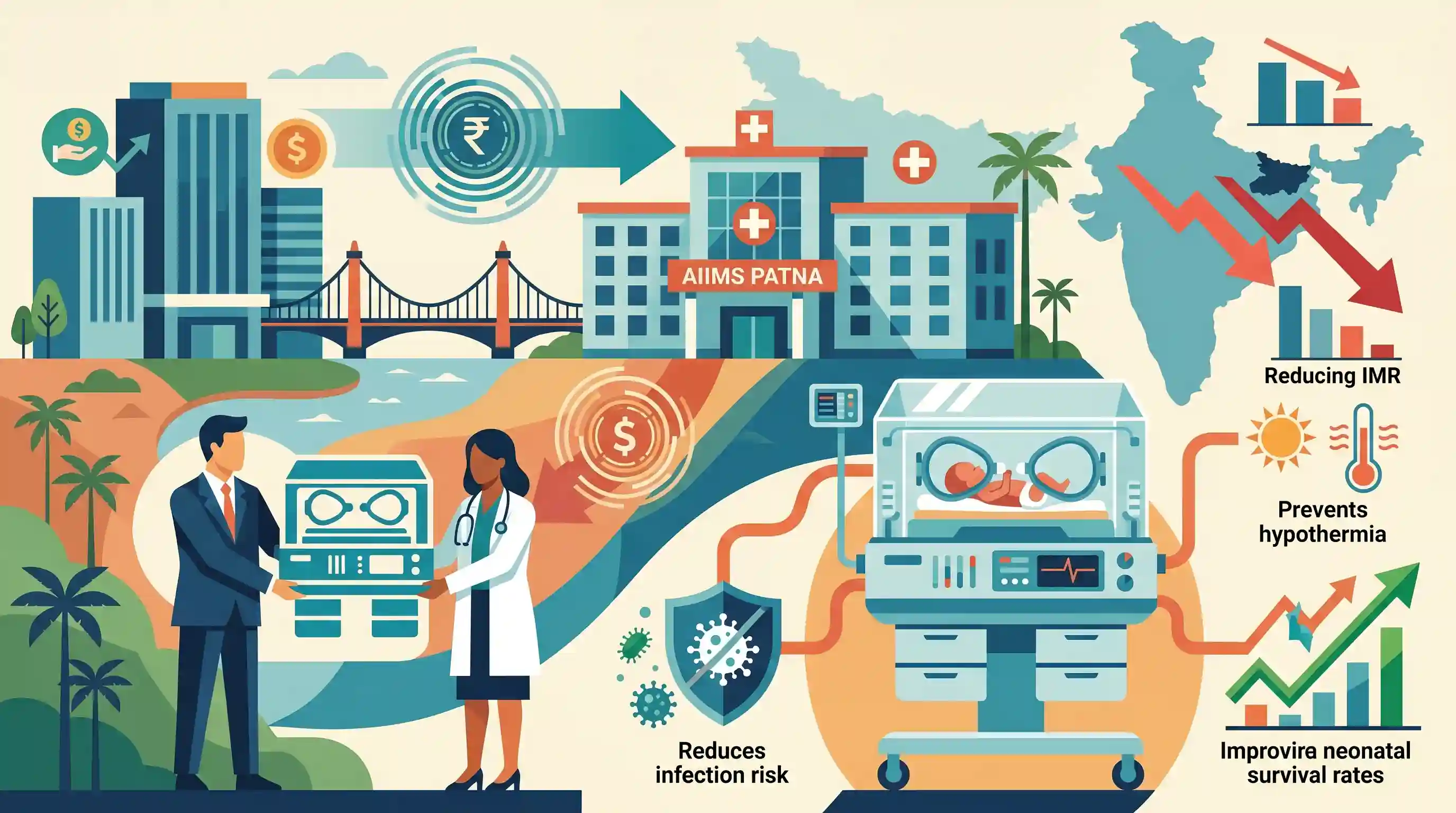
AIIMS Patna has strengthened its neonatal care facilities with the addition of a state-of-the-art neonatal incubator valued at Rs 22 lakh. The advanced medical equipment was donated by Axis Bank as part of its Corporate Social Responsibility (CSR) initiative. Designed to offer a controlled environment for critically ill and premature newborns, it aims to prevent hypothermia, reduce infection risk, and improve neonatal survival rates in Bihar.
Key Points
- AIIMS Patna has inaugurated a state-of-the-art neonatal incubator valued at Rs 22 lakh, donated by Axis Bank under its Corporate Social Responsibility (CSR) initiative.
- The incubator is designed to provide a safe, controlled environment for premature and critically ill newborns, protecting them from hypothermia, preventing excessive weight loss, and reducing infection risk.
- The advanced equipment was inaugurated by AIIMS Patna Director Prof. (Brig.) Dr. Raju Agarwal and Axis Bank's Bihar Circle Head Dheeraj Kumar Rai.
- The initiative highlights the growing significance of Public-Private Partnerships (PPP) and corporate support in improving Bihar's healthcare infrastructure and maternal-child health outcomes.
Important Terms
Companies Act, 2013

Landmark Indian legislation regulating corporate governance. Under Section 135, it mandates eligible corporations to spend 2% of their average net profits over the past three years on Corporate Social Responsibility (CSR).
UPSC context
GS Paper II (Governance) and GS III (Corporate Governance); tests regulatory frameworks, inclusive growth, and public-private funding of welfare.
Corporate Social Responsibility (CSR)
A self-regulating business model integrating social and environmental objectives. In India, statutory spending under the Companies Act targets sectors like public healthcare, education, poverty alleviation, and rural development.
UPSC context
GS Paper II (Social Sector/Health) and GS Paper IV (Ethics); tests understanding of corporate ethics and alternative public service financing.
AIIMS Patna
An autonomous public medical school and clinical research institution established in 2012 in Bihar. Designated as an Institute of National Importance, it aims to rectify regional imbalances in tertiary-level healthcare.
UPSC context
GS Paper II (Social Sector & Health); tests awareness of regional medical disparities and statutory bodies under public health management.
Pradhan Mantri Swasthya Suraksha Yojana (PMSSY)
A flagship Central Sector Scheme announced in 2003. It aims to resolve geographical imbalances in affordable tertiary healthcare and expand domestic capacities for high-quality medical education across underserved states.
UPSC context
GS Paper II (Government Schemes & Public Health); tests policy initiatives targeting health infrastructure, regional equity, and medical pedagogy.
Infant Mortality Rate (IMR)
The number of infant deaths (under one year of age) per 1,000 live births. It is a critical demographic proxy for evaluating national healthcare quality and maternal welfare.
UPSC context
GS Paper I (Demography/Social Issues) and GS II (Health/SDG 3); tests analytical skills regarding development outcomes and human health indicators.
Prelims Trap
CSR mandates under Section 135 apply only to companies that satisfy all three criteria—net worth, turnover, and net profit—simultaneously.
The law applies if a company meets ANY single condition in the preceding financial year, not all of them cumulatively.
Static Concepts Connected
What is the statutory framework governing Corporate Social Responsibility in India?
- Statutory Mandate: Section 135 of the Companies Act, 2013, requires eligible companies to spend 2% of their average net profit of the past three years on social activities.
- Eligibility Thresholds: Applies to companies meeting any single condition: net worth ≥ ₹500 crore, turnover ≥ ₹1000 crore, or net profit ≥ ₹5 crore.
- Schedule VII: Lists permitted areas of investment, including eradicating hunger, promoting healthcare, education, gender equality, and environmental sustainability.
How are demographic indicators like NMR and IMR defined and targeted?
- Neonatal Mortality Rate: Refers to deaths of infants within the first 28 days of life per 1,000 live births. SDG 3.2 targets reducing this below 12 by 2030.
- Infant Mortality Rate: Measures deaths of children under one year of age per 1,000 live births. It differs from crude death rates as it uses live births.
Cross-Topic Patterns
CSR + Public Health Infrastructure
Corporate funding bridges the public expenditure gap in tertiary healthcare, directly addressing regional infrastructural imbalances in economically lagging states like Bihar.
Demographics + Economic Development
Bihar’s high TFR (2.8) and demographic pressure require rapid expansion of neonatal care to prevent infant mortality from bottlenecking future human capital development.

Expect a 2026 question linking India's NMR targets (SDG 3.2) with Section 135 CSR mandates as tools for public health capital formation.
Linked PYQs · 3
Linked PYQs · 3
- 2023BPSC_PRELIMSGS1
Consider the following statements about infant mortality rate:1. It is the probability of dying between birth and exactly 1 year of age, expressed per 10000 live births. 2. The infant mortality rate in the year 1950 was 189.6. 3. In the year 2019, the infant mortality rate was 30. 4. As per the Sample Registration System (SRS) Bulletin of Registrar General of India (RGI), the State with the highest infant mortality rate in the year 2019 was Uttar Pradesh.
- 2008BPSC_PRELIMSGS1
The infant mortality rate of Bihar, is:
- 2019BPSC_PRELIMSGS1
In NITI Aayog's Health Index, 2019, Bihar scored
