AIIMS Study on Air Pollution and Lung Cancer Correlation
Source:Indian Express ↗
Why It Matters
It bridges the gap between environmental issues (air pollution) and public health outcomes (cancer) in India, highlighting the need for indigenous medical research to form localized screening protocols instead of relying solely on Western data.
Summary
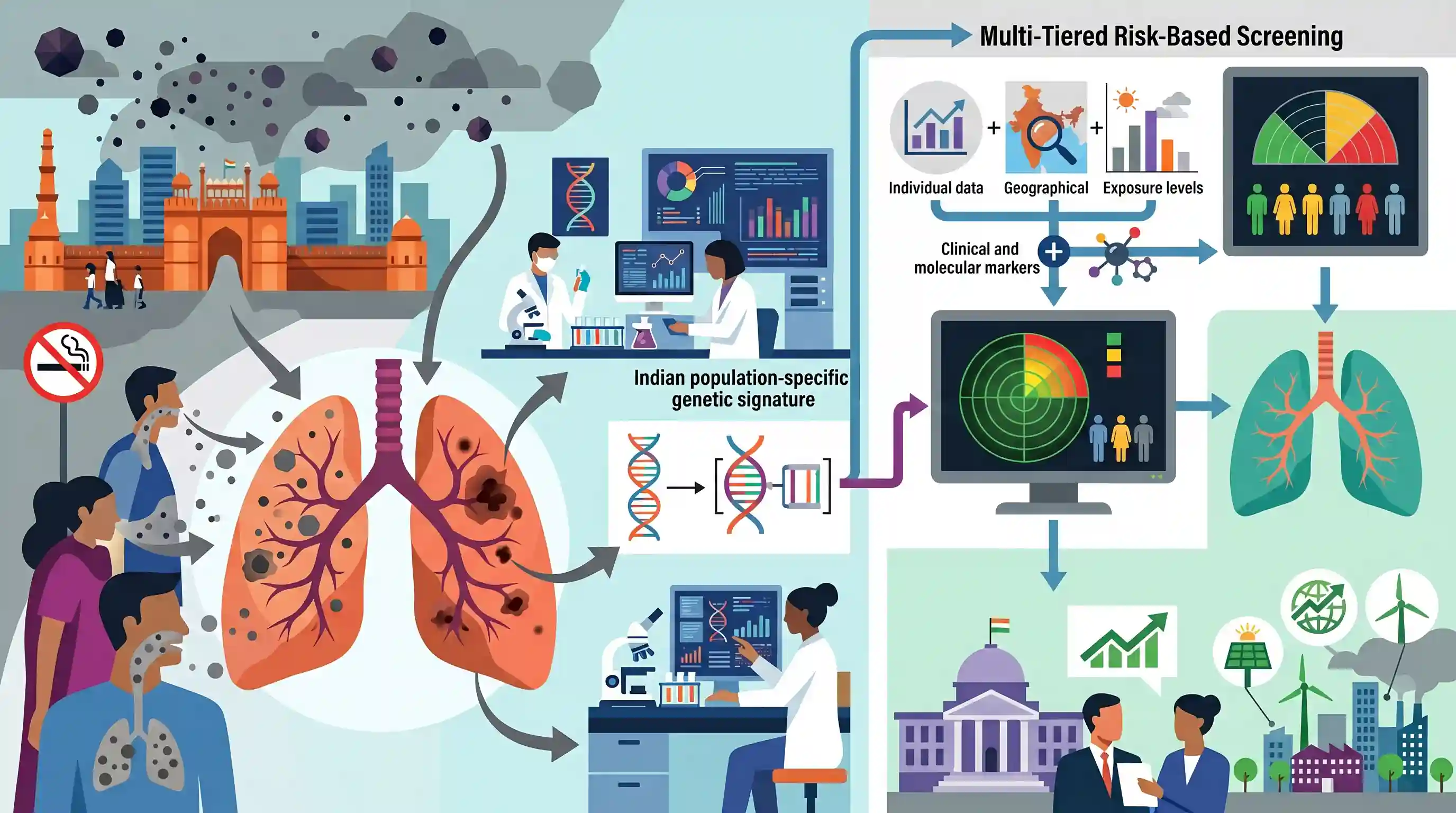
AIIMS has launched the AIRCARE (Air Pollution and Cancer Research Ecosystem) initiative to study the correlation between prolonged exposure to PM2.5 air pollution and the rising incidence of lung cancer among non-smokers in Delhi-NCR. The project aims to identify an Indian population-specific genetic signature that explains how pollution translates into cancer risk. By generating localized evidence, the study seeks to develop a risk-based screening framework tailored to Indian conditions, integrating both clinical and molecular markers to inform early detection and public health interventions.
Key Points
- AIIMS launched the AIRCARE initiative to study the impact of PM2.5 exposure on lung cancer in Delhi-NCR.
- Doctors have noted a concerning rise in lung cancer cases among non-smokers, pointing to air pollution as a significant environmental trigger.
- The study will use a case-control design, enrolling 1,615 patients and matching them with family members as controls to ensure comparable baseline environmental exposure.
- A primary objective is identifying an Indian population-specific genetic signature that links pollution exposure to cancer risk.
- The project aims to develop a risk-based screening model for early cancer detection, integrating clinical and molecular markers tailored to Indian demographics.
- Lung cancer remains a major health burden, ranking as the second most common cancer among men and fourth overall in India.
Important Terms
AIRCARE (Air Pollution and Cancer Research Ecosystem)

An AIIMS-led research project investigating the link between PM2.5 exposure and lung cancer among non-smokers in Delhi-NCR to develop a population-specific screening framework.
UPSC context
GS II (Health) and GS III (Environment); relevant for evidence-based policy making and environmental health interventions.
PM2.5
Fine particulate matter with a diameter less than 2.5 micrometers. These particles bypass respiratory defenses to enter the bloodstream, causing cancer and cardiovascular diseases.
UPSC context
GS III (Pollution); core topic for air quality standards (NAAQS) and public health impact assessments.
AIIMS (All India Institute of Medical Sciences)
Premier statutory autonomous medical universities established by the AIIMS Act, 1956, and declared as 'Institutes of National Importance' for excellence in medical education and research.
UPSC context
GS II (Statutory Bodies); tests knowledge of India’s healthcare institutional framework and specialized research mandates.
Genetic Signature
A unique pattern of gene activity or mutations that identifies a specific disease or a population’s biological response to environmental carcinogens.
UPSC context
GS III (Science & Technology); focuses on biotechnology, genomic research, and personalized medicine in healthcare.
Non-Communicable Diseases (NCDs)
Chronic diseases like cancer and diabetes that are not spread through infection. They are the leading cause of mortality in India's epidemiological transition.
UPSC context
GS II (Health/Social Justice); crucial for understanding India’s disease burden and national health policies like NP-NCD.
Prelims Trap
AIRCARE is an initiative by the Ministry of Environment, Forest and Climate Change to monitor PM2.5.
AIRCARE is a medical research project by AIIMS focused on lung cancer in non-smokers, not an environmental monitoring scheme under NCAP.
Static Concepts Connected
What is PM2.5 and how does it impact human health?
- Definition: Fine inhalable particles with diameters 2.5 micrometers or smaller, often emitted from combustion, industries, and vehicles.
- Penetration: Its microscopic size allows it to bypass nose and throat barriers, penetrating deep into the alveolar region of the lungs and entering the bloodstream.
- Carcinogenic nature: Classified as a Group 1 carcinogen by IARC (WHO); prolonged exposure causes chronic inflammation and cellular mutations, leading to cancer.
What is the National Programme for Prevention and Control of NCDs?
- Core focus: Formerly NPCDCS, it targets the prevention and management of Cancer, Diabetes, Cardiovascular Diseases, and Stroke.
- Implementation: Focuses on health promotion, early diagnosis, and management through NCD clinics at District Hospitals and Community Health Centres (CHCs).
Cross-Topic Patterns
Pollution as a primary NCD driver
Environmental health is rapidly merging with NCD management. PM2.5 is no longer just an air quality issue but a major trigger for cancer, expanding NCD policy beyond traditional lifestyle factors like tobacco.
Genomics + Public Health precision medicine
The search for an 'Indian genetic signature' for pollution-linked cancer mirrors genome sequencing efforts like the IndiGen project, highlighting India's growing push for localized precision medicine.

Expect a multi-statement question linking PM2.5 as an IARC Group 1 carcinogen with India's rising NCD burden and the AIRCARE initiative.
Linked PYQs · 2
Linked PYQs · 2
- 2021MainsGS3
Describe the key points of the revised Global Air Quality Guidelines (AQGs) recently released by the World Health Organisation (WHO). How are these different from its last update in 2005? What changes in India's National Clean Air Programme are required to achieve these revised standards?
- 2024MainsGS2
In a crucial domain like the public healthcare system the Indian State should play a vital role to contain the adverse impact of marketisation of the system. Suggest some measures through which the State can enhance the reach of public healthcare at the grassroots level.
