AIIMS Delhi Study on PM2.5 and Lung Cancer Risk
Source:The Hindu ↗
Why It Matters
This bridges the gap between environmental issues and health infrastructure, highlighting how urban air pollution (PM2.5) is creating new epidemiological challenges (rising cancer in non-smokers). It provides crucial context for questions on the efficacy of pollution control measures like the National Clean Air Programme (NCAP) and the broader burden of non-communicable diseases.
Summary
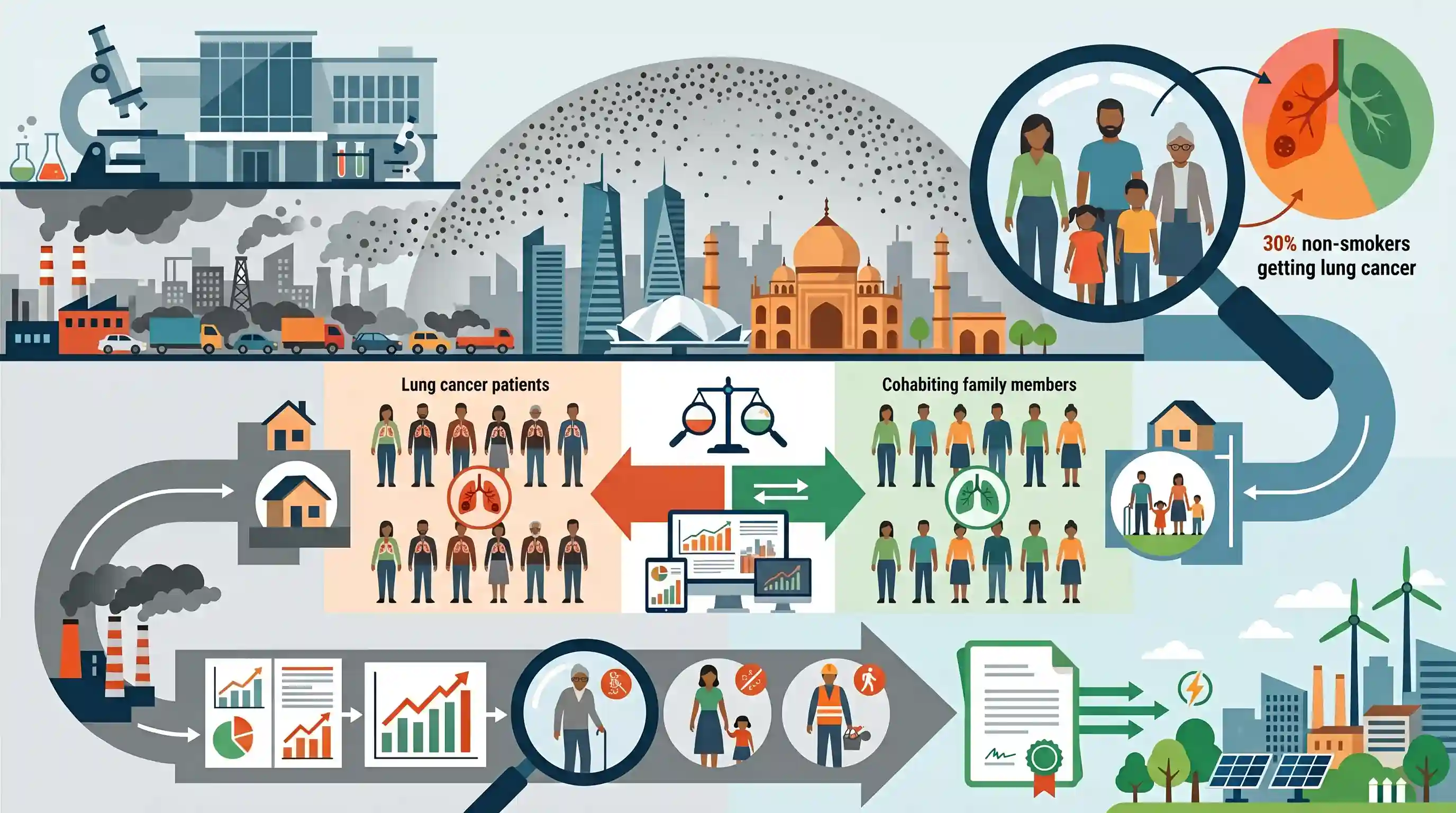
AIIMS Delhi has launched a comprehensive three-year study to investigate the role of prolonged exposure to PM2.5 in causing lung cancer, particularly among non-smokers. With non-smokers now accounting for 30-40% of lung cancer cases worldwide, the study aims to move beyond the traditional tobacco-cancer link by examining environmental determinants. By comparing 1,615 lung cancer patients with an equal number of cohabiting family members in Delhi-NCR, researchers hope to definitively link severe urban air pollution with rising oncological burdens and identify vulnerable demographics for targeted policy intervention.
Key Points
- AIIMS Delhi is conducting a three-year study to establish a link between prolonged exposure to fine particulate matter (PM2.5) and lung cancer.
- The study focuses on non-smokers, who now account for nearly 30-40% of lung cancer cases globally, challenging the conventional association solely with tobacco use.
- Researchers will compare data from 1,615 lung cancer patients with 1,615 of their family members acting as a control group exposed to the same ambient environment.
- Delhi-NCR was selected for the study due to its notoriously high pollution levels and the availability of detailed air quality data over the past decade.
- The findings aim to identify vulnerable populations and create empirical evidence to shape future environmental regulations and public health policies.
Important Terms
PM2.5 (Fine Particulate Matter)

Atmospheric particulate matter with a diameter less than 2.5 micrometers. These fine particles can penetrate deep into the lungs and enter the bloodstream, posing severe respiratory and cardiovascular risks.
UPSC context
GS Paper III: Environment (Pollution) and GS Paper II: Public Health. Tests knowledge of pollutants and their physiological impacts.
Non-Communicable Diseases (NCDs)
Chronic medical conditions not transmitted between persons, such as cancer and diabetes. They are driven by genetic, physiological, environmental, and behavioral factors, representing a major portion of India's disease burden.
UPSC context
GS Paper II: Social Justice/Health. Tests understanding of epidemiological shifts and healthcare policy challenges in India.
All India Institute of Medical Sciences (AIIMS)
A group of premier autonomous public medical institutes under the Ministry of Health and Family Welfare. They are designated as 'Institutes of National Importance' for excellence in medical education and research.
UPSC context
GS Paper II: Governance and Health. Tests knowledge of premier institutional frameworks and their role in national health missions.
National Clean Air Programme (NCAP)
India's flagship policy launched in 2019 to tackle urban air pollution. It targets a 40% reduction in particulate matter concentration by 2026 across 131 non-attainment cities.
UPSC context
GS Paper III: Environmental Pollution and Degradation. Tests knowledge of government strategies and time-bound environmental targets.
Department of Radiation Oncology
A medical specialty using high-energy ionizing radiation (e.g., X-rays or gamma rays) to treat cancer by destroying the DNA of malignant cells and preventing their growth.
UPSC context
GS Paper III: Science and Technology. Tests awareness of technological applications in medicine and advanced cancer treatment modalities.
Prelims Trap
PM2.5 particles are trapped in the upper respiratory tract and do not enter the human bloodstream.
PM2.5's minute size (<2.5 micrometers) allows it to bypass upper respiratory defenses, penetrate the alveolar wall, and directly enter the bloodstream, triggering systemic inflammation.
Static Concepts Connected
What 8 pollutants are measured in India's National Air Quality Index (AQI)?
- Particulates: Fine particulate matter (PM2.5) and inhalable particulate matter (PM10).
- Gases: Nitrogen Dioxide (NO2), Sulphur Dioxide (SO2), Carbon Monoxide (CO), and ground-level Ozone (O3).
- Others: Ammonia (NH3) and Lead (Pb). Note that Greenhouse Gases like Carbon Dioxide (CO2) are strictly excluded from the AQI.
What are the 2021 WHO Global Air Quality Guidelines for PM2.5?
- Annual Limit: The safe annual average concentration of PM2.5 is capped at a highly stringent 5 µg/m³.
- Daily Limit: The 24-hour mean concentration should not exceed 15 µg/m³.
- Epidemiological Shift: These limits were drastically tightened compared to the 2005 guidelines (which had an annual limit of 10 µg/m³), reflecting severe new data on NCD mortality.
Cross-Topic Patterns
NCDs + Urban Environmental Management
Lung cancer rising among non-smokers forces a shift in Non-Communicable Disease (NCD) policy. It proves urban air quality is as critical as lifestyle choices (diet, tobacco) in public health governance.
Article 21 + Climate Litigation
Definitive medical studies linking NCR pollution to cancer provide empirical backing for constitutional litigation, expanding the fundamental Right to Health and a Clean Environment under Article 21.

Expect a prelims question blending WHO's 2021 PM2.5 limits, India's 8 AQI pollutants, and PM2.5's ability to breach the lung barrier.
Linked PYQs · 3
Linked PYQs · 3
- 2021MainsGS3
Describe the key points of the revised Global Air Quality Guidelines (AQGs) recently released by the World Health Organisation (WHO). How are these different from its last update in 2005? What changes in India's National Clean Air Programme are required to achieve these revised standards?
- 2022PrelimsGS1
In the context of WHO Air Quality Guidelines, consider the following statements: 1. The 24-hour mean of PM2.5 should not exceed 15 µg/m³ and annual mean of PM2.5 should not exceed 5 µg/m³. 2. In a year, the highest levels of ozone pollution occur during the periods of inclement weather. 3. PM10 can penetrate the lung barrier and enter the bloodstream. 4. Excessive ozone in the air can trigger asthma. Which of the statements given above are correct?
- 2016PrelimsGS1
In the cities of our country, which among the following atmospheric gases are normally considered in calculating the value of Air Quality Index? 1. Carbon dioxide 2. Carbon monoxide 3. Nitrogen dioxide 4. Sulfur dioxide 5. Methane Select the correct answer using the code given below.
