Women Empowerment Framework through Choice Control Capital
Source:The Hindu ↗
Why It Matters
Women's empowerment is a recurrent cross-cutting theme in UPSC, impacting GS1 (Society), GS2 (Social Justice/Governance), and GS3 (Inclusive Growth). Understanding the 'Choice, Control, Capital' framework provides a structured approach for Mains answers addressing female labor force participation, reproductive agency, and the socio-economic impacts of financial inclusion.
Summary
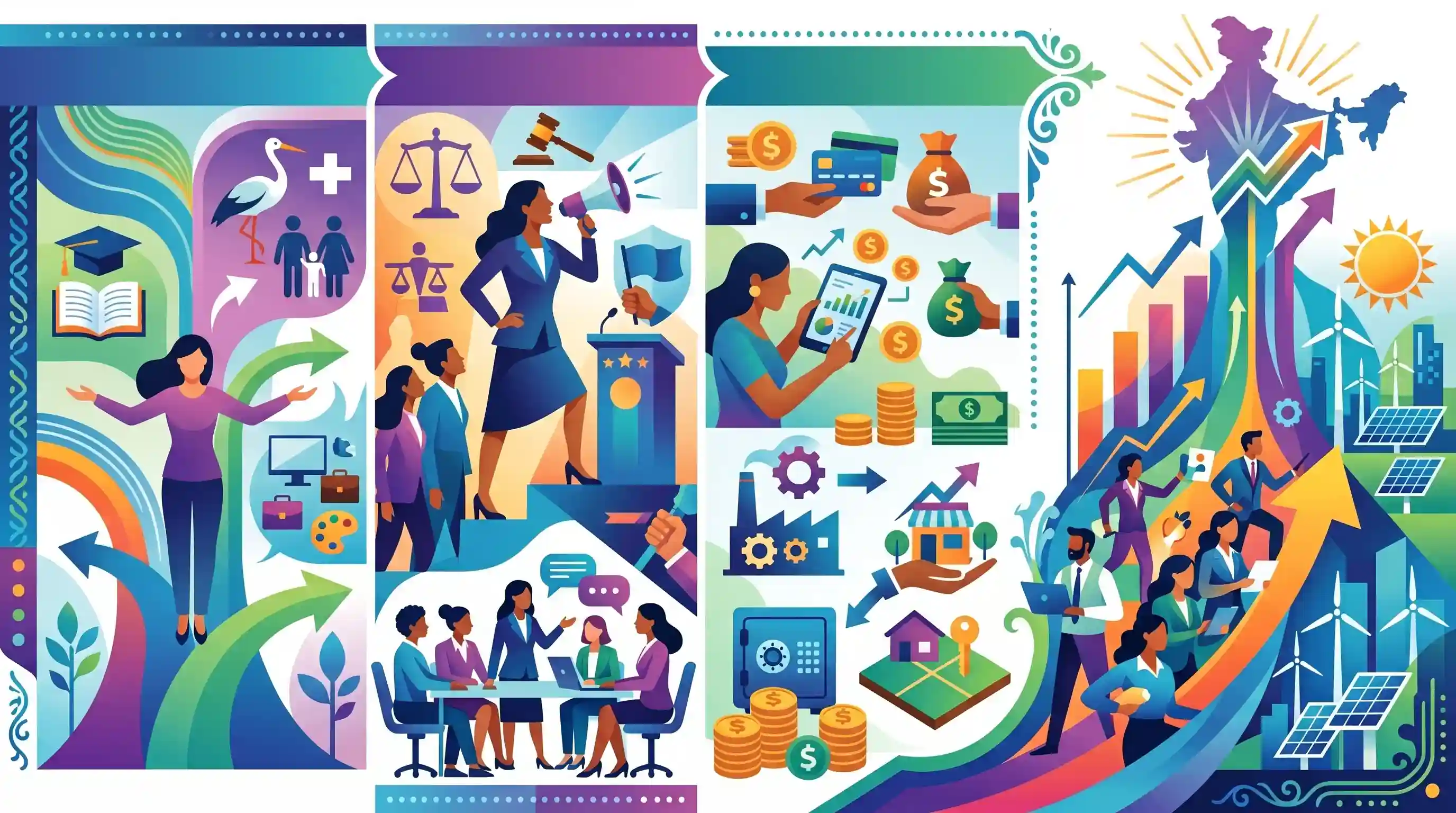
The article advocates for accelerating India's progress by focusing on women's empowerment through three essential dimensions: Choice, Control, and Capital. 'Choice' involves providing women with the autonomy to make decisions regarding their reproductive health, education, and livelihood. 'Control' focuses on building women's agency and decision-making authority within society and their households. 'Capital' emphasizes the vital role of financial inclusion, ensuring women have access to credit, assets, and economic opportunities. By addressing these three pillars in tandem, India can effectively harness its demographic dividend, significantly boost female labor force participation, and drive inclusive and sustainable economic development.
Key Points
- India's developmental trajectory and realization of its demographic dividend depend intrinsically on empowering women through three critical pillars: Choice, Control, and Capital.
- 'Choice' relates to bodily autonomy, reproductive rights, and access to family planning, which are fundamental to a woman's ability to pursue education and participate in the workforce.
- 'Control' refers to women's agency and decision-making power within their households, communities, and over their own generated income.
- 'Capital' highlights the necessity of financial inclusion, microfinance, and credit accessibility (like SHGs and MUDRA) to foster female entrepreneurship and economic independence.
- Addressing gender disparities holistically by combining social empowerment with economic access ensures sustainable, inclusive economic growth.
Important Terms
Female Labour Force Participation Rate (FLFPR)

Percentage of women (aged 15+) who are either employed or actively seeking work. It is a critical indicator of gender inclusivity and economic health.
UPSC context
GS-III (Economy/Employment); tests knowledge of workforce gender gaps and socio-economic barriers to inclusive growth.
Demographic Dividend
Economic growth potential resulting from shifts in age structure, specifically when the working-age population (15-64) significantly outnumbers the non-working dependent population.
UPSC context
GS-I (Society) and GS-III (Economy); tests ability to link population dynamics with long-term national development strategies.
Self Help Groups (SHGs)
Voluntary associations of 10-20 people (typically women) from similar backgrounds who pool savings to provide collateral-free micro-loans and foster mutual self-help.
UPSC context
GS-II (Governance/Social Justice); evaluates understanding of grassroots empowerment, poverty alleviation, and community-led development models.
Pradhan Mantri Jan-Dhan Yojana (PMJDY)
India's flagship financial inclusion mission ensuring universal access to bank accounts, insurance, pensions, and Direct Benefit Transfers (DBT) for the unbanked.
UPSC context
GS-III (Economy/Inclusive Growth); tests comprehension of financial inclusion as a tool for economic formalization and women's empowerment.
Pradhan Mantri MUDRA Yojana (PMMY)
A scheme providing collateral-free loans up to ₹10 lakh (now up to ₹20 lakh for some) to non-corporate, non-farm micro-enterprises under Shishu, Kishor, and Tarun categories.
UPSC context
GS-III (Economy/MSMEs); tests awareness of micro-credit mechanisms and their impact on self-employment and women's entrepreneurship.
Stand Up India
Facilitates bank loans between ₹10 lakh and ₹1 crore to at least one SC/ST and one woman borrower per branch for greenfield enterprises.
UPSC context
GS-II (Vulnerable Sections); focuses on institutional credit support for economic upliftment of women and marginalized entrepreneurs.
Prelims Trap
"Stand Up India provides loans exclusively to women entrepreneurs for setting up both greenfield and brownfield enterprises."
The scheme is not exclusive to women (it also mandates loans to SC/ST borrowers) and is strictly limited to setting up *greenfield* (first-time) enterprises, not brownfield.
Static Concepts Connected
What are the core features of the SHG-Bank Linkage Programme (SBLP)?
- NABARD Initiative: Launched by NABARD in 1992, it integrates informal grassroots groups into the formal banking system.
- Collateral-free Loans: Provides credit to SHGs based on their internal group savings and credit discipline without requiring physical collateral.
- NRLM Integration: SBLP now serves as the financial backbone for the Deendayal Antyodaya Yojana-National Rural Livelihoods Mission (DAY-NRLM).
What structural factors limit Female Labour Force Participation (FLFP) in India?
- U-Shaped Curve: FLFP often drops as household income and education rise initially, only rising again when women access high-skill formal jobs.
- Time Poverty: The disproportionate burden of unpaid domestic care work severely restricts women's ability to enter or remain in the formal labor market.
- Institutional Bottlenecks: Lack of secure transport, inadequate maternity benefits, and workplace discrimination create structural barriers to female economic participation.
Cross-Topic Patterns
SHGs as springboards for local governance
Economic "control" gained via microfinance often translates into political agency. Many SHG members successfully contest Panchayati Raj Institution (PRI) elections, directly linking financial inclusion to grassroots democratic empowerment.
Bodily autonomy and the Demographic Dividend
UPSC frequently tests the shift from coercive population policies to rights-based "choice" (family planning access). Autonomy over reproductive health is now fundamentally linked to realizing the demographic dividend.

Expect a multi-statement Prelims question comparing beneficiary quotas (Women vs SC/ST) and loan conditions across MUDRA and Stand Up India.
Linked PYQs · 5
Linked PYQs · 5
- 2024MainsGS1
Distinguish between gender equality, gender equity and women's empowerment. Why is it important to take gender concerns into account in programme design and implementation?
- 2019MainsGS1
“Empowering women is the key to control population growth.” Discuss.
- 2025MainsGS2
Women's social capital complements in advancing empowerment and gender equity. Explain.
- 2021MainsGS2
Can the vicious cycle of gender inequality, poverty and malnutrition be broken through microfinancing of women SHGs? Explain with examples.
- 2022MainsGS3
Is inclusive growth possible under market economy ? State the significance of financial inclusion in achieving economic growth in India.
