AIADMK Faction Split and Defection to Ruling Party
Source:Indian Express ↗
Why It Matters
The mass defection of legislators to a ruling party brings the vulnerabilities of the Tenth Schedule (Anti-Defection Law) into sharp focus, particularly the provisions governing mergers and the discretionary powers of the Speaker. It also serves as a critical case study on the undue influence of corporate money ('horse-trading') in undermining democratic mandates, which is highly relevant for GS2 (Polity and Governance) and electoral reform discussions.
Summary
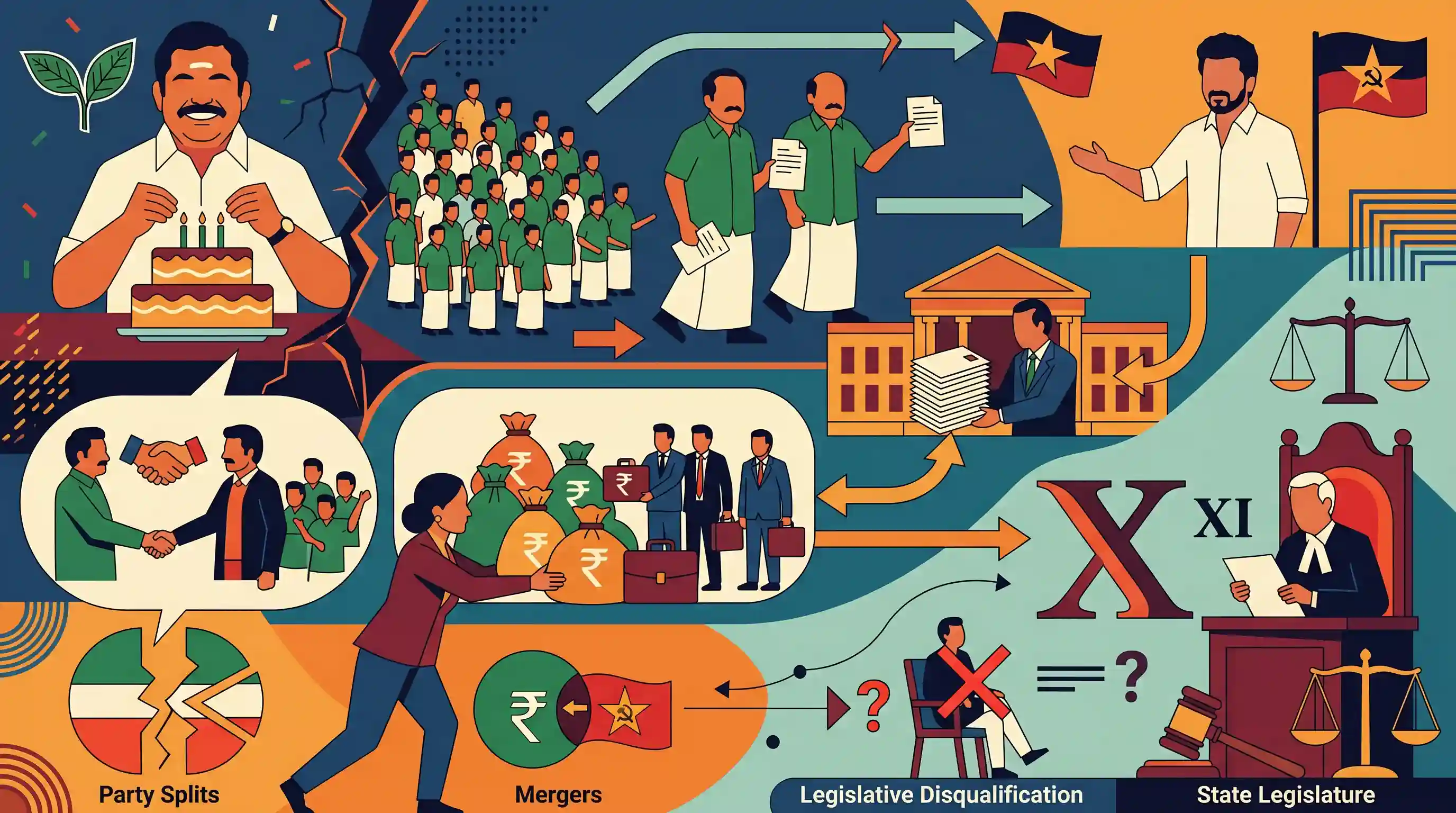
The AIADMK suffered a severe vertical split on the birthday of its general secretary, Edappadi K Palaniswami (EPS), as a rebel faction of around 30 MLAs announced their decision to join Chief Minister Vijay's Tamilaga Vettri Kazhagam (TVK) government in Tamil Nadu. The rebel group, led by senior figures S P Velumani and C Ve Shanmugham, submitted letters to the Assembly Secretary. While the rebels publicly justified the move as a revolt against EPS's alleged willingness to ally with the rival DMK, reports highlight the extensive use of money power and corporate lobbying—spearheaded by figures like Leema Rose Martin—to orchestrate the defections. The development places a spotlight on the evolving dynamics of regional state politics and tests the provisions of the Tenth Schedule (Anti-Defection Law) concerning party splits, mergers, and legislative disqualification.
Key Points
- A massive vertical split occurred in the AIADMK as a rebel faction of nearly 30 MLAs formally broke away from party chief Edappadi K Palaniswami (EPS).
- The rebel leaders, S P Velumani and C Ve Shanmugham, submitted letters to the Assembly Secretary indicating their support for Chief Minister Vijay's TVK government.
- While political disagreements over potential power-sharing with the DMK or VCK were cited publicly, insiders suggest intense corporate lobbying and financial inducements drove the defections.
- The involvement of corporate figures like Leema Rose Martin underscores the growing influence of money power and horse-trading in state politics.
- This political realignment highlights significant constitutional issues regarding the Anti-Defection Law (Tenth Schedule), the threshold for legitimate party mergers, and the Speaker's role in deciding disqualifications.
Important Terms
Tenth Schedule (Anti-Defection Law)

Constitutional provision (52nd Amendment, 1985) that disqualifies legislators for defection. It currently protects collective shifts only if two-thirds of a legislative party agree to a merger.
UPSC context
GS II (Polity); tests legislative stability, 91st Amendment rules, and the Speaker’s quasi-judicial role in preventing horse-trading.
Representation of the People Act, 1951
A statutory law governing the actual conduct of elections, candidate qualifications/disqualifications, party registration (Section 29A), and the legal framework for resolving electoral disputes.
UPSC context
GS II (Salient features of RPA); vital for understanding electoral integrity, candidate eligibility, and the Election Commission’s regulatory powers.
Tamilaga Vettri Kazhagam (TVK)
A regional political party in Tamil Nadu founded in 2024 by actor C. Joseph Vijay, focusing on egalitarianism and social justice as an alternative to DMK-AIADMK dominance.
UPSC context
GS II (Regional Parties); illustrates the role of regional identity and celebrity-led movements in Indian state-level political dynamics.
AIADMK
A major Dravidian party founded in 1972 by M.G. Ramachandran; it is one of the two principal political forces in Tamil Nadu and Puducherry.
UPSC context
GS II (Regionalism); relevant for studying factionalism, party-system evolution, and the impact of internal leadership splits on legislative performance.
Money Power in Politics
The excessive influence of financial resources and corporate lobbying on elections, often used to induce defections or influence government formation through corrupt practices.
UPSC context
GS II/III (Electoral Reforms); critical for ethics in governance and discussions on transparency in political funding and horse-trading.
Speaker (State Legislature)
The presiding officer of the State Legislative Assembly who holds the constitutional authority to decide on the disqualification of members under the Tenth Schedule.
UPSC context
GS II (State Legislature); tests the scope of judicial review and the impartiality required by high constitutional offices.
Prelims Trap
A split is protected from disqualification under the Tenth Schedule if one-third of the legislators break away.
The 91st Amendment (2003) deleted the exemption for a 'split' (1/3rd members). Currently, only a 'merger' involving at least 2/3rds of the legislative party protects members from disqualification.
Static Concepts Connected
What are the conditions for a valid merger under the Tenth Schedule?
- Party Merger: The original political party must formally merge with another political party.
- Two-thirds Majority: At least two-thirds of the members of the legislature party must agree to this merger to be protected from disqualification.
- Member Choice: Legislators can either join the new merged party or choose to function as a separate group without attracting disqualification.
What is the scope of judicial review over the Speaker's anti-defection decisions?
- Quasi-judicial role: The Speaker acts as a tribunal when deciding disqualification petitions under the Tenth Schedule (established in Kihoto Hollohan, 1992).
- No prior intervention: Courts generally cannot intervene before the Speaker makes a final decision on the disqualification petition.
- Subject to review: The Speaker's final decision is subject to judicial review on grounds of mala fides, perversity, or violation of constitutional mandates.
Cross-Topic Patterns
Corporate lobbying & Political Defections
The alleged use of corporate money to engineer defections links the Tenth Schedule with Section 123 of RPA 1951 (corrupt practices) and the broader debate on opaque political funding.
Governor's discretion & Floor Tests
When ruling parties split, Governors often call for floor tests. The Supreme Court (Shiv Sena case) ruled that Governors cannot use internal party disputes alone to mandate a floor test.

Expect a 2026 GS2 question linking 10th Schedule 'merger' loopholes, Speaker delay tactics, and the rising role of money power in splits.
Linked PYQs · 5
Linked PYQs · 5
- 2014PrelimsGS1
Which one of the following Schedules of the Constitution of India contains provisions regarding anti-defection?
- 2025PrelimsGS1
Consider the following statements : I. If any question arises as to whether a Member of the House of the People has become subject to disqualification under the 10th Schedule, the President's decision in accordance with the opinion of the Council of Union Ministers shall be final. II. There is no mention of the word 'political party' in the Constitution of India. Which of the statements given above is/are correct?
- 2023MainsGS2
Discuss the role of Presiding Officers of state legislatures in maintaining order and impartiality in conducting legislative work and in facilitating best democratic practices.
- 2020MainsGS2
Once a Speaker, Always a Speaker' ! Do you think this practice should be adopted to impart objectivity to the office of the Speaker of Lok Sabha ? What could be its implications for the robust functioning of parliamentary business in India?
- 2022MainsGS2
“While the national political parties in India favour centralisation, the regional parties are in favour of State autonomy.” Comment.
