AIADMK Protests DMK Stance on New Rural Job Guarantee Scheme
Source:The Hindu ↗
Why It Matters
It provides a contemporary example of structural changes in rural employment schemes (such as addressing agricultural labor shortages) and highlights the political and administrative dynamics of decentralizing power to Panchayati Raj Institutions.
Summary
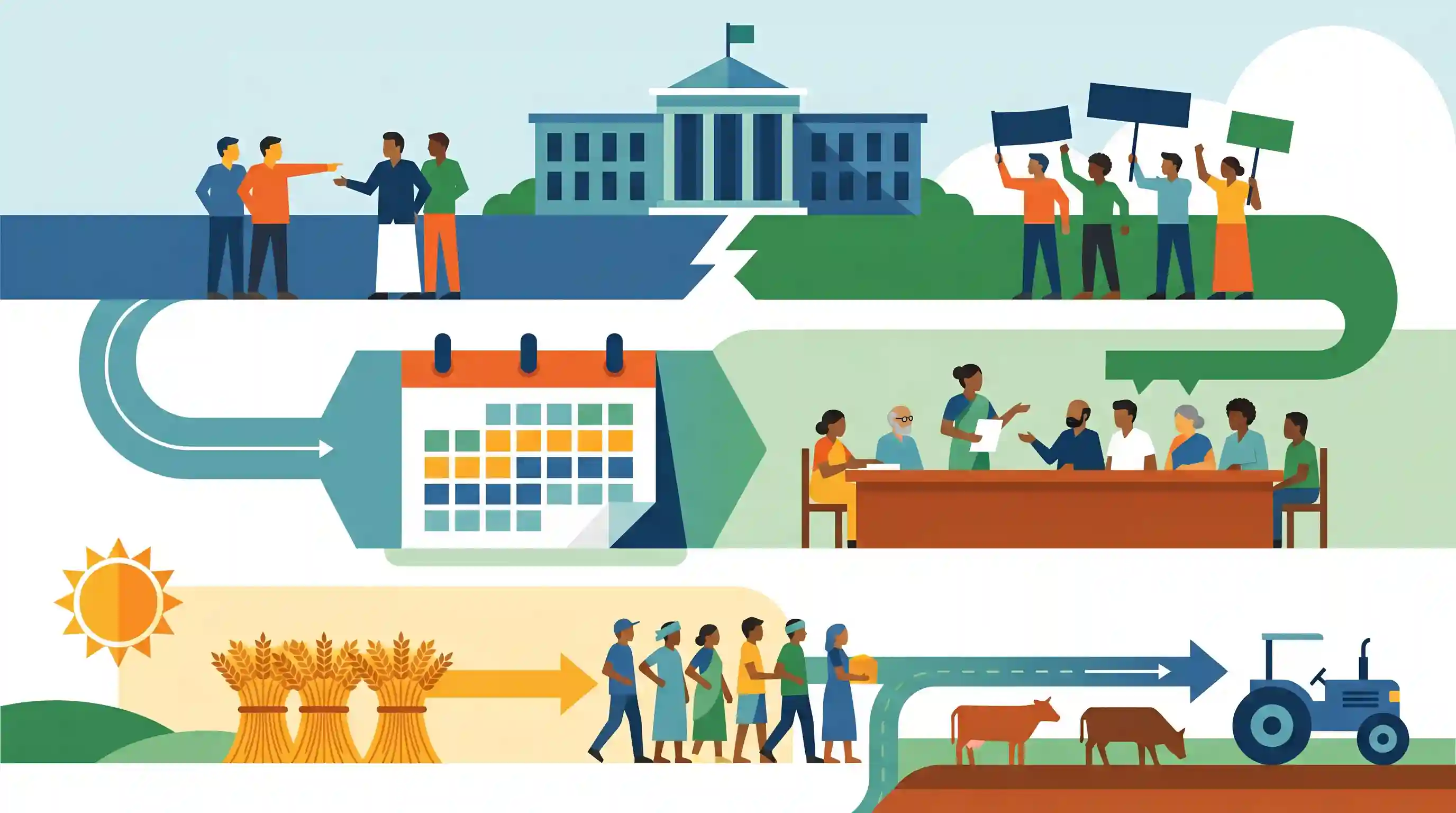
The AIADMK has announced protests against the DMK government's opposition to a proposed new rural job guarantee scheme in Tamil Nadu. The scheme promises 125 days of employment and seeks to empower local panchayat unions by allowing them to decide the nature of work and beneficiary capacity. Crucially, it includes a provision to suspend the scheme during peak agricultural seasons to prevent farm labor shortages. While the AIADMK argues the scheme strengthens local bodies without infringing upon state powers, the DMK remains opposed. The issue brings to light the intersections of rural welfare policies, grassroots decentralization, and the political friction surrounding state autonomy.
Key Points
- The AIADMK has announced state-wide protests against the DMK government's opposition to a new rural job guarantee scheme in Tamil Nadu.
- The proposed scheme provides 125 days of employment and allows panchayat unions to determine the nature of the jobs and the capacity of beneficiaries.
- To balance agricultural labor needs, the scheme includes a provision allowing its suspension during peak farming seasons.
- The political contention highlights ongoing debates regarding the devolution of power to Panchayati Raj Institutions, Centre-State relations, and the structural design of welfare programs.
Important Terms
VB-G RAM G (Viksit Bharat–Guarantee for Rozgar and Ajeevika Mission)

A 2025 Central Act replacing MGNREGA, guaranteeing 125 days of rural employment. It introduces seasonal work suspensions to support agriculture and shifts toward a more centralized funding and supply-driven model.
UPSC context
GS II: Welfare schemes for vulnerable sections. Tests understanding of evolving social safety nets and the federal friction in scheme implementation.
MGNREGA (Mahatma Gandhi National Rural Employment Guarantee Act)
The landmark 2005 Act guaranteeing 100 days of unskilled manual work to rural households. It serves as the benchmark for rural welfare and rights-based legislation in India.
UPSC context
GS II: Governance and Social Justice. Crucial for questions on poverty alleviation, rural distress, and legislative effectiveness.
Panchayat Unions
The intermediate tier (Block or Taluk level) of the three-tier Panchayati Raj system. They coordinate developmental activities across village panchayats and manage localized welfare implementation.
UPSC context
GS II: Local self-government. Tests knowledge of the PRI hierarchy and the functional devolution of power to the second tier.
Devolution of Powers
The statutory transfer of authority, resources, and decision-making from central or state governments to local bodies. It aims to achieve "Principle of Subsidiarity" and grassroots democracy.
UPSC context
GS II: Federal structure and local governance. A frequent theme in questions about the challenges and effectiveness of democratic decentralization.
73rd Constitutional Amendment Act
The 1992 constitutional reform that institutionalized the three-tier Panchayati Raj system. It mandated regular elections, reservations for SC/STs and women, and the devolution of 29 specific subjects.
UPSC context
GS II: Indian Constitution. Fundamental for Prelims (provisions) and Mains (evolution of local self-government).
Prelims Trap
"Under the proposed new rural job guarantee scheme, the Centre retains 100% funding for unskilled wages."
While MGNREGA currently mandates 100% central funding for unskilled wages, the proposed new scheme framework alters this to a 60:40 Centre-State sharing ratio.
Static Concepts Connected
What are the core constitutional provisions for Panchayati Raj economic planning?
- Article 243G: Authorises State legislatures to endow Panchayats with powers to prepare and implement plans for economic development and social justice.
- 11th Schedule: Contains 29 functional items transferred to Panchayats, explicitly including poverty alleviation programmes, rural housing, and agriculture.
- Gram Sabha: Acts as the foundational democratic unit for social audit and identifying beneficiaries for welfare schemes.
How is MGNREGA fundamentally funded and administered?
- Wage Funding: The Central government currently bears 100% of the cost for unskilled manual labour wages.
- Material Sharing: Material costs and wages for skilled/semi-skilled workers are shared between the Centre and States in a 75:25 ratio.
- Local Execution: Gram Panchayats are statutorily responsible for executing at least 50% of the works in terms of cost.
Cross-Topic Patterns
Public Works vs. Agricultural Labour
The 60-day suspension of the job scheme during peak farming seasons bridges rural welfare with agricultural productivity, resolving the classic critique that public works programs artificially induce farm labour shortages.
Fiscal Federalism & Welfare Shifts
Altering wage funding from 100% Central to a 60:40 ratio transforms the safety net into a standard Centrally Sponsored Scheme model, triggering Centre-State friction over fiscal autonomy and state debt burdens.

Expect a 2026 prelims multi-statement question contrasting MGNREGA with the new scheme, specifically targeting the 60:40 wage funding shift.
Linked PYQs · 4
Linked PYQs · 4
- 2024MainsGS2
Analyse the role of local bodies in providing good governance at local level and bring out the pros and cons merging the rural local bodies with the urban local bodies.
- 2015MainsGS2
In absence of a well-educated and organized local level government system, 'Panchayats' and 'Samitis' have remained mainly political institutions and not effective instruments of governance. Critically discuss.
- 2022MainsGS2
“While the national political parties in India favour centralisation, the regional parties are in favour of State autonomy.” Comment.
- 2024MainsGS2
What changes has the Union Government recently introduced in the domain of Centre-State relations ? Suggest measures to be adopted to build the trust between the Centre and the States and for strengthening federalism.
