Enterprise Artificial Intelligence faces scalability and cost hurdles
Source:The Hindu ↗
Why It Matters
Provides critical administrative and ethical perspectives on why AI adoption in governance and business is stalling, which is directly relevant to GS2 (e-governance barriers), GS3 (AI and technology applications), and GS4 (ethics of AI decision-making).
Summary
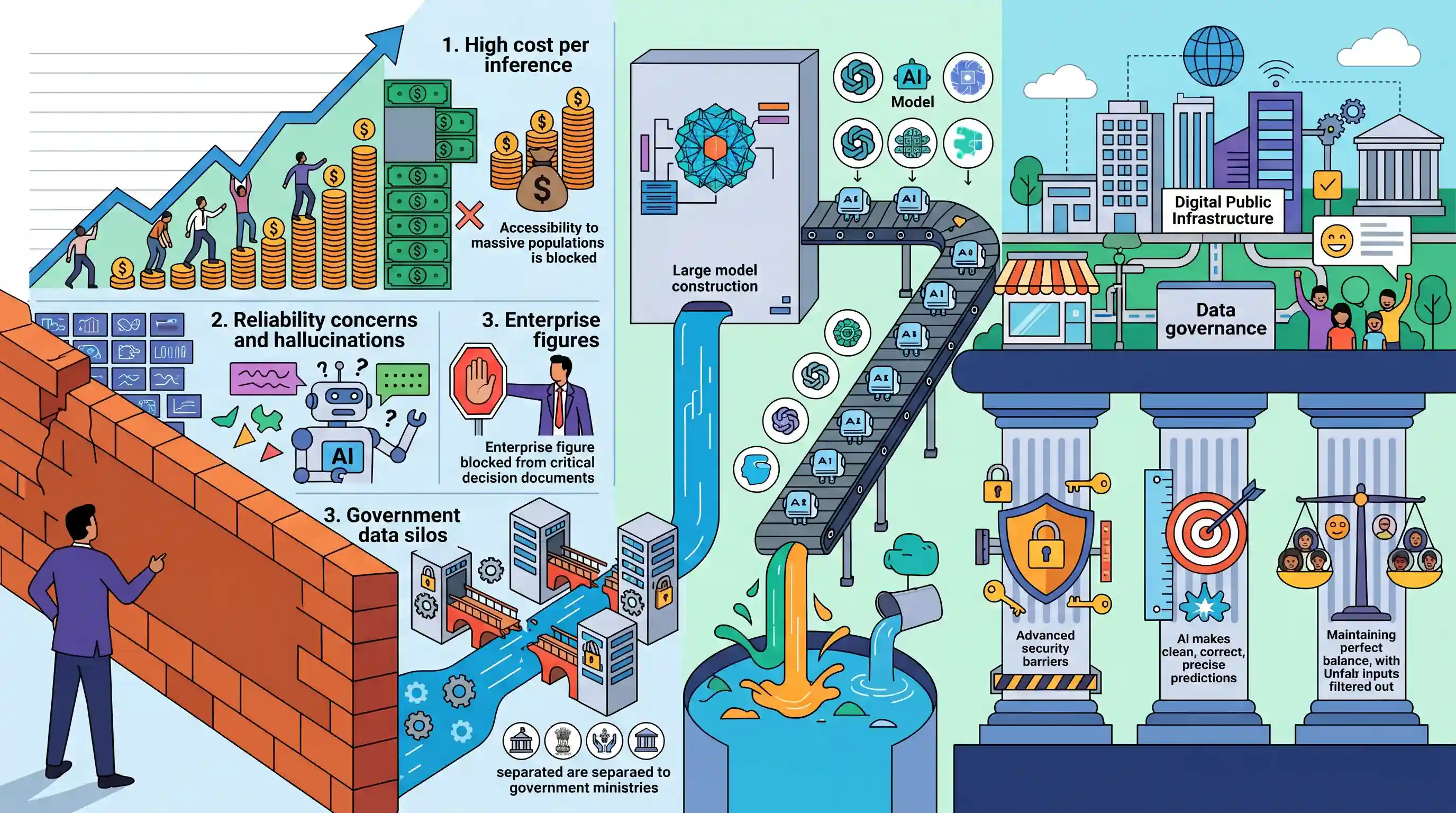
Infosys founder Nandan Nilekani highlighted that scaling Artificial Intelligence (AI) for enterprise and public sector applications is proving harder than expected. He identified three primary barriers: the high "cost per inference" that limits accessibility for massive populations; reliability concerns such as AI "hallucinations" that make enterprises hesitant to entrust it with critical decisions; and severe data silos within government ministries that block the data-sharing necessary for public sector AI deployment. Nilekani also argued that while building an indigenous Indian Large Language Model (LLM) is not strictly necessary due to the rapid commoditization of models (like DeepSeek), the real challenge lies in ensuring AI deployment is highly secure, highly accurate, and devoid of bias.
Key Points
- Implementing AI at scale is proving more difficult than anticipated due to cost, accuracy, and organizational barriers.
- For AI to be viable for India's population, the "cost per inference" must be extremely low (e.g., ₹1), which currently limits deployment to smaller models rather than massive Large Language Models.
- Enterprise adoption of AI is slow and cautious due to reliability issues, such as "hallucinations," making organizations reluctant to delegate decision-making to AI systems.
- Public sector AI deployment faces severe structural hurdles because government departments often operate in territorial silos, restricting the sharing of data necessary to fuel AI models.
- Deploying AI securely, accurately, and without bias is more important than building indigenous foundational models, especially as foundational models are becoming rapidly commoditized.
Important Terms
DeepSeek

A Chinese open-source AI model that rivals Western systems like GPT-4 at a fraction of the training cost, signaling a shift toward efficient, low-cost AI development.
UPSC context
GS Paper III: Science & Technology and Geopolitics; impacts global AI competition and India's 'Sovereign AI' strategy.
AI Hallucinations
Occurrences where AI generates factually incorrect, nonsensical, or fabricated information with high confidence, posing reliability risks for critical decision-making in enterprises and governance.
UPSC context
GS Paper III (Sci-Tech) and Paper IV (Ethics); challenges the deployment of 'Responsible AI' in public service.
Data Silos
Isolated pockets of data held by individual departments or ministries that are not easily accessible or shared across an organization, hindering integrated AI-driven insights.
UPSC context
GS Paper II: Governance; a major structural barrier to effective e-Governance and inter-departmental coordination in India.
Cost per Inference
The recurring operational expense of using a trained AI model to generate a single response or prediction, which can become prohibitively high when scaled to large populations.
UPSC context
GS Paper III: Economy/Sci-Tech; a key viability metric for scaling 'IndiaAI Mission' and large-scale public sector AI.
Digital Public Infrastructure (DPI)
Foundational digital systems like Aadhaar and UPI that enable secure, large-scale interactions; modern versions (DPI 2.0) increasingly integrate AI to improve citizen-centric public service delivery.
UPSC context
GS Paper II & III: Governance and Sci-Tech; tests knowledge of India's unique digital development model.
Technology Commoditization
The transition of complex technology into a standard, widely available good, shifting market value from building the technology to how it is applied in specific solutions.
UPSC context
GS Paper III: Economy and Sci-Tech; relevant to India's strategy of 'application-first' AI over building new base models.
Prelims Trap
Developing indigenous foundational LLMs is a mandatory prerequisite for deploying population-scale AI in India.
Experts argue model commoditization makes fine-tuning existing open-source models more viable than building from scratch. Absolute requirements are classic traps.
Static Concepts Connected
What is the National Data Governance Framework Policy (NDGFP)?
- Objective: Addresses structural data silos by standardizing non-personal data collection, management, and sharing across different government ministries.
- India Datasets Program: Creates a massive repository of anonymized, non-personal data to train AI models and support the domestic startup ecosystem.
- IDMO: The India Data Management Office (IDMO) under MeitY serves as the nodal agency to enforce these data standards.
What do 'Inference' and 'Hallucination' mean in Artificial Intelligence?
- AI Inference: The operational phase where a previously trained machine learning model processes new data to generate outputs, predictions, or text.
- Cost per Inference: The computational and financial cost required to generate a single response; keeping this low is crucial for population-scale deployment.
- AI Hallucinations: Instances where an AI system confidently generates false, fabricated, or nonsensical information, severely limiting its reliability in critical governance.
Cross-Topic Patterns
AI layer on top of India's DPI
India's DPI (UPI, Aadhaar) thrives on interoperability. Deploying population-scale AI demands breaking departmental data silos, directly linking GS2 e-governance structures with GS3 emerging technologies.
Tech commoditization vs. Data Sovereignty
As foundational AI models commoditize, national focus shifts from building indigenous models from scratch to localized fine-tuning, bias mitigation, and robust non-personal data governance.

Expect a 2026 Mains question analyzing structural bottlenecks—compute cost, hallucinations, data silos—in scaling AI for India's e-governance.
Linked PYQs · 3
Linked PYQs · 3
- 2024MainsGS4
The application of Artificial Intelligence as a dependable source of input for administrative rational decision-making is a debatable issue. Critically examine the statement from the ethical point of view.
- 2025MainsGS2
e-governance projects have a built-in bias towards technology and back-end integration than user-centric designs. Examine.
- 2023MainsGS3
Introduce the concept of Artificial Intelligence (AI). How does Al help clinical diagnosis? Do you perceive any threat to privacy of the individual in the use of Al in healthcare?
