Artificial General Intelligence and Global Technology Governance
Source:The Hindu ↗
Why It Matters
As AI rapidly approaches AGI capabilities, the dual-use nature of the technology becomes a critical governance issue. Understanding its vast potential in healthcare alongside the urgent need for global ethical frameworks is highly relevant for both GS3 (Science & Tech applications) and GS4 (Ethical dilemmas in emerging technologies).
Summary
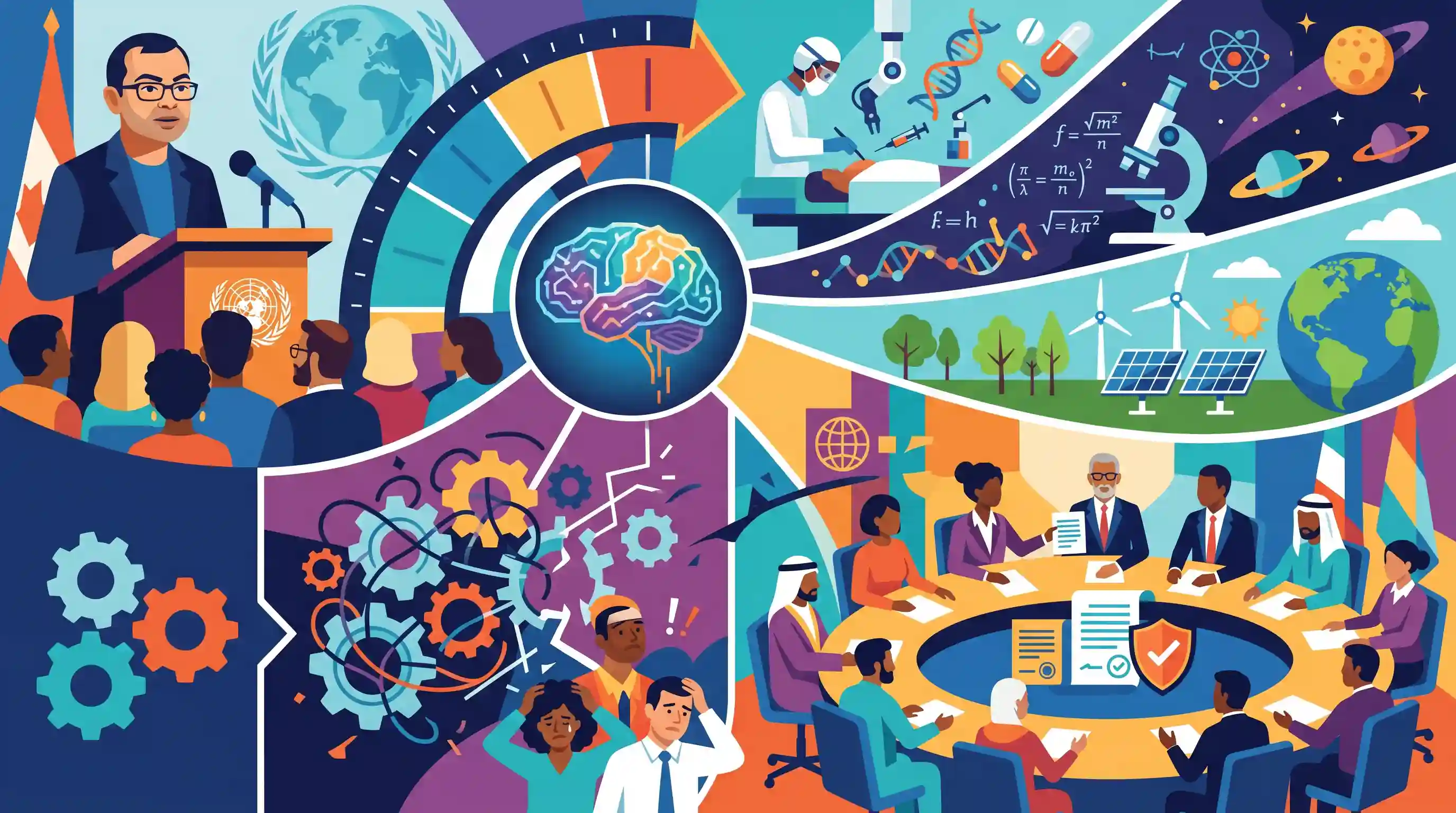
Speaking at the India AI Impact Summit, Google DeepMind CEO Demis Hassabis projected that Artificial General Intelligence (AGI) could emerge within 5 to 8 years. While he remains highly optimistic about AI's revolutionary potential in fields like medicine, scientific discovery, and climate action, he cautioned that managing AI's societal implications will be far more complex than resolving its technical challenges. Consequently, he stressed the urgent need for international cooperation and structured global dialogues to ensure AI development aligns with the public good and its risks are collectively mitigated.
Key Points
- Google DeepMind CEO Demis Hassabis predicts that Artificial General Intelligence (AGI) could become a reality within the next five to eight years.
- Hassabis emphasized AI's potential to revolutionize scientific discovery, particularly in medicine, drug development, material science, and climate action (citing systems like AlphaFold).
- He warned that mitigating the societal challenges and risks posed by AI will likely be more difficult than solving the underlying technical problems.
- Addressing AI's global impact requires robust international dialogue and cooperation, building on recent global AI summits held in the UK, South Korea, and France.
Important Terms
Artificial General Intelligence (AGI)

A theoretical form of artificial intelligence capable of performing any intellectual task a human can, featuring general cognitive abilities like reasoning and problem-solving across diverse domains.
UPSC context
GS Paper III (Science & Technology); tests understanding of emerging technologies and their potential long-term socio-economic impacts.
Global AI Governance
The international effort to establish rules, standards, and ethical guidelines to manage cross-border AI risks like bias, privacy, and security while promoting equitable access.
UPSC context
GS Paper II (International Relations & Governance); relevant for discussions on digital sovereignty and multilateral cooperation in technology.
IndiaAI Mission
A ₹10,372 crore national initiative to bolster India's AI ecosystem through high-end compute capacity (10,000+ GPUs), indigenous foundational models, and datasets for social impact.
UPSC context
GS Paper III (Economy & Science/Tech); tests knowledge of government policies for digital infrastructure and technological self-reliance.
AlphaFold
An AI system developed by Google DeepMind that predicts 3D protein structures from amino acid sequences, solving the 50-year-old 'protein-folding problem' in biology.
UPSC context
GS Paper III (Science & Technology - Biotechnology); tests knowledge of AI applications in medicine, drug discovery, and biological research.
India AI Impact Summit
A major global forum hosted in New Delhi to discuss AI's transformative potential for science and society, focusing on global cooperation and safety.
UPSC context
GS Paper II (Governance); highlights India's leadership in the Global South for shaping international technology policy.
AI Ethics
The branch of ethics that addresses moral issues such as algorithmic bias, data privacy, accountability, and the alignment of AI systems with human values.
UPSC context
GS Paper IV (Ethics) and GS Paper III (S&T); tests the ability to analyze the moral dimensions of disruptive technology.
Prelims Trap
"AGI (Artificial General Intelligence) currently exists in advanced systems like AlphaFold."
Aspirants often confuse highly capable Narrow AI (like ChatGPT or AlphaFold) with AGI. AGI remains hypothetical and represents human-level cognitive capabilities across all domains.
Static Concepts Connected
What distinguishes Artificial General Intelligence (AGI) from Narrow AI?
- Narrow AI: Excels only in specific, predefined tasks (e.g., AlphaFold for protein structures, facial recognition). Currently, all existing AI falls into this category.
- AGI: A hypothetical stage where a system can emulate human-level cognitive capabilities, transfer learning, and complex reasoning across diverse, unrelated domains.
- Superintelligent AI: A theoretical future stage where machine intellect surpasses the smartest human minds in practically every field, including scientific creativity and social skills.
What are the major multilateral frameworks for global AI governance?
- Bletchley Declaration: The world's first global pact on AI safety (2023), signed by 28 nations including India, focusing on mitigating risks from 'frontier AI' models.
- GPAI: A multi-stakeholder initiative where India (2024 chair) led the adoption of the New Delhi Declaration, balancing AI innovation with ethical guardrails.
- EU AI Act: The world's first comprehensive legal framework by the European Union, which categorizes AI systems strictly based on their risk to society.
Cross-Topic Patterns
AI’s intersection with structural biology
AlphaFold’s protein-folding prediction bridges deep learning with biotechnology, vastly accelerating clinical diagnostics and drug discovery, a frequent theme in UPSC Prelims S&T biology questions.
Algorithmic bias and administrative ethics
The push for AI in administration connects S&T to GS-IV (Ethics), raising critical concerns about algorithmic biases, systemic unpredictability, and accountability in automated governance.

Expect a multi-statement Prelims question comparing Narrow AI vs AGI capabilities, paired with India's role in GPAI or the Bletchley pact.
Linked PYQs · 3
Linked PYQs · 3
- 2023MainsGS3
Introduce the concept of Artificial Intelligence (AI). How does Al help clinical diagnosis? Do you perceive any threat to privacy of the individual in the use of Al in healthcare?
- 2024MainsGS4
The application of Artificial Intelligence as a dependable source of input for administrative rational decision-making is a debatable issue. Critically examine the statement from the ethical point of view.
- 2024MainsGS4
ABC Incorporated is a technological company named which is the second largest worldwide, situated in the Third World. You are the Chief Executive Officer and the majority shareholder of this company. The fast technological improvements have raised worries among environmental activists, regulatory authorities, and the general public over the sustainability of this scenario. You confront substantial issues about the business's environmental footprint. In 2023, your organization had a significant increase of 48% in greenhouse gas emissions compared to the levels recorded in 2019. The significant rise in energy consumption is mainly due to the surging energy requirements of your data centers, fuelled by the exponential expansion of Artificial Intelligence (AI). AI-powered services need much more computational resources and electrical energy compared to conventional online activities, notwithstanding their notable gains. The technology's proliferation has led to a growing concern over the environmental repercussions, resulting in an increase in warnings. Al models, especially those used in extensive machine learning and data processing, exhibit much greater energy consumption than conventional computer tasks, with an exponential increase. Although there is already a commitment and goal to achieve net zero emissions by 2030, the challenge of lowering emissions seems overwhelming as the integration of Al continues to increase. To achieve this goal, substantial investments in renewable energy use would be necessary. The difficulty is exacerbated by the competitive environment of the technology sector, where rapid innovation is essential for preserving market standing and shareholders' worth. To achieve a balance between innovation, profitability and sustainability, a strategic move is necessary that is in line with both, business objectives and ethical obligations. (a) What is your immediate response to the challenges posed in the above case? (b) Discuss the ethical issues involved in the above case. (c) Your company has been identified to be penalized by technological giants. What logical and ethical arguments will you put forth to convince about its necessity? (d) Being a conscience being, what measures would you adopt to maintain balance between AI innovation and environmental footprint?
