AI Applications in Tiger Conservation and Wildlife Management
Source:Indian Express ↗
Why It Matters
Understanding the intersection of emerging technologies like Artificial Intelligence and environmental conservation is vital for modern wildlife management and answers questions on tech applications in GS Paper 3.
Summary
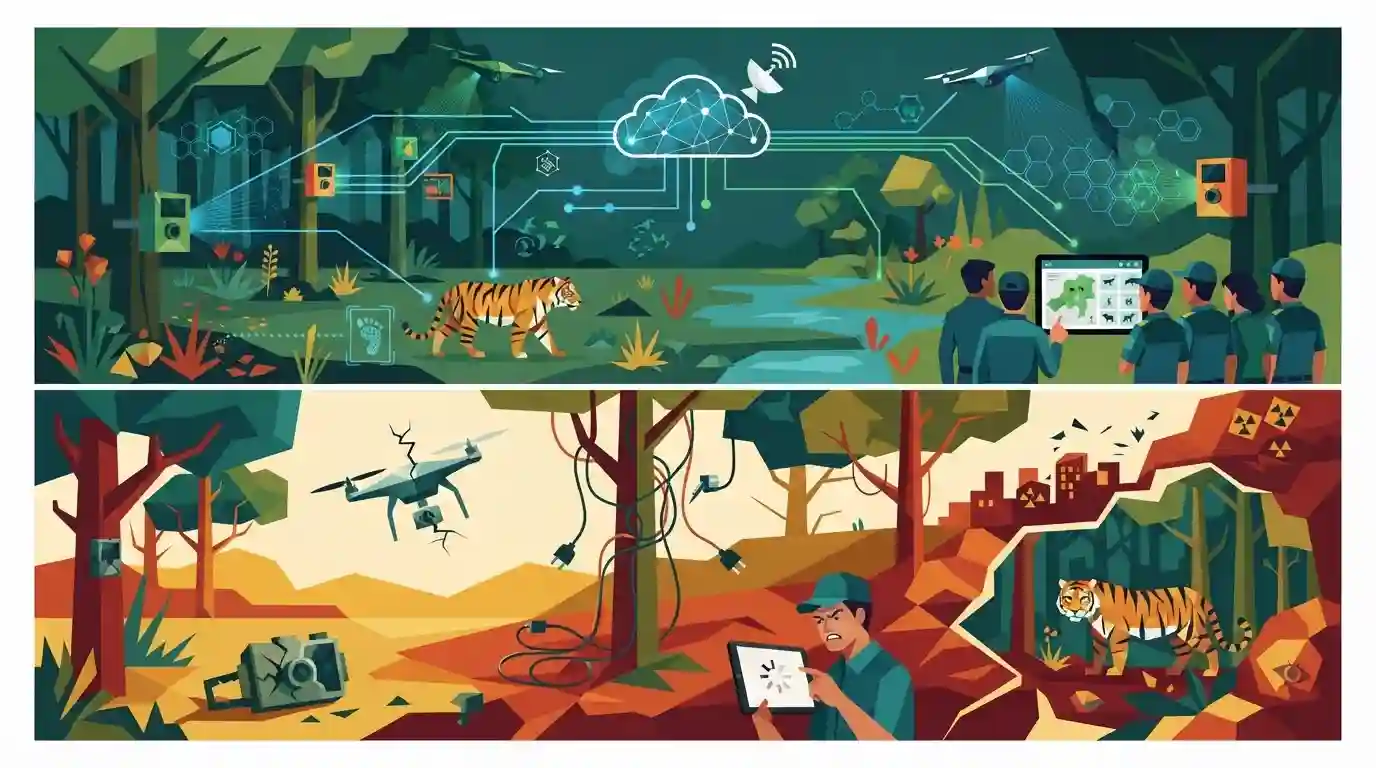
The article examines the growing role of Artificial Intelligence (AI) and machine learning in tiger conservation and wildlife protection in India. It highlights how automated camera-trap analysis, pattern recognition, and data-driven monitoring help track wildlife populations efficiently, while addressing the limitations and practical challenges of relying heavily on technology in forest management.
Key Points
- Artificial Intelligence and machine learning are increasingly transforming wildlife monitoring, enabling automated identification of individual tigers and wildlife tracking.
- AI-driven tools reduce human workload in analyzing massive camera-trap data, improving the accuracy of wildlife population estimates.
- Challenges remain in deploying AI for conservation, including data quality, algorithmic bias, infrastructural gaps in remote forests, and balancing tech reliance with field expertise.
Important Terms
Wild Life Protection Act 1972

A comprehensive Indian legislation enacted in 1972 to protect wild animals, birds, and plants, providing legal frameworks for establishing protected areas, regulating hunting, and preventing illegal wildlife trade.
UPSC context
UPSC Prelims/Mains (GS Paper III): Essential biodiversity legislation; tests statutory frameworks, protected area categories, and wildlife conservation policies.
National Tiger Conservation Authority
A statutory body under the Ministry of Environment, Forest and Climate Change established in 2006 to provide oversight, policy direction, and funding for Project Tiger and tiger reserves.
UPSC context
UPSC Prelims/Mains (GS Paper III): Environment and Conservation; tests knowledge of statutory conservation bodies, tiger census methodologies, and habitat management.
Prelims Trap
M-STrIPES is a purely automated satellite-based remote sensing system that operates independently of forest guard patrolling.
M-STrIPES is an operational field monitoring system for patrolling forest guards, not an autonomous AI satellite surveillance tool for civilian use.
Static Concepts Connected
What are the key statutory bodies and monitoring frameworks for tiger conservation in India?
- NTCA mandate:: Statutory body established under the Wild Life Protection Act, 1972, headed by the Union Environment Minister.
- All India Tiger Estimation:: Launched in 2006, conducted once every four years to assess tiger numbers, habitat status, and anthropogenic pressures.
- M-STrIPES framework:: GPS-enabled mobile application and software used by forest guards for intensive patrolling and ecological monitoring.
Cross-Topic Patterns
AI in Conservation + Digital Governance
AI applications in biodiversity monitoring intersect with digital public infrastructure initiatives and governance frameworks, bridging technology applications with ecological security.
Wildlife Surveillance + Right to Privacy
Deploying surveillance tech in ecologically sensitive areas raises constitutional questions regarding the right to privacy versus state monitoring in protected forests.

Expect a statement-based question combining M-STrIPES, Wildlife Protection Act, and AI tools like TrailGuard in tiger reserves.
Linked PYQs · 2
Linked PYQs · 2
- 2020PrelimsGS1
Among the following Tiger Reserves, which one has the largest area under "Critical Tiger Habitat"?
- 2026PrelimsGS1
With reference to Madhav National Park, which of the following statements is/are correct ? 1. It was declared a Tiger Reserve in India in 2025. 2. Sakhya Sagar, which is designated as a Ramsar Site, is situated within this National Park. 3. Its area is shared between Madhya Pradesh and Rajasthan. Select the answer using the code given below :
