AI Applications in Tiger Conservation and Wildlife Protection
Source:Indian Express ↗
Why It Matters
It highlights the intersection of cutting-edge technology (AI) and environmental conservation (Project Tiger), aligning with UPSC GS3 syllabus requirements on technology applications and biodiversity conservation.
Summary
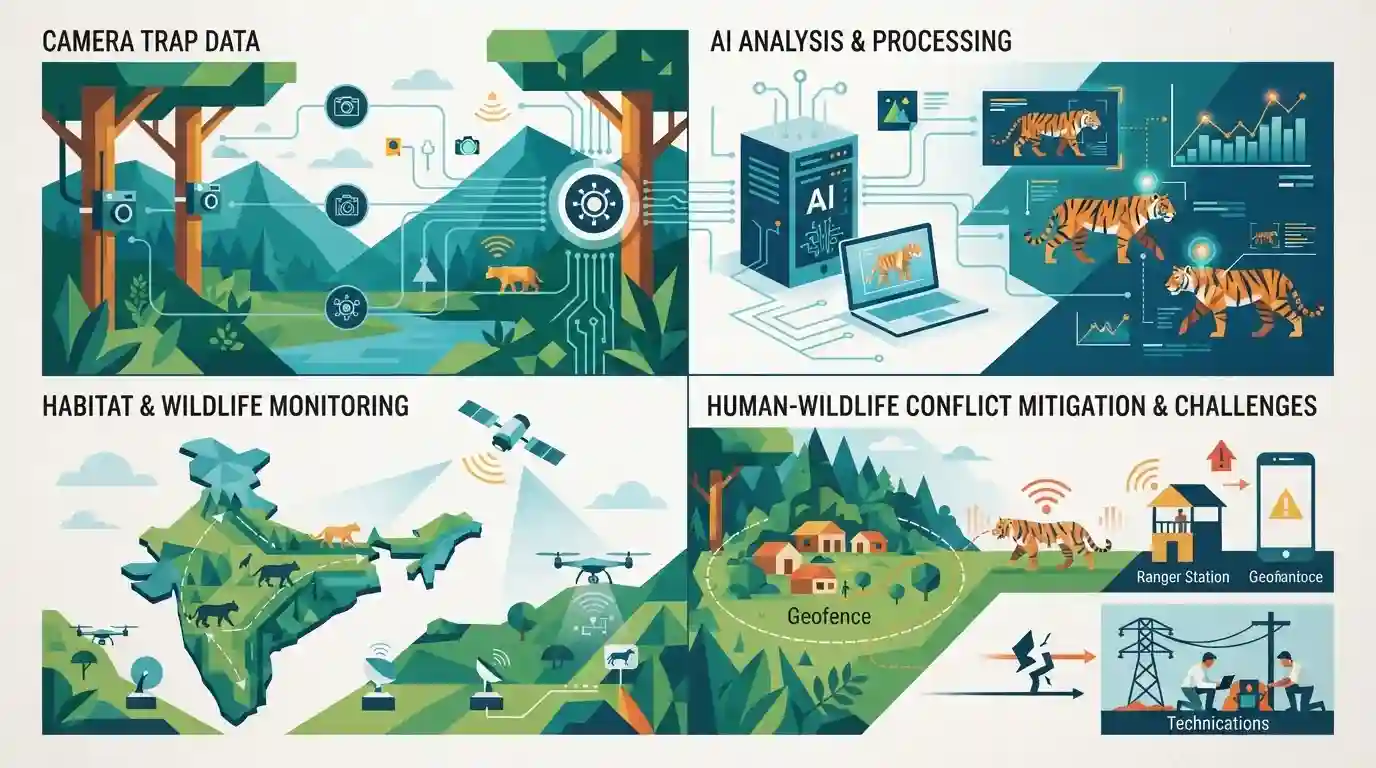
The article explores the growing role of Artificial Intelligence and advanced technologies in tiger conservation and wildlife management in India. By automating image processing from camera traps, AI enables precise population estimates, wildlife tracking, habitat monitoring, and mitigation of human-wildlife conflict, though infrastructural and systemic challenges persist.
Key Points
- Artificial Intelligence (AI) and machine learning are increasingly revolutionizing tiger conservation and wildlife monitoring in India.
- AI-driven camera traps and automated image processing help in individual tiger identification and population estimation, reducing manual labor and time.
- Technology aids in mapping wildlife corridors, preventing human-wildlife conflict, and tracking illegal poaching activities.
- Challenges remain regarding data privacy, technological infrastructure in remote forest areas, and standardizing AI models for ecological research.
Important Terms
Project Tiger

A centrally sponsored flagship conservation program launched in 1973 to protect the Bengal tiger and its habitats through a core-buffer strategy across designated tiger reserves in India.
UPSC context
UPSC Prelims/Mains (GS Paper III): Important for environmental conservation, biodiversity, and species recovery programs.
Wildlife Protection Act 1972
The principal legislation enacted in 1972 to provide a legal framework for the protection of wild animals, birds, and plants, and to regulate wildlife trade and sanctuaries in India.
UPSC context
UPSC Prelims/Mains (GS Paper III): Core environmental law testing statutory protections and conservation schedules.
National Tiger Conservation Authority
A statutory body established under the Wildlife Protection Act, 1972, providing oversight, funding, and coordination for Project Tiger and tiger reserve management across India.
UPSC context
UPSC Prelims/Mains (GS Paper III): Tests institutional mechanisms, statutory bodies, and governance in environmental conservation.
Static Concepts Connected
What are the statutory mandates and institutional frameworks of the National Tiger Conservation Authority (NTCA)?
- Statutory Basis: Established in 2005 under the Wildlife (Protection) Act, 1972, following recommendations of the Tiger Task Force.
- Core Functions: Statutorily mandated to evaluate and manage tiger reserves, approve tiger conservation plans, and conduct quadrennial national tiger status evaluations.
Cross-Topic Patterns
AI Conservation & Statutory Wildlife Frameworks
The integration of AI camera traps into the Wildlife Protection Act framework shows how digital infrastructure intersects with traditional statutory conservation bodies like the NTCA.

AI-driven wildlife monitoring + NTCA quadrennial estimation methodology is a high-yield area for science-tech and environment prelims.
Linked PYQs · 4
Linked PYQs · 4
- 2022PrelimsGS1
With reference to Indian laws about wildlife protection, consider the following statements : 1. Wild animals are the sole property of the government. 2. When a wild animal is declared protected, such animal is entitled for equal protection whether it is found in protected areas or outside. 3. Apprehension of a protected wild animal becoming a danger to human life is sufficient ground for its capture or killing. Which of the statements given above is/are correct?
- 2020PrelimsGS1
Which one of the following protected areas is well-known for the conservation of a sub-species of the Indian swamp deer (Barasingha) that thrives well on hard ground and is exclusively graminivorous?
- 2023PrelimsGS1
Consider the following statements: Once the Central Government notifies an area as a 'Community Reserve' 1. the Chief Wildlife Warden of the State becomes the governing authority of such forest 2. hunting is not allowed in such area 3. people of such area are allowed to collect non-timber forest produce 4. people of such area are allowed traditional agricultural practices How many of the above statements are correct?
- 2023MainsGS3
Introduce the concept of Artificial Intelligence (AI). How does Al help clinical diagnosis? Do you perceive any threat to privacy of the individual in the use of Al in healthcare?
