Regulatory and Ethical Challenges of AI Therapy Applications
Source:The Hindu ↗
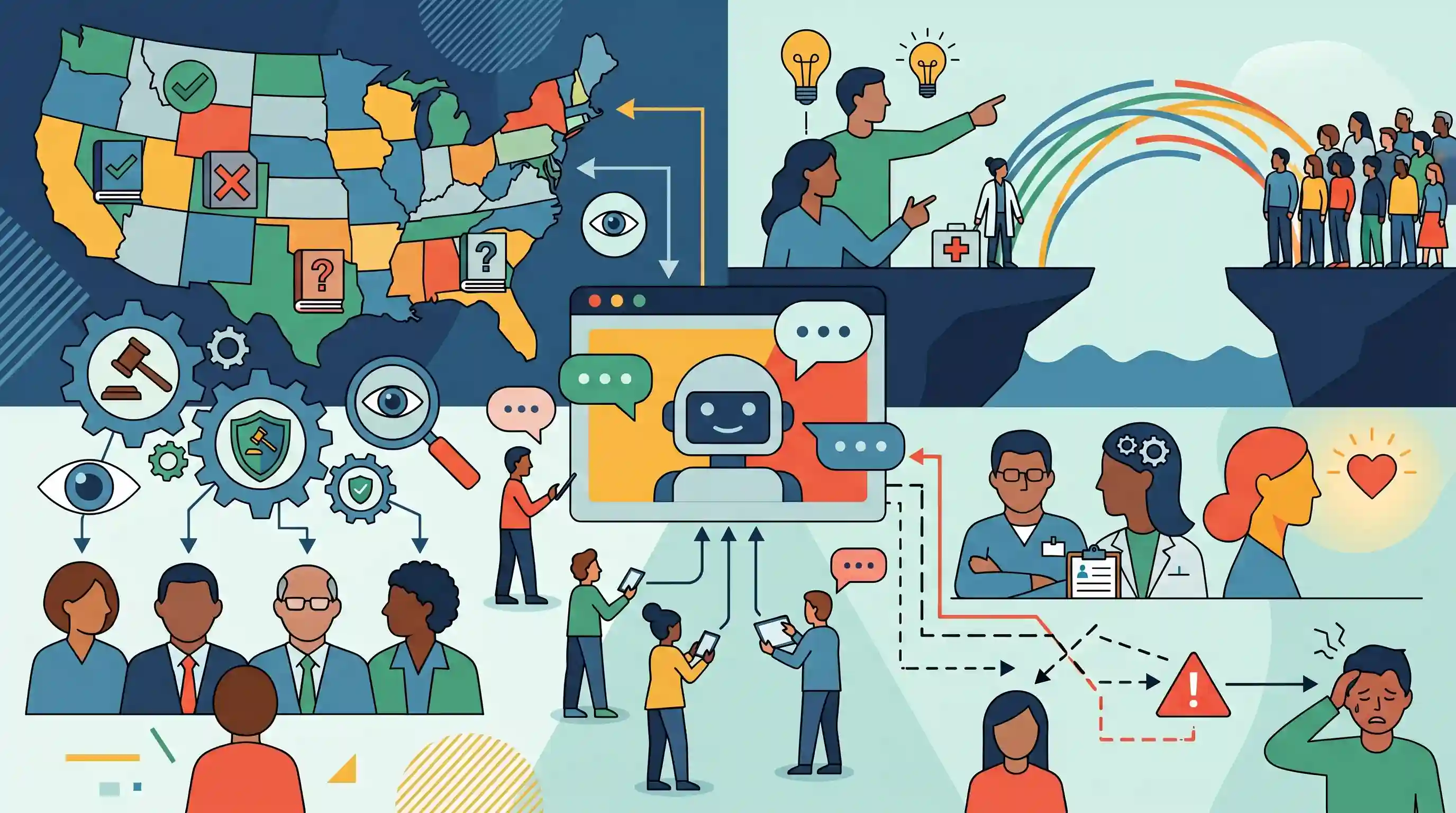
Why It Matters
This topic sits at the intersection of GS3 (AI and technological advancements), GS2 (healthcare policies and mental health deficits), and GS4 (ethical dimensions of replacing human empathy with machines). It serves as an excellent case study for AI regulation and the limits of technology in sensitive sectors like healthcare.
Summary
The rapid proliferation of AI-driven mental health chatbots has prompted urgent regulatory and ethical debates. In the U.S., a patchwork of state laws has emerged, with some banning AI in mental health treatment altogether, while federal agencies like the FTC and FDA evaluate the technology's risks to vulnerable populations. Although AI developers argue these apps can bridge the gap caused by a shortage of human therapists, clinical psychologists warn that current models lack human empathy, clinical judgment, and ethical responsibility, making them potentially dangerous for individuals in crisis.
Key Points
- The unregulated rise of generative AI chatbots marketed as 'AI therapists' or mental wellness companions has triggered varied state-level legislative responses in the U.S., including bans in Illinois and Nevada.
- Federal agencies like the FTC and FDA are increasingly scrutinizing tech companies over the mental health impacts of their AI tools, especially on children and teenagers.
- While AI chatbots can potentially help address the severe shortage of mental health professionals, experts warn they lack human empathy, clinical judgment, and ethical accountability.
- Developers of tools like Earkick are altering their marketing language to avoid regulatory penalties, while clinical trials for apps like Dartmouth\'s 'Therabot' aim to build strictly evidence-based AI interventions.
Important Terms
Federal Trade Commission (FTC)

An independent US agency that protects consumers by preventing deceptive or unfair business practices. In AI, it investigates data privacy, teen safety, and misleading marketing claims by chatbot developers.
UPSC context
Relevant for GS Paper 2 (Governance/International Regulatory Models) and GS Paper 3 (Cybersecurity/Data Privacy). Tests understanding of tech oversight.
Food and Drug Administration (FDA)
The primary US regulator for public health. It evaluates whether AI software functions as a 'medical device' to diagnose or treat conditions, potentially requiring prescription-grade clinical trials for therapy apps.
UPSC context
Significant for GS Paper 2 (Health Governance) and GS Paper 3 (Science and Technology/Medical AI regulation).
American Psychological Association (APA)
The leading professional organization representing psychology in the US. It issues ethical guidelines for AI use, emphasizing that technology should augment—not replace—human clinical judgment and empathy.
UPSC context
Relevant for GS Paper 4 (Ethics in healthcare/AI) and GS Paper 2 (Professional bodies' role in policy).
OpenAI
An AI research and deployment company that created ChatGPT. It collaborates with clinicians to develop safety guardrails for users seeking mental health support from generative AI models.
UPSC context
Key for GS Paper 3 (Science and Technology/AI developments) and GS Paper 4 (Corporate social responsibility/AI ethics).
Character.AI
A conversational AI platform that allows users to interact with customizable personas. It has faced legal scrutiny over its potential to foster unhealthy emotional attachments in vulnerable minors.
UPSC context
Useful for GS Paper 4 (Ethics: Vulnerable groups and digital addiction) and GS Paper 3 (Social consequences of AI).
Meta
The parent company of Facebook and Instagram. It is a major stakeholder in the AI market currently being studied by regulators for its impact on children's mental well-being and privacy.
UPSC context
GS Paper 3 (Technology/Information Technology) and GS Paper 2 (Role of big tech in public health and governance).
A global technology leader heavily invested in AI (e.g., Gemini). Along with other 'Big Tech' firms, it is part of federal inquiries into chatbot safety and consumer protection.
UPSC context
Relevant for GS Paper 3 (Science and Technology/Innovation and Indigenization of Technology).
Prelims Trap
"ICMR guidelines permit fully autonomous AI for mental health interventions if patient consent is obtained."
The ICMR Ethical Guidelines for AI in Healthcare (2023) strictly mandate human-in-the-loop oversight and accountability. Fully autonomous AI in clinical interventions is not permitted.
Static Concepts Connected
What are the core principles of ICMR's Ethical Guidelines for AI in Healthcare (2023)?
- Human Oversight: Mandates continuous 'Human-in-the-loop' (HITL) oversight. AI is a supportive tool and cannot replace human clinical judgment or bear ultimate accountability.
- Safety and Validity: AI algorithms must undergo rigorous clinical validation and continuous monitoring to prevent harm stemming from algorithmic hallucinations or biases.
- Data Privacy: Requires stringent protection of sensitive health records, ensuring that AI deployment complies entirely with national data protection laws.
How does India's Tele-MANAS initiative structure its mental health service delivery?
- Two-Tier System: Tier 1 comprises state-level IVRS and trained counsellors. Tier 2 provides specialist psychiatric care via e-Sanjeevani, audio/video consultations, and medical colleges.
- Nodal Agencies: NIMHANS serves as the apex nodal centre for clinical protocols, while IIIT-Bangalore provides the underlying technological support framework.
Cross-Topic Patterns
AI Healthcare + DPDP Act 2023
Mental health chatbots process highly sensitive personal data. Under India's DPDP Act 2023, exploiting this data violates purpose limitation and requires stringent, verifiable consent protocols.
GS-4: Compassion vs. Automation
AI bridges the mental health professional shortage but poses a GS-4 dilemma: the ethical imperative of human empathy, clinical judgment, and accountability when treating vulnerable individuals in crisis.

Expect a GS-3 or GS-4 question integrating AI regulation, ICMR guidelines, and the ethical limits of autonomous AI in healthcare in 2026.
Linked PYQs · 4
Linked PYQs · 4
- 2023MainsGS3
Introduce the concept of Artificial Intelligence (AI). How does Al help clinical diagnosis? Do you perceive any threat to privacy of the individual in the use of Al in healthcare?
- 2024MainsGS4
The application of Artificial Intelligence as a dependable source of input for administrative rational decision-making is a debatable issue. Critically examine the statement from the ethical point of view.
- 2020MainsGS2
In order to enhance the prospects of social development, sound and adequate health care policies are needed particularly in the fields of geriatric and maternal health care. Discuss.
- 2024MainsGS3
Describe the context and salient features of the Digital Personal Data Protection Act, 2023.
