Data protection laws and the weakening Right to Information framework
Source:Indian Express ↗
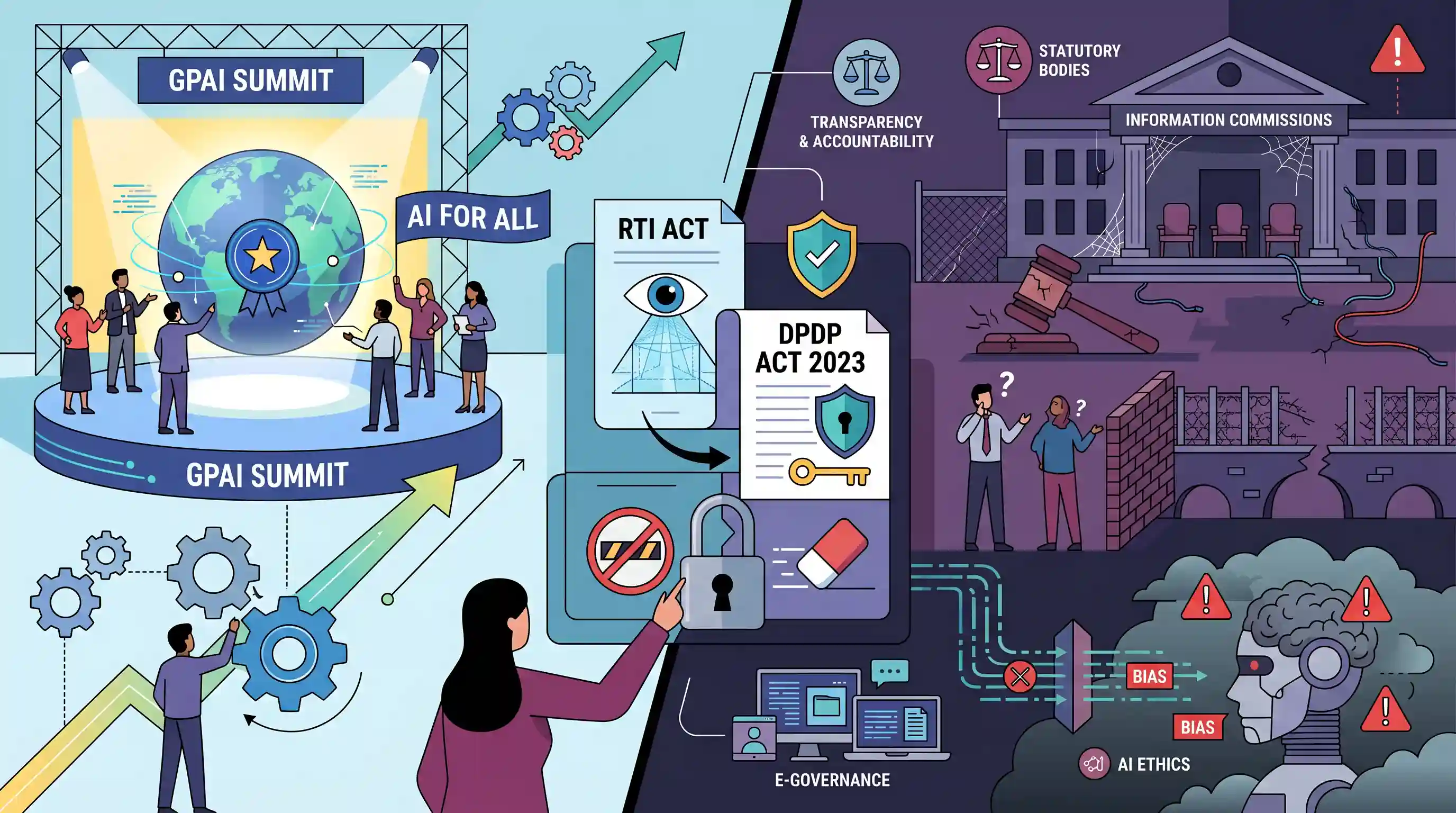
Why It Matters
This topic highlights the crucial tension between the Right to Privacy (DPDP Act) and the Right to Information (RTI Act). It is highly relevant for GS2 (Governance) questions evaluating the impact of recent legal amendments on transparency, as well as for GS3 questions addressing the governance and ethical implications of Artificial Intelligence and data protection frameworks.
Summary
The article draws a sharp contrast between India's global advocacy for inclusive technology, highlighted by the 'AI for All' slogan at the Global Partnership on Artificial Intelligence (GPAI) summit, and the domestic erosion of transparency mechanisms. It heavily criticizes the Digital Personal Data Protection (DPDP) Act, 2023, which amended the Right to Information (RTI) Act, 2005, to introduce blanket exemptions on the disclosure of 'personal information'. This legislative shift, alongside institutional paralysis caused by prolonged vacancies in Information Commissions, threatens public accountability. The author underscores that the ethical deployment of AI requires transparent datasets to prevent biases, an objective actively hindered by a weakened right-to-information architecture.
Key Points
- India hosted the Global Partnership on Artificial Intelligence (GPAI) summit with the progressive slogan 'AI for All', projecting a commitment to inclusive and transparent technology governance.
- This global posturing contrasts sharply with domestic realities, specifically the weakening of the Right to Information (RTI) Act framework.
- The Digital Personal Data Protection (DPDP) Act, 2023, controversially amended Section 8(1)(j) of the RTI Act to create a blanket exemption prohibiting the disclosure of all 'personal information'.
- This broad exemption risks shielding public officials from scrutiny, fundamentally undermining anti-corruption efforts and public accountability.
- The transparency architecture is further crippled by chronic vacancies and severe delays in appointments at both the Central and State Information Commissions.
- Ethical AI development relies heavily on transparent datasets and algorithmic accountability, which cannot be achieved under a shrinking RTI regime.
Important Terms
Right to Information (RTI) Act, 2005

Parliamentary legislation enabling citizens to access government information, promoting transparency and accountability. It mandates timely responses from public authorities to combat corruption and empower the public.
UPSC context
GS II (Governance/Accountability). Tests the framework of citizen-centric administration and its role in fostering transparency.
Digital Personal Data Protection (DPDP) Act, 2023
India’s comprehensive privacy law regulating digital personal data processing. It introduces "Data Principal" rights while amending the RTI Act to widely exempt "personal information" from public disclosure.
UPSC context
GS II (Governance) & GS III (Tech). Tests the balance between the Right to Privacy and Right to Information.
Global Partnership on Artificial Intelligence (GPAI)
A multi-stakeholder international initiative (29 members, including India) promoting responsible, human-centric AI development by bridging the gap between theoretical research and practical application.
UPSC context
GS II (IR) & GS III (S&T). Relevant for India’s role in global tech governance and responsible AI advocacy.
Central Information Commission (CIC)
A statutory, quasi-judicial body under the RTI Act that adjudicates second appeals and complaints concerning information requests from central public authorities.
UPSC context
GS II (Statutory Bodies). Tests knowledge of quasi-judicial oversight mechanisms and institutional independence.
State Information Commissions (SICs)
State-level statutory bodies created by the RTI Act to handle appeals and complaints regarding information requests from state public authorities.
UPSC context
GS II (Governance). Evaluates the decentralized implementation of transparency laws and current institutional challenges.
Prelims Trap
"The DPDP Act retains public interest overrides for personal data disclosure under the RTI Act."
The DPDP Act 2023 amended Section 8(1)(j) of the RTI Act, removing the caveat that allowed personal data disclosure if it served a larger public interest.
Static Concepts Connected
How did the DPDP Act 2023 alter RTI exemptions?
- Original Sec 8(1)(j): Exempted personal information disclosure unless the public interest outweighed the harm, or if the information could not be denied to Parliament/State Legislature.
- DPDP Amendment: Introduced a blanket exemption on disclosing any "personal information," completely stripping away the overarching public interest test and the legislative caveat.
How is the Central Information Commission (CIC) appointed and structured?
- Composition: Consists of a Chief Information Commissioner and a maximum of 10 Information Commissioners.
- Selection Committee: Appointed by the President on the recommendation of a committee: PM (Chair), Leader of Opposition in Lok Sabha, and a Union Cabinet Minister.
- Tenure & Conditions: The 2019 RTI Amendment Act empowered the Central Government to notify the tenure and salaries of commissioners, removing the fixed 5-year term.
Cross-Topic Patterns
Data Privacy vs. State Transparency
The DPDP Act-RTI clash embodies the classic constitutional friction between Article 21 (Right to Privacy post-Puttaswamy) and Article 19(1)(a) (freedom of speech inherently incorporating the right to information).
AI Ethics & E-Governance biases
Opaque government AI datasets violate principles of algorithmic accountability. Without RTI scrutiny, biased training data can lead to automated state decisions that prejudice marginalized groups, inviting Article 14 challenges.

Expect a 2026 Prelims question on DPDP Act's amendment to RTI Act Sec 8(1)(j) removing the public interest override for personal data.
Linked PYQs · 4
Linked PYQs · 4
- 2020MainsGS2
Recent amendments to the Right to Information Act will have profound impact on the autonomy and independence of the Information Commission". Discuss.
- 2024MainsGS3
Describe the context and salient features of the Digital Personal Data Protection Act, 2023.
- 2024PrelimsGS1
Under which of the following Articles of the Constitution of India, has the Supreme Court of India placed the Right to Privacy ?
- 2021PrelimsGS1
'Right to Privacy' is protected under which Article of the Constitution of India?
