Artificial Intelligence deployment in health and education sectors
Source:The Hindu ↗
Why It Matters
UPSC frequently tests the practical applications of emerging technologies like AI (as seen in the 2023 Mains and 2020 Prelims). Understanding real-world use cases in crucial sectors like health and education provides concrete examples for GS-3 answers and helps in critically analyzing the benefits versus ethical/privacy threats of AI.
Summary
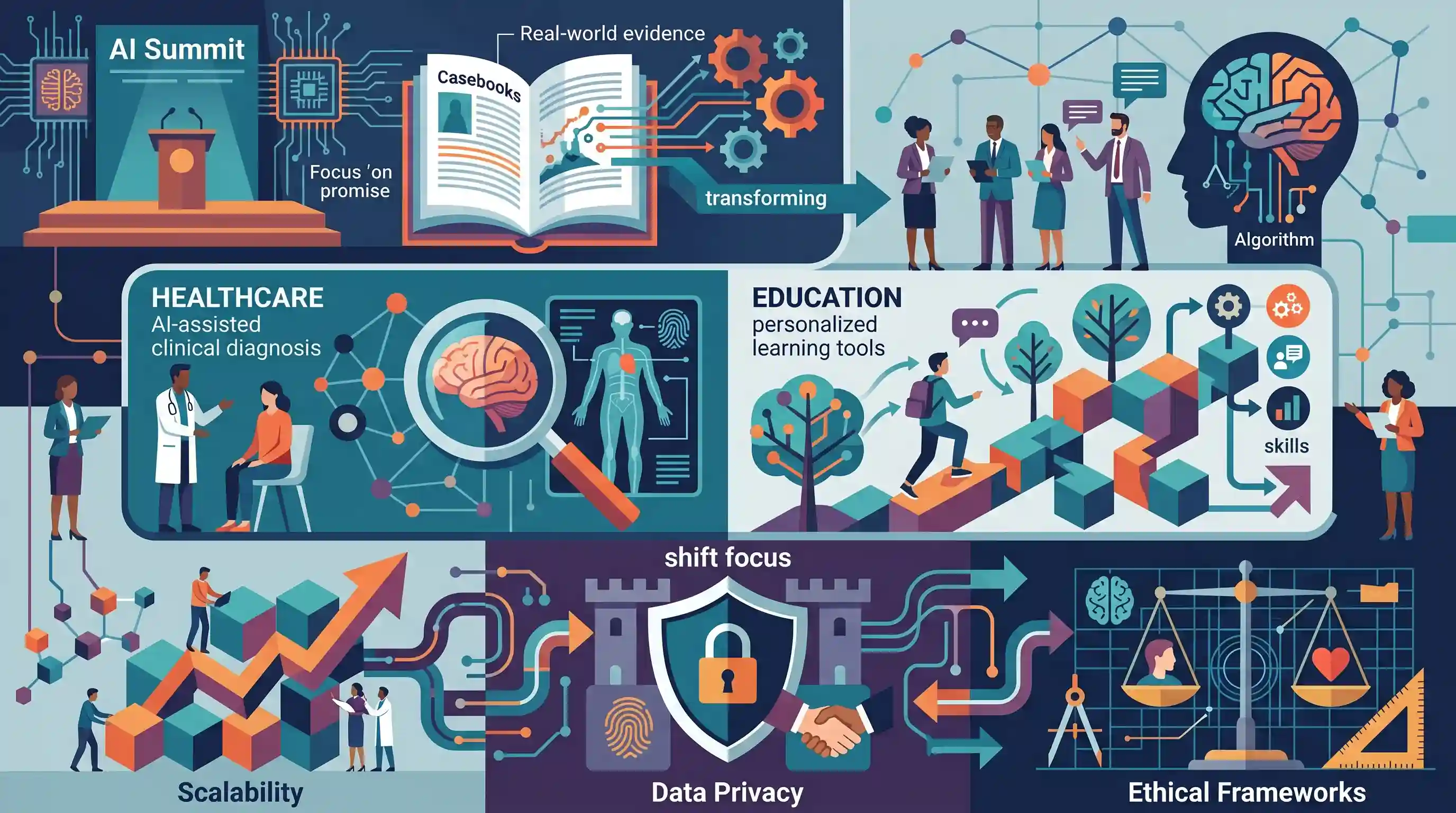
Recent AI summit discussions and newly released casebooks on health and education demonstrate that Artificial Intelligence is actively transforming critical social sectors rather than just holding future promise. By showcasing tangible use-cases such as AI-assisted clinical diagnosis in healthcare and personalized learning tools in education, policymakers are highlighting successful deployments. This shift focus towards scalability, data privacy, and ethical frameworks necessary to integrate AI into public service delivery effectively.
Key Points
- Recent AI summits have highlighted specific casebooks and real-world implementations of Artificial Intelligence in health and education, proving the technology has moved beyond theoretical promises.
- In healthcare, AI applications are being utilized for clinical disease diagnosis, predictive analytics, and improving rural medical access, moving from pilot phases to scalable solutions.
- In the education sector, AI is being deployed for personalized learning experiences, automated assessments, and overcoming language barriers for inclusive education.
- The release of these casebooks underscores the importance of ethical AI deployment, maintaining data privacy, and fostering public-private partnerships to scale these technological interventions.
Important Terms
IndiaAI Mission

A national program (approved 2024) to build India's AI ecosystem via 10,000+ GPUs, indigenous language models, and datasets, ensuring technological sovereignty and ethical deployment.
UPSC context
GS Paper III (S&T); tests knowledge of indigenization, digital infrastructure, and socio-economic transformation through technology.
Global Partnership on Artificial Intelligence (GPAI)
An international multi-stakeholder alliance (founded 2020) hosted by the OECD that promotes responsible, human-centric AI development. India is a founding member and influential lead chair.
UPSC context
GS Paper II (International Relations) & III (S&T); tests India's role in global digital governance and ethical tech standards.
Ministry of Electronics and Information Technology (MeitY)
The nodal central ministry responsible for IT policy, electronics manufacturing, and digital governance, including the implementation of the IndiaAI Mission and AI safety guidelines.
UPSC context
GS Paper II (Government Policies); crucial for understanding the institutional framework and regulatory oversight of India’s digital economy.
Prelims Trap
"The Global Partnership on Artificial Intelligence (GPAI) is a specialized agency of the United Nations."
GPAI is an international and multi-stakeholder initiative hosted by the OECD, not the UN. India is a founding member and recent chair.
Static Concepts Connected
What is the institutional framework and purpose of the Global Partnership on AI (GPAI)?
- Origin & Hosting: It is an international initiative launched in 2020 to bridge the gap between theory and practice on AI, hosted by the OECD Secretariat.
- Core Objective: It brings together experts from science, industry, and civil society to support cutting-edge research and applied AI activities.
- India's Role: India is a founding member of GPAI and served as its Lead Chair for 2024, hosting the annual summit.
How do key Indian digital platforms utilize AI for social sector delivery?
- Bhashini (NLP): Under the National Language Translation Mission, Bhashini uses Natural Language Processing (NLP) to break language barriers in public service delivery across Indian scheduled languages.
- DIKSHA (Education): The Ministry of Education's platform integrates AI-driven recommendation engines to deliver adaptive, personalized learning paths and track student progress.
- ICMR Guidelines: ICMR released India's first ethical guidelines for AI in healthcare to address data privacy, algorithmic bias, and accountability.
Cross-Topic Patterns
AI Ethics + ICMR Health Guidelines
AI in healthcare directly intersects with the right to privacy (Puttaswamy judgment). ICMR's ethical guidelines bridge GS3's AI applications with GS2's health sector regulation and data protection regimes.
AI scaling through Digital Public Infrastructure
India's strategy uniquely couples AI with existing Digital Public Infrastructure (like Bhashini and DIKSHA), transforming siloed technology into population-scale, inclusive e-governance solutions.

Expect a multi-statement question combining Bhashini's NLP capabilities, ICMR’s AI healthcare guidelines, and India's role in GPAI.
Linked PYQs · 3
Linked PYQs · 3
- 2023MainsGS3
Introduce the concept of Artificial Intelligence (AI). How does Al help clinical diagnosis? Do you perceive any threat to privacy of the individual in the use of Al in healthcare?
- 2020PrelimsGS1
With the present state of development, Artificial Intelligence can effectively do which of the following? 1. Bring down electricity consumption in industrial units 2. Create meaningful short stories and songs 3. Disease diagnosis 4. Text-to-Speech Conversion 5. Wireless transmission of electrical energy Select the correct answer using the code given below:
- 2024PrelimsGS1
Consider the following statements: I. It is expected that Majorana 1 chip will enable quantum computing. II. Majorana 1 chip has been introduced by Amazon Web Services (AWS). III. Deep learning is a subset of machine learning. Which of the statements given above are correct?
