Global AI summit focuses on practical technology governance
Source:Indian Express ↗
Why It Matters
Understanding India's active role in shaping global AI governance and utilizing AI for inclusive development is vital for both GS3 (Science & Technology) and GS2 (International Relations/Tech Diplomacy). It provides crucial examples of India leveraging technology for societal progress and asserting leadership in the Global South.
Summary
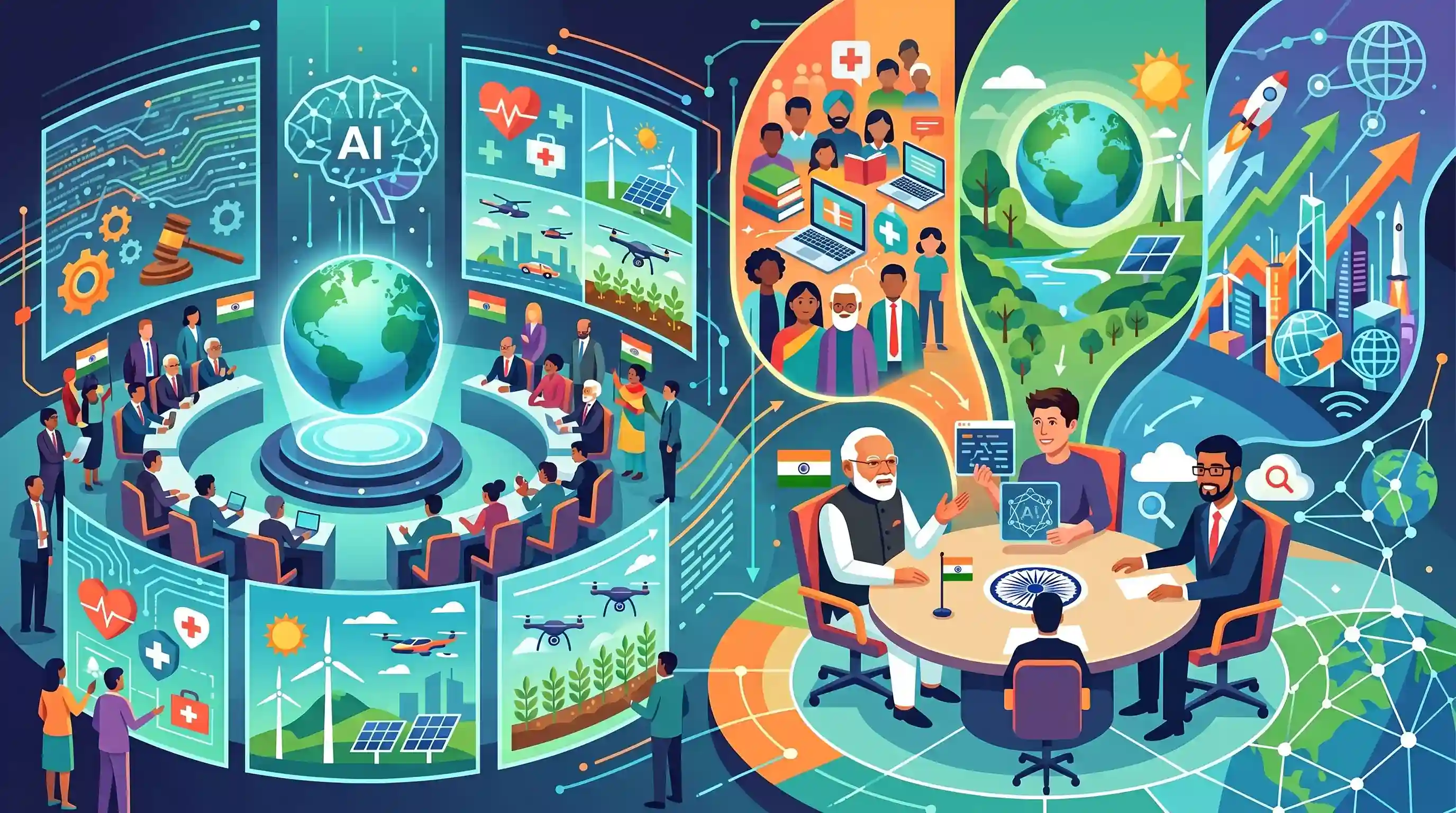
A major global Artificial Intelligence Summit kicks off today, bringing together state leaders and tech pioneers to discuss practical applications and regulation of AI. India seeks to redefine the global AI race by advocating a 'People, Planet, Progress' framework during Prime Minister Modi's meetings with tech leaders like Sam Altman and Sundar Pichai.
Key Points
- The global AI Summit begins today, featuring discussions on real-world applications of Artificial Intelligence and global tech governance.
- Prime Minister Narendra Modi is slated to meet with prominent global AI leaders, including OpenAI's Sam Altman and Google's Sundar Pichai.
- India is positioning itself as a key player in the global AI race by introducing a unique 'People, Planet, Progress' framework for technology development and regulation.
- The summit aims to address immediate practical solutions and ethical guardrails rather than just focusing on hypothetical future risks.
Important Terms
People, Planet, Progress (Framework)

India's tripartite framework for AI governance ensuring human-centricity (People), environmental sustainability (Planet), and equitable growth (Progress) to bridge the Global North-South digital divide.
UPSC context
GS Paper 2 & 3: India's leadership in global AI ethics, technology diplomacy, and sustainable development goals.
Global Partnership on Artificial Intelligence (GPAI)
An international multi-stakeholder initiative (29 members) promoting responsible, human-centric AI development. India is a founding member and the Lead Chair for 2024.
UPSC context
GS Paper 2: International organizations and global technology governance.
IndiaAI Mission
A ₹10,300 crore+ national initiative to build India's AI ecosystem, focusing on domestic compute capacity (GPUs), high-quality datasets, skilling, and startup financing.
UPSC context
GS Paper 3: Science & Tech, indigenization of technology, and digital economy.
M.A.N.A.V. Vision
India's strategic roadmap for AI development emphasizing five pillars: Ethics, Accountability, Sovereignty, Inclusion, and Legitimacy (Legal Validity) to protect human dignity.
UPSC context
GS Paper 3: Ethical considerations in AI and public interest technology.
AI Sovereignty
A state's exercise of control over its digital infrastructure, data, and foundational models to ensure strategic autonomy and reduce reliance on foreign technology giants.
UPSC context
GS Paper 3: National security, strategic autonomy, and IT policy.
Technology Diplomacy
The strategic use of technological cooperation and regulatory frameworks as a tool of foreign policy to manage global challenges and influence international norms.
UPSC context
GS Paper 2: International Relations and India's role in global policy-making.
Prelims Trap
The New Delhi AI Impact Summit 2026 primarily focused on existential frontier AI safety risks.
The New Delhi summit deliberately pivoted away from Bletchley Park's focus on existential safety, prioritizing real-world socio-economic applications and digital inclusion for the Global South.
Static Concepts Connected
What constitutes Digital Public Infrastructure (DPI)?
- Identity (Aadhaar): Foundational, biometric or digital ID systems enabling access to services.
- Payments (UPI): Interoperable, fast payment gateways enabling seamless digital transactions.
- Data Exchange: Consent-based data sharing architectures (like DEPA) allowing users to securely share their data.
How do AI models impact environmental sustainability?
- Energy Intensity: Training Large Language Models requires massive computational power, driving up greenhouse gas emissions.
- Water Footprint: Data center cooling infrastructure consumes millions of liters of freshwater, often in water-stressed regions.
- E-waste generation: Rapid obsolescence of specialized AI hardware (GPUs) accelerates global electronic waste.
Cross-Topic Patterns
DPI Diplomacy as Soft Power
India is using 'DPI for AI' as a geopolitical tool to lead the Global South, offering an alternative to Western private tech monopolies and Chinese state-led models.
Global AI governance fragmentation
The West's focus on existential safety (Bletchley Park) contrasts with India's focus on socioeconomic utility (New Delhi), highlighting a North-South divide in global tech governance priorities.

DPI for AI + Global South diplomacy + Sustainable compute will likely merge into a multi-part GS3 Mains question on Indian tech leadership.
Linked PYQs · 2
Linked PYQs · 2
- 2023MainsGS3
Introduce the concept of Artificial Intelligence (AI). How does Al help clinical diagnosis? Do you perceive any threat to privacy of the individual in the use of Al in healthcare?
- 2020PrelimsGS1
With the present state of development, Artificial Intelligence can effectively do which of the following? 1. Bring down electricity consumption in industrial units 2. Create meaningful short stories and songs 3. Disease diagnosis 4. Text-to-Speech Conversion 5. Wireless transmission of electrical energy Select the correct answer using the code given below:
