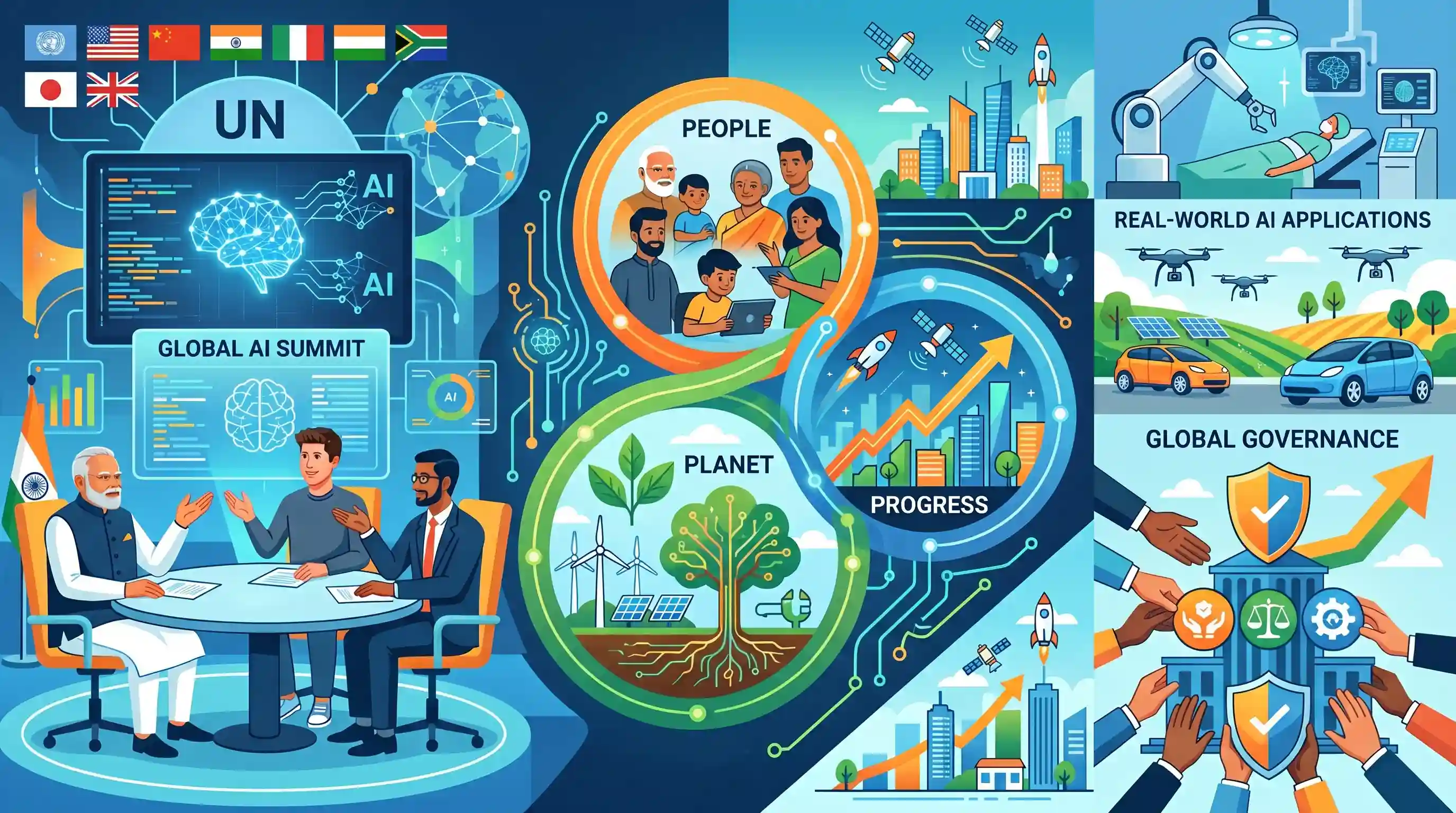
Global AI Summit India Human Centric Technology Framework
Source:Indian Express ↗
Why It Matters
Global AI governance is a critical emerging issue. India's 'People, Planet, Progress' framework highlights its strategy to position itself as a leader in ethical, sustainable, and inclusive AI deployment, which is highly relevant for GS-3 (Science and Technology) and Essay topics concerning technology and human development.
Summary
A global AI summit is focusing on real-world applications of artificial intelligence, featuring high-level discussions between Indian Prime Minister Narendra Modi and tech leaders like Sam Altman and Sundar Pichai. India is leveraging the platform to pitch its 'People, Planet, Progress' vision for AI, advocating for a human-centric, inclusive, and sustainable approach to global technology governance that redefines the ongoing AI race.
Key Points
- A global AI summit has commenced with a focus on delivering real-world solutions using artificial intelligence.
- Prime Minister Narendra Modi is scheduled to meet prominent tech leaders, including OpenAI's Sam Altman and Google's Sundar Pichai.
- India is promoting a 'People, Planet, Progress' framework for AI development.
- This approach emphasizes inclusive, sustainable, and human-centric technological growth, aiming to redefine the global AI race.
Important Terms
AI Impact Summit 2026

A global forum hosted by India focusing on transitioning AI from theoretical dialogue to real-world solutions. It emphasizes inclusive growth, safety, and sustainable technology governance for the international community.
UPSC context
GS Paper III (S&T/IT); evaluates India's leadership in global technology policy and the development of indigenous AI frameworks.
MANAV Vision
India's human-centric AI framework standing for Moral, Accountable, National Sovereignty, Accessible, and Valid systems. It prioritizes human dignity and agency, ensuring individuals are not treated as mere data points.
UPSC context
GS Paper III (AI Ethics); tests understanding of India's approach to balancing innovation with ethical and sovereign considerations.
People, Planet, Progress
Known as the 'Three Sutras', these are the core pillars of India’s AI vision. They mandate that AI serves diverse humanity, aligns with environmental stewardship, and ensures equitable benefit-sharing.
UPSC context
GS Paper III (Sustainable Development/AI); relevant for questions on technology's role in achieving inclusive economic growth.
Human-centric AI
A design philosophy where AI systems are developed to augment human capabilities and preserve agency. It focuses on transparency, accountability, and the protection of fundamental human rights over automated control.
UPSC context
GS Paper IV (Ethics) and Paper III (S&T); crucial for discussing the ethical implications of automation.
OpenAI
A prominent AI research organization. In policy contexts, it represents the influence of private entities on global AI standards, safety protocols, and the democratization of advanced technology.
UPSC context
GS Paper III (S&T); represents the role of private global entities in shaping international AI landscape and safety.
A multinational technology giant. Its role in India involves significant infrastructure investment and partnerships to build full-stack AI hubs, bridging the digital and AI divide in developing economies.
UPSC context
GS Paper III (S&T/Infrastructure); highlights the role of FDI and global tech partnerships in India's digital transformation.
Global South
Developing nations seeking a greater voice in global technology governance. The summit aims to ensure AI addresses their unique socio-economic challenges and avoids an 'AI divide' between nations.
UPSC context
GS Paper II (International Relations); important for analyzing India’s leadership in advocating for developing nations in tech-governance forums.
Prelims Trap
The 2026 AI Summit in India primarily focused on mitigating existential and catastrophic AI risks.
India’s summit deliberately pivoted away from the Western focus on catastrophic risks, prioritizing 'People, Planet, Progress' and practical AI applications for the Global South.
Static Concepts Connected
What are "Foundation Models" in Artificial Intelligence?
- Large Scale: They are trained on vast, unlabelled datasets to perform a wide range of general tasks rather than narrow, specific ones.
- Adaptability: They serve as a base architecture that can be fine-tuned for specific downstream applications, such as healthcare diagnostics or legal coding.
- Resource Intensive: They require massive computational power, energy, and water for cooling data centers during the initial training phase.
What is the Global Partnership on Artificial Intelligence (GPAI)?
- Origin: Launched in 2020, it is an international initiative to guide the responsible development and human-centric use of Artificial Intelligence.
- India's Role: India is a founding member and has served as the Lead Chair, actively advocating for the technological interests of the Global South.
- Secretariat: Hosted by the OECD in Paris, the secretariat connects global experts from science, industry, and civil society.
Cross-Topic Patterns
Sovereign AI meeting DPI
India's push for Sovereign AI integrates with existing Digital Public Infrastructure (DPI) like Bhashini, translating indigenous foundation models into tangible governance tools for diverse linguistic populations.
AI computing and ecological stress
The 'Planet' focus highlights a GS-3 environmental linkage: the massive water and energy consumption of AI data centers exacerbates climate stress, necessitating green computing policies.

Expect a chronological matching question on AI summits (Bletchley, Seoul, Paris, India) or a GS-3 Mains question on 'Sovereign AI'.
Linked PYQs · 2
Linked PYQs · 2
- 2023MainsGS3
Introduce the concept of Artificial Intelligence (AI). How does Al help clinical diagnosis? Do you perceive any threat to privacy of the individual in the use of Al in healthcare?
- 2020PrelimsGS1
With the present state of development, Artificial Intelligence can effectively do which of the following? 1. Bring down electricity consumption in industrial units 2. Create meaningful short stories and songs 3. Disease diagnosis 4. Text-to-Speech Conversion 5. Wireless transmission of electrical energy Select the correct answer using the code given below:
